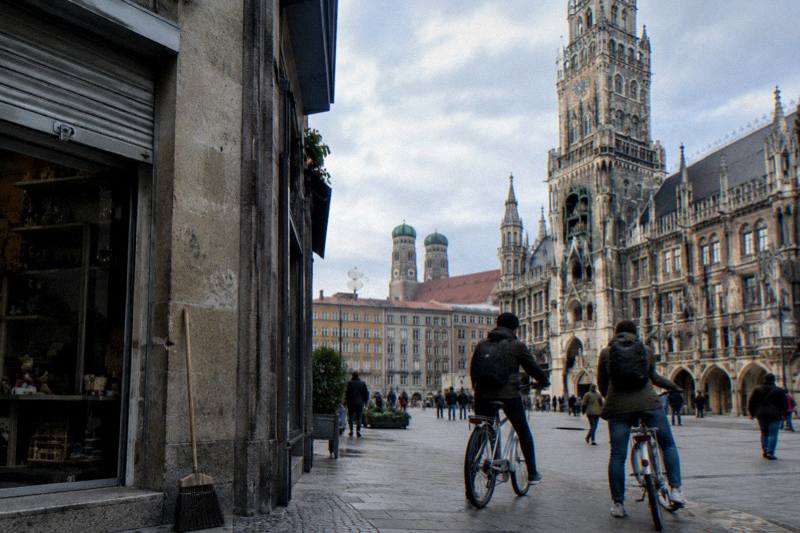
Eisbach Wave: Where To Watch And What To Know
A metre-high standing wave in the middle of a city park, surfed year round and watched from the bank by thousands: here is what the Eisbach wave actually is, what the current rules allow, and how to fold it into a ride through the English Garden.
Short answer
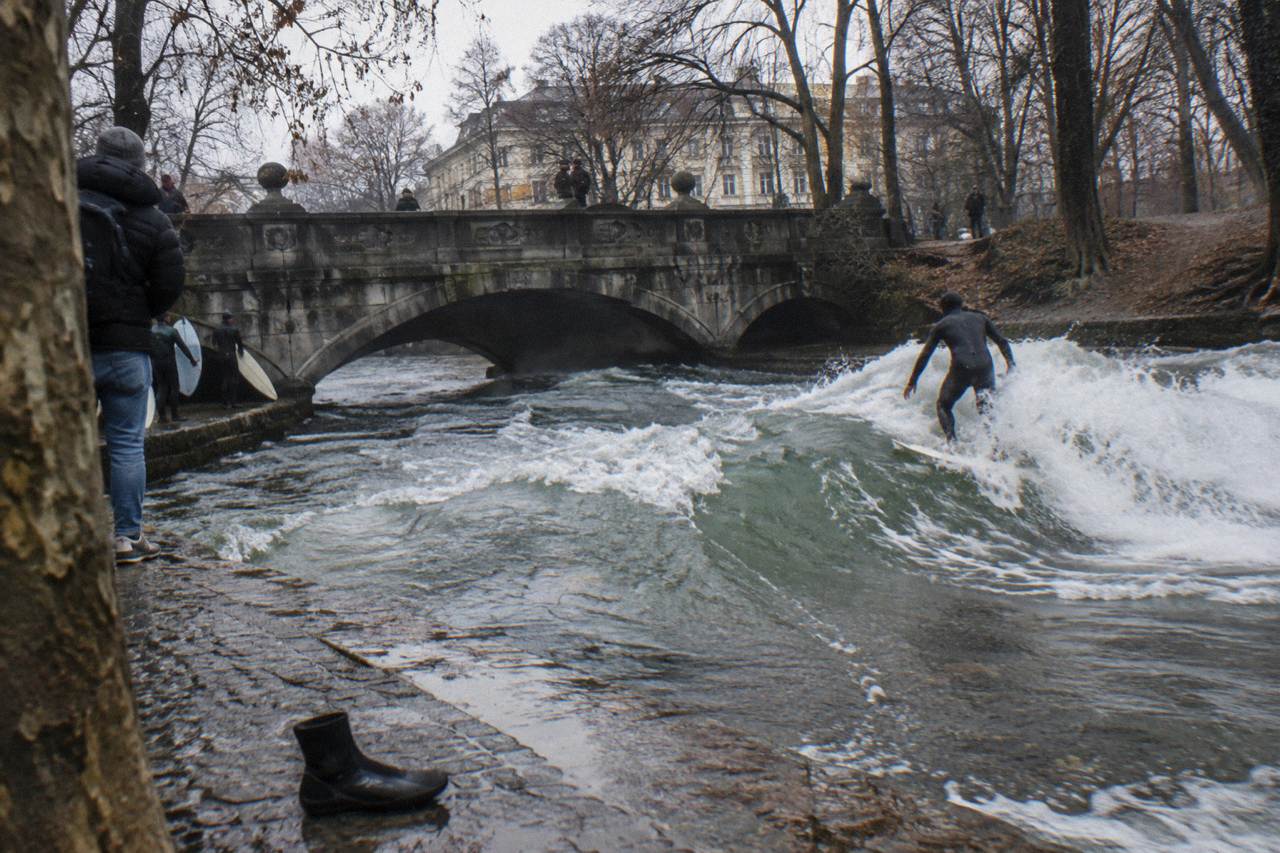
The Eisbach wave is a standing wave on the Eisbach stream at the southern edge of the English Garden in Munich, next to the Haus der Kunst. Surfing is allowed again under an amended decree of Lord Mayor Dominik Krause, with a self-releasing leash, a ban from 22:00, and posted signs to follow. Watching from the bank is free.
Munich keeps its strangest attraction behind the Haus der Kunst, where a narrow canal called the Eisbach pours out from under a road bridge and forms a standing wave that surfers have ridden for decades. No sand, no ocean, no entry fee. The wave works because the stream is funnelled through a constrained channel, and the water pushes back hard enough to hold a board in place while the city cycles past on the bank above. It is one of the most photographed spots in the English Garden, and it sits directly on the natural cycling line between the city centre and the park's meadows. This guide covers what the wave is, what happened when it closed and reopened, the rules that govern surfing now, where to stand to watch, and how to build the stop into a ride, whether you are on your own bike or on a guided tour.
What Is The Eisbach Wave In Munich?
The Eisbach wave is a permanent standing wave on the Eisbach, a fast, cold stream that runs along the southern edge of the English Garden, a few minutes by bike from the Altstadt. Water forced under the Prinzregentenstrasse bridge stacks up into a rideable face, and surfers take turns on it one at a time, year round, in view of the bank. The stream itself is not a gentle park brook. It is fed from the Isar system, runs cold even in summer, and moves with enough force that swimming in the Eisbach is prohibited, as the park rules state. That same force is what makes the wave surfable at all. The spot sits at the very south of the English Garden, the 376-hectare park laid out from a 1789 design, which gives the stop a convenient double role: you watch the wave, then ride straight into the largest green space in the city centre's reach. The park's network of some 78 km of paths for cyclists and joggers starts practically at the wave's bank.
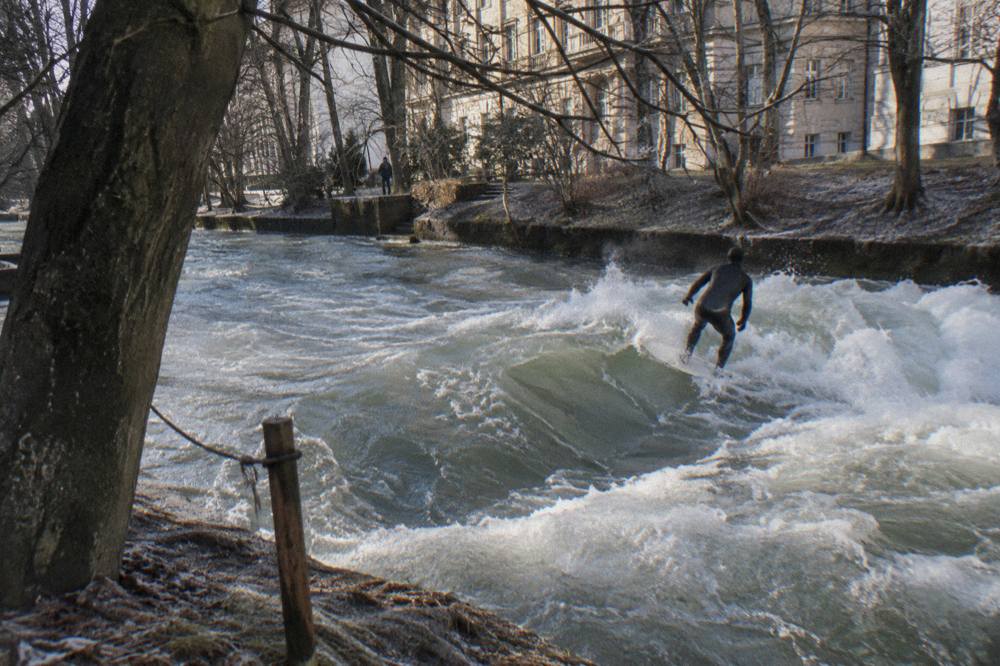
The wave is a genuine local institution rather than a tourist invention. Boards lean against the bridge parapets, wetsuits dry on railings, and a crowd gathers most afternoons without any organisation making it happen. What visitors sometimes miss is how small the stage is: the rideable face is roughly a metre of standing water, one surfer at a time, with the audience close enough to hear the board. There is no beach, no rental hut and no ticket. You watch from the bank, and the whole visit can take ten minutes or an hour depending on how good the surfing is that day.
Where Are The Best Spots To Watch The Surfers?
The best watching is from the south bank and the bridge itself on Prinzregentenstrasse, both a few steps from the Haus der Kunst. The bank gives you the surfer at eye level from the side, while the bridge deck looks straight down the wave face; both are public pavement, free, and reachable on foot or by pushing a bike the last metres. The two angles suit different visitors. From the bank you see the whole ride, the fall and the scramble back to the queue; from the bridge you see how steep the face really is. In between runs the path that cyclists use to enter the English Garden proper, which is why so many guided rides pause here without adding any real distance to their route.
A few practical notes make the stop better. The ground near the bank is worn and can be muddy after rain, so ordinary shoes are fine but polish is not. Crowds are thinnest on weekday mornings, and the surfing itself is improvised: there is no schedule, so the honest answer to when the best surfers appear is that there is no way to promise it. If nobody is in the water when you arrive, wait ten minutes or ride on and come back. The spot is also a natural pairing with the park around it, covered in detail in the English Garden by bike guide, which lays out the ride north from the wave toward the Chinese Tower and the meadows.
| Watching spot | Angle on the wave | Best for | Access |
|---|---|---|---|
| South bank path | Side view at water level | Photos, seeing falls and recoveries | Steps from Haus der Kunst |
| Prinzregentenstrasse bridge | Top-down view of the face | Judging how steep the wave is | Public pavement |
| North bank near the path junction | View across the stream | Combining the stop with a ride into the park | On the cycling line north |
If you want the wave as one stop inside a bigger ride rather than as a destination in its own right, a guided loop makes sense. These three city rides all work as frameworks that pass the southern edge of the English Garden:
How Do You Get To The Eisbach Wave?
The wave sits on Prinzregentenstrasse at the southern tip of the English Garden, across the road from the Haus der Kunst. From Marienplatz it is a short ride or an easy walk; by U-Bahn the nearest stations are along the lines serving Lehel and the university quarter, and from any of them the wave is signposted by footfall more than by signage. For cyclists the approach is simple: leave the Altstadt northbound, cross into Lehel, and the park entrance on Prinzregentenstrasse is unmistakable. Bike racks and railings near the bridge serve riders who prefer to watch on foot. Note one rule of thumb for the pavement around the bridge: it is a busy mixed area, so dismounting for the last stretch is both courteous and expected.
Public transport works too, with one cyclist caveat. Bikes are not permitted on buses and trams except children's and folding bikes, so a rider arriving with a full-size bike should plan around the S-Bahn and U-Bahn, which carry bikes outside the weekday blocked periods, on presentation of the MVV bike day ticket; check mvv-muenchen.de for the current price and the exact restricted hours. The details, including the school-holiday exceptions to the afternoon block, are laid out in the bikes on trains and S-Bahn guide. Visitors without a bike of their own can use the MyRadl share system, launched on 7 May 2026 with roughly 1,000 stations planned across the region; classic bikes cost 1 euro per 30 minutes with a 9 euro day cap, and e-bikes 3 euros per 30 minutes capped at 18 euros a day.
When Is The Best Time To Visit The Eisbach Wave?
Any time of day and any season works for watching, because the wave runs constantly and surfing is allowed until the 22:00 ban each evening. Mornings bring thinner crowds and softer light for photos; afternoons bring more surfers and a livelier bank. In winter the wave keeps working, and cold air makes the water's power visible as spray. The one certainty worth planning around is the curfew: under the amended decree, surfing is banned from 22:00, so late-evening visits find a quiet wave. There is no published schedule of who surfs when, and no operator promise exists about surfers being in the water at any given hour.
Season changes the experience more than the clock. In high summer the bank is busy, the meadows around it are full, and the wave is one stop on a crowded park circuit; in the colder months the crowd shrinks to regulars and the contrast between the grey city and the bright wetsuits is striking. The surrounding park is open year round with free entry. Visitors combining the wave with a longer ride north should remember that the beer garden at the Chinese Tower, the 25-metre pagoda a short ride into the park, opens its garden seasonally depending on weather, with the kiosk opening daily from 12:00 in colder conditions. Rain does not stop the wave, though it thins the audience, and the question of whether guided tours run in wet weather is answered in do Munich bike tours run in the rain.
Can You Ride A Bike Along The Eisbach?
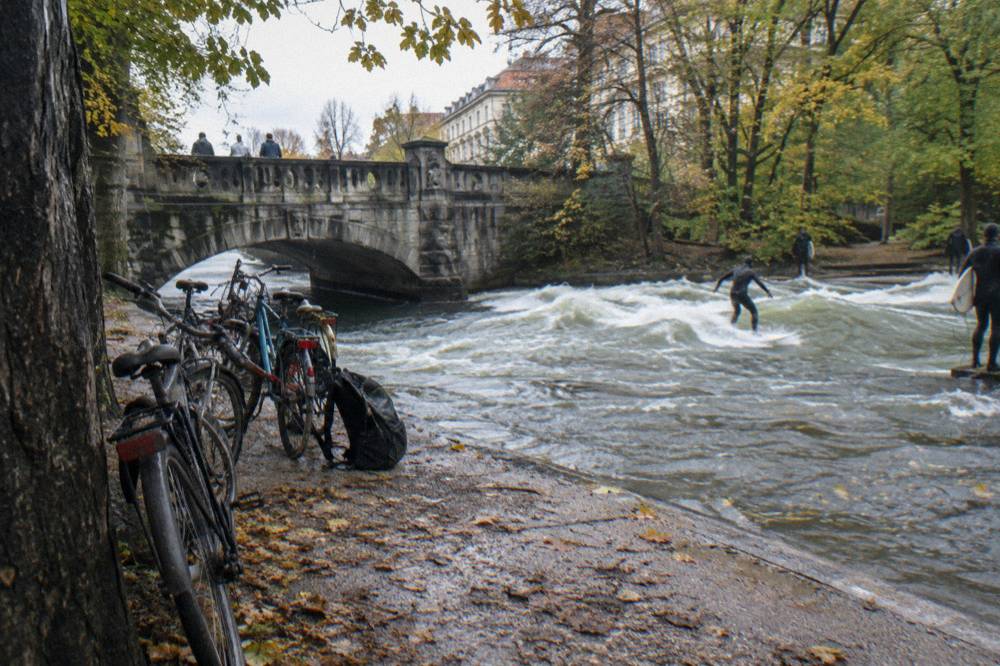
Yes, cycling is permitted on the English Garden's paths, and the route that follows the Isar and the Eisbach is one of Munich's signature rides. An official tour description from the city's tourist board traces a loop of about 15 km from Marienplatz, following the Isar downstream and returning through the garden past the wave toward Aumeister. That loop, covered in the Isar cycle path guide, is the natural answer for confident riders. The paths inside the park are shared with pedestrians, so the usual etiquette applies, and the park rules ask cyclists to stay on the ways: barbecues and open fires are prohibited, dogs must be leashed, and walking on the meadows is discouraged. The wave itself sits at the point where a road-riding approach and a park-path approach meet, which is exactly why guided tours use it as a stop.
Two cautions keep the ride pleasant. First, the pavement immediately around the bridge is pedestrian-dense, so the wave is a dismount-and-watch stop, not a ride-through. Second, the stream is cold and fast, and swimming in the Eisbach is prohibited, a rule the park authorities state plainly because the current is genuinely dangerous. Swimming in the Isar itself is a different matter, regulated to seven designated sections with a closure threshold when the water level passes 1.20 m at the city measuring point, and typical summer water temperatures of 14 to 22 degrees Celsius; that belongs to the river's gravel banks further south, not to the wave's channel.
Which Guided Rides Stop At The Surfers?
**Several guided city rides pass the wave because it lies on the natural route into the English Garden, and one lists it in its own name: the Munich Classic Bike Tour at 11.30am with Surfers and Beer Garden Stop, a shared classic-bike ride of 3 to 4 hours. The Classic Bike Tour at 11.30am pairs a stop at the surfers' wave with a beer garden break, which makes it a strong pick for first-time visitors. No waiting time at the wave can be promised, so leave some slack in your day. The live booking page carries the current price and meeting arrangements. See the classic morning ride's details before you plan around a specific departure.
Other formats reach the same spot by different philosophies. The half-day tour above keeps the day short for visitors with a packed schedule. A 3-hour loop covering the English Garden, Olympic Park and Nymphenburg Palace trades the beer garden pace for sheer ground covered, and its booking page carries what the listing includes:
For visitors who want the beer garden half of the classic formula as the centrepiece rather than the ride, a 4-hour tour with a dedicated beer garden break takes the same southern park edge at a gentler pace. None of these operators publishes a fixed time at the wave, so if watching the surfers is the priority of your day, pick the tour whose overall shape fits, and treat the wave as the flexible stop it is on every route.
| Tour | Length | Format | Relation to the wave |
|---|---|---|---|
| Munich Classic Bike Tour @ 11.30am with Surfers and Beer Garden Stop | 3 to 4 hours | Shared, classic bike | Surfers stop named in the title |
| Munich by Bike: Half-Day Tour with Local Guide | 3 hours | Shared, classic bike | Short day, park-edge route |
| English Garden, Olympic Park and Nymphenburg Palace by Bike | 3 hours | Shared, classic bike | Park loop with wide coverage |
| Munich: Bike Tour with Beer Garden Break | 4 hours | Shared, classic bike | Slower pace, garden-centred |
Prices and group details for each ride sit on the respective booking pages, and they change often enough that repeating them here would mislead more than help.
What Are The Rules For Surfing The Eisbach?
Surfing is currently allowed under an amended general decree issued by Lord Mayor Dominik Krause. The conditions are a mandatory self-releasing leash, a ban on surfing from 22:00, and the instruction to follow the signs posted on site. The city's page on the wave states that surfing happens at the surfer's own risk. Reports mention other conditions, such as experience and supervision requirements, though these do not appear on the official page. The signs posted at the bank are the final word on the day you visit; the posted signs at the bank are the final word on the day you visit. If your trip lines up with festival season, the same habit of checking what officials actually say pays off, and our guide to what is banned at Oktoberfest separates the confirmed prohibitions from the rumors.
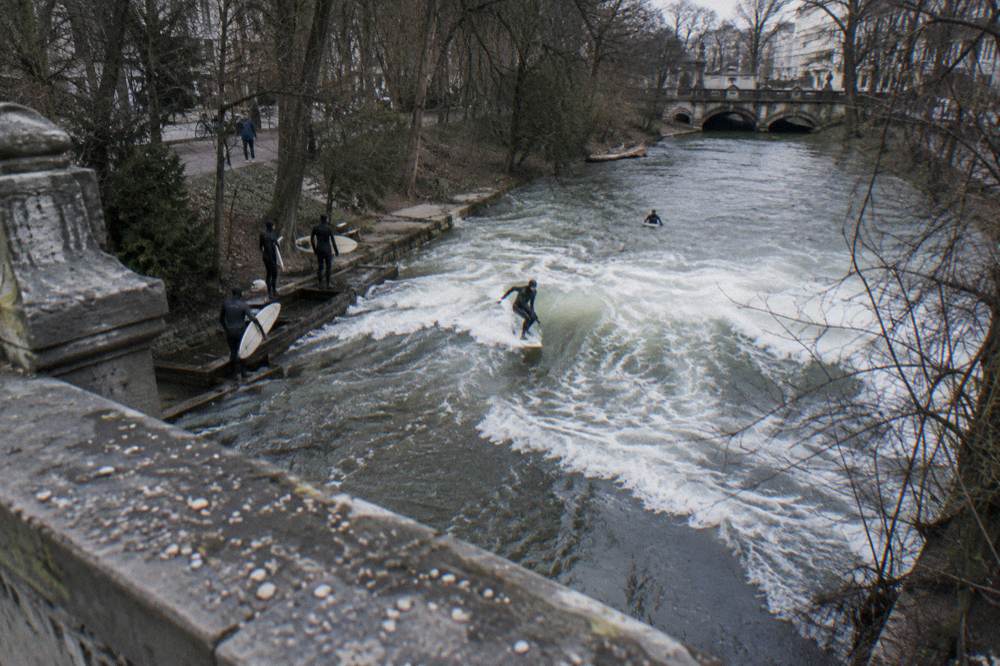
The leash rule deserves a word of explanation for spectators, because it changes what you see. A self-releasing leash detaches under strong pull, which on a wave this forceful is a safety feature rather than a restraint: it stops the board from dragging a fallen surfer into the bridge pilings. The 22:00 curfew exists for the neighbourhood as much as the surfers, since the wave is floodlit by street lamps and the banks sit in a residential quarter's earshot. For visitors the practical reading of the whole rulebook is simple: watch from the bank, keep off the water, and let the people with the boards manage their own queue, which functions as an informal but well-understood rota.
| Rule | What it means |
|---|---|
| Amended general decree | Surfing is permitted again under stated conditions |
| Self-releasing leash | Mandatory; detaches under load to protect the surfer |
| 22:00 ban | No surfing in the late evening |
| Posted signs | On-site signs govern on the day |
| Own risk | The city's page states surfing is at the surfer's own risk |

What Happened To The Eisbach Wave?
The wave was closed to surfing for a period before 2026, which is why so many older travel pieces describe it as banned. Surfing was permitted again under the amended general decree of Lord Mayor Dominik Krause, and the reopening on 8 May 2026 restored the spot under the current conditions: the leash, the 22:00 ban and the posted signs. For a while the honest travel advice was that the wave was watchable but not legally surfable. That changed with the decree, and today the sight visitors expect, wetsuited riders on a city stream, is back. The history matters for one practical reason: plenty of articles, printed maps and even some guided commentary still circulate from the closed period, so if you read that surfing is banned, that information predates the reopening. If you want the full backstory of what shut the wave down and what the rules allow now, the guide to why the Eisbachwelle was closed covers it in detail.
The background to the closure was a long-running argument about safety and liability on a wave that is surfed by highly experienced riders in a public park. The decree's answer was codified conditions rather than prohibition. Visitors do not need the legal detail; they need the current status, which the city's own page states plainly, and which this guide matches: the official wave page is the source to check before a visit planned around surfing rather than watching.
How Close Is The Wave To Other English Garden Sights?
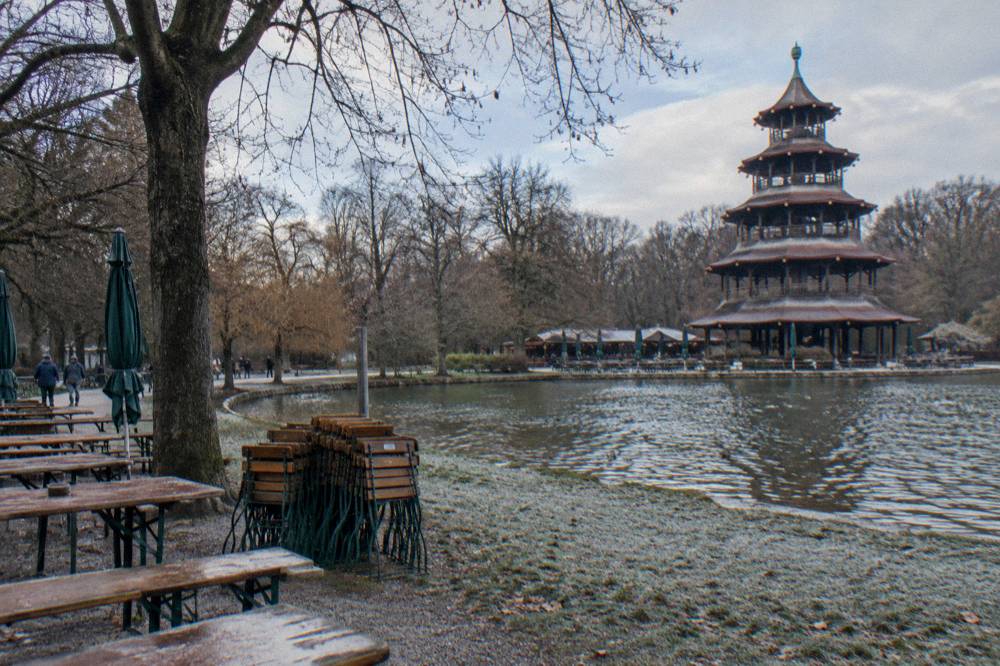
Very close: the wave marks the garden's southern gate, and the main sights string north from it along the same paths. A short ride brings you to the Seehaus beer garden on the lake, the Chinese Tower with its 25-metre pagoda and roughly 7,000-seat beer garden, and the quiet meadows beyond; the whole southern stretch is a single continuous ride. That geography is the strongest argument for visiting the wave by bike rather than on foot. A walking visit tends to see the wave and turn back; a cycling visit naturally continues into the park, and the park repays the extra distance.
Timing a day around the beer gardens works well because their hours differ. The Seehaus opens from 12:00 on weekdays and 11:30 at weekends, the Chinese Tower's garden opens from 11:00 on weekdays and 10:00 at weekends in fine weather, and the Hofbraukeller on the eastern edge near the wave keeps daily hours from 12:00 to 22:00. A rider leaving the Altstadt mid-morning can watch the surfers, roll north through the park, and land at a garden table by opening time. Fine weather is the condition for the full garden service at the Chinese Tower; in cold or uncertain conditions the kiosk runs instead. The park rules that matter on the way: no barbecues or open fires anywhere, dogs on leads, and no swimming in the Eisbach itself.
| Stop north of the wave | What it is | Opening pattern |
|---|---|---|
| Seehaus | Beer garden on the Kleinhesseloher See | Mon to Fri from 12:00, weekends from 11:30 |
| Chinese Tower | 25 m pagoda of the 1789 park design, beer garden at its foot | Garden from 11:00 weekdays, 10:00 weekends in fine weather; kiosk from 12:00 otherwise |
| Northern meadows | Open parkland toward Aumeister | Park open year round, free |
How Do You Plan A Day Around The Wave?
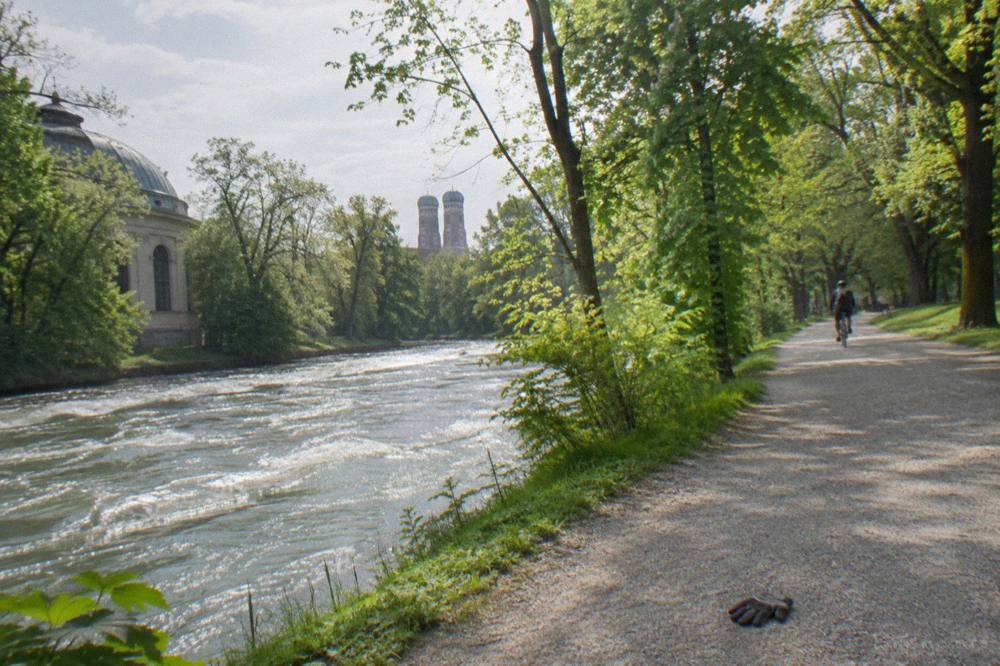
Build the wave into the first hour of your day and let the park take the rest: start in the Altstadt, ride to the wave for a surfing watch, continue north through the English Garden to the Chinese Tower or Seehaus, and loop back along the Isar paths. That shape works on a rental bike, on a MyRadl share bike, or on any of the guided city rides that use the same corridor. The order matters less than the geography: everything worth seeing sits on one continuous line from the centre outward, so the day cannot really go wrong. Since the longest stretch of that route runs inside the park, our guide to cycling in the English Garden covers which paths are open to bikes and how a guided ride covers the same ground.
For visitors who prefer to hand the day to a guide, the choice comes down to pace and focus, and the three rides below cover the useful spread: the classic morning loop that names the surfers stop, a same-family alternative with a beer garden emphasis, and a shorter highlights format for tight schedules.
One last planning note that applies to every version of this day: the wave is weatherproof but the beer gardens are not, and the park's rules close it to barbecues and fires regardless. Check the booking page of whichever ride you choose for what it includes, and check the posted signs at the bank for the surfing conditions of the day. The wave has outlasted closures, decrees and decades of Munich winters; it will still be running when your visit comes around.
Common Questions About The Eisbach Wave
What Happened To The Eisbach Wave?
The wave was closed to surfing for a period, then reopened under an amended general decree of Lord Mayor Dominik Krause, with surfing permitted again from 8 May 2026 under conditions including a self-releasing leash and a 22:00 ban. Older articles describing a ban predate the reopening.
Where Is The Eisbach Wave?
On the Eisbach stream at the southern edge of the English Garden, at the Prinzregentenstrasse bridge next to the Haus der Kunst, a short ride or walk from the Altstadt.
Can Anyone Surf The Eisbach Wave?
Surfing is allowed under the amended decree's conditions, including a mandatory self-releasing leash and the 22:00 ban, at the surfer's own risk. The posted signs at the bank govern on the day; the official city page is the source to check for anything beyond that.
Can You Swim In The Eisbach?
No. Swimming in the Eisbach is prohibited, and the current in the channel is strong and cold. Swimming in the Isar is separate and allowed only in seven designated sections, closed when the water level passes 1.20 m at the city measuring point.
How Much Does It Cost To Watch The Surfers?
Nothing. The bank and the bridge are public pavement with free access, and the English Garden itself is open year round with free entry.
Do Bike Tours Stop At The Eisbach Wave?
Several do, because the wave lies on the natural route into the English Garden. The Munich Classic Bike Tour at 11.30am names a surfers stop in its title, alongside a beer garden stop; the listing promises no waiting times, since surfers come and go unscheduled.