English Garden By Bike: Routes, Rules And Stops
The English Garden is the single biggest reason Munich works so well by bike. Here is how the park is laid out for cyclists, which stops earn their pedal, and the rules that keep the ride smooth.
Short answer
The English Garden is a 376-hectare park, free and open year-round, with a reported 78 km of paths shared by cyclists and joggers. A classic loop from the centre along the Isar, up to Aumeister and back runs about 15 km and takes about 2 hours at a relaxed pace, per the official city tourism route.
The English Garden begins where Munich's museum quarter ends. One moment you are riding past the Haus der Kunst on Prinzregentenstrasse, the next the city simply stops and a meadow the size of a small town takes over. Created to a design of 1789, the park stretches north along the Isar for kilometres, and it is the centrepiece of most guided rides in the city. That is not a marketing line: nearly every city-highlights tour on the books routes through it, because a bike is the only sensible way to see a park this long end to end. To work out which of those rides suits you, our comparison of Munich's guided bike tours and other city tour formats lays out what each option covers, from themed routes to private guides.
This guide covers what the park actually is, where you can and cannot ride, the routes that make sense on wheels, the stops worth dismounting for, and the local rules that trip up first-time visitors.
What Is The English Garden In Munich?
The English Garden is Munich's largest park: 376 hectares of meadow, woodland and streams along the Isar, open year-round with free entry, created to a design of 1789 and named for the informal English landscape style. It runs from the city centre northwards, and its most famous landmarks are the 25 m Chinese Tower, the Monopteros hilltop temple and the Eisbach surf wave at its southern edge. That scale is the whole reason cyclists love it. Walking the full length would eat a day; on a bike the park becomes a single rolling ride with a beer garden roughly every couple of kilometres. For most riders that first stop is an easy call, and our guide to Munich's most famous beer garden explains why the Chinese Tower draws the crowds and how to reach it by bike.
The park is a protected landscape and garden monument, administered as a state park rather than an ordinary city green, which is why its rules are posted and enforced. Locals treat it as their backyard: sunbathers on the meadows in summer, cross-country skiers in January, surfers at the Eisbach wave most days of the year. For a visitor, the practical takeaway is simpler: the garden is free, always open, and stitched together by a dense network of paths.
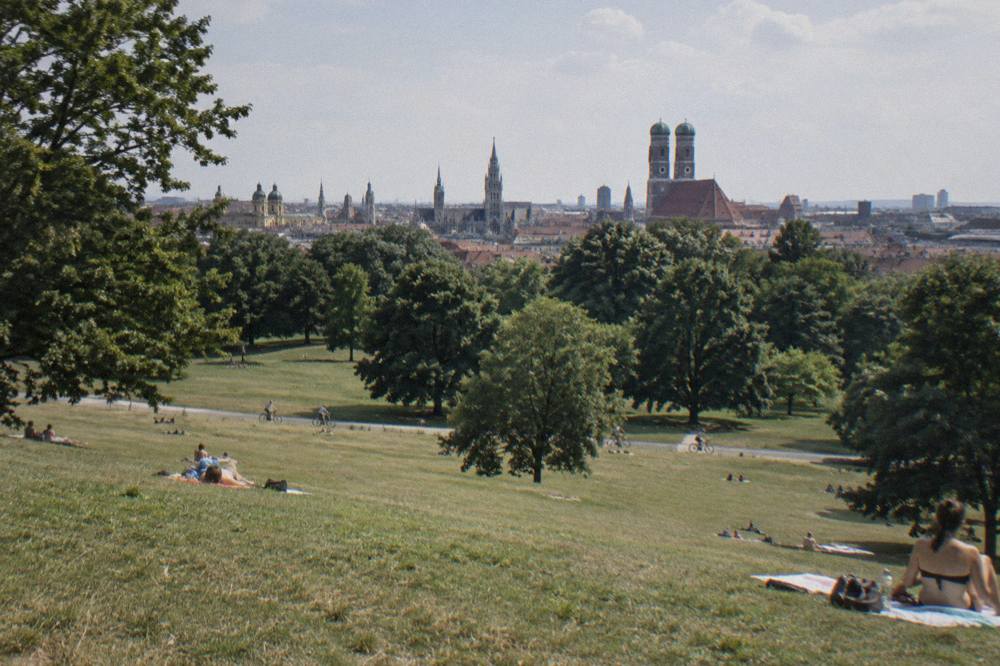
How the park is put together matters for planning a ride. The southern half, from the Haus der Kunst up to the Chinese Tower, holds the famous sights and the crowds. The northern half, from above the Chinese Tower towards Aumeister and Oberföhring, is quieter, more wooded and, honestly, the part many visitors never reach. The Isar runs along the eastern edge, and the small Eisbach stream threads down the western side, which is where the surf wave sits.
If you are weighing whether the garden alone justifies a bike, the answer is yes, and it combines naturally with the river paths on either side. The Isar routes are covered in detail in the Isar cycle path from Munich guide, which picks up where the park's northern end finishes.
Can You Ride A Bike In The English Garden?
Yes, cycling is allowed in the English Garden on the park's extensive path network, a reported 78 km of paths shared between cyclists and joggers, and there is no general ban or entry fee. Cyclists must ride with consideration for pedestrians, dismount in crowded spots, respect pedestrian priority wherever paths are shared, and follow the posted signs at pinch points and crossings. No fence, gate or ticket stands between a rider and the park. What exists instead is a dense, mostly car-free network that makes the garden one of the most pleasant places to ride in any German city.
The nuance is in how the paths work. Most of them are shared-use, which means pedestrians, joggers, prams and bikes all mix, and pedestrians have priority. On a busy July afternoon around the Eisbach wave or the Chinesischer Turm, the right move is often to walk the bike for a hundred metres rather than thread through. Early mornings, weekday afternoons from autumn to spring, and the northern half of the park are a different world: you can roll for long stretches without slowing down.
Because the park is a state-run landscape monument, some specific prohibitions apply to everyone, not just cyclists. Barbecues, open fires and camping are reported to be prohibited, swimming in the Eisbach is banned, dogs must be kept on a leash and their waste removed, and staying off meadows and woodland where signed is expected. None of that targets bikes, but all of it shapes the atmosphere that makes riding here pleasant in the first place. The city's own overview of the park, including the leashed-dog rule, is on muenchen.de.
Two designated nude sunbathing zones, the Schönfeldwiese near the Haus der Kunst and the Schwabinger Bucht in the north, sit right beside main cycling routes, which is a genuine Munich thing and worth knowing before you wonder why the meadow looks different here. Ride on, look or don't, nobody cares.
For visitors who want the garden delivered rather than self-navigated, three guided options cover it well:
Each is a shared ride with a guide, each lasts roughly 3 to 4 hours, and each treats the garden as one stop among several, so read the descriptions on the booking pages to see how much park time you actually get.
What Are The Best Cycling Routes Through The English Garden?
The classic loop is the official city tourism route: roughly 15 km and about 2 hours, starting at Marienplatz, following the Isar downstream, cutting into the garden, riding north past the Chinese Tower to Aumeister, then returning through the park to the centre. There is no single signed "garden loop"; riders assemble their own from the path network, and the two dependable spines are the Isar bank on the east and the Eisbach side on the west. The 15 km figure and 2-hour riding time come from the official route description published by the city's tourism office, and they are the only solid numbers to plan around.
For a shorter ride, the southern circuit works: enter near the Haus der Kunst, ride up the western side past the beer garden at the Chinese Tower, cross to the Isar bank near the Seehaus, watch the surfers at the Eisbach wave, and roll back into town. None of the published sources give a distance for that inner loop, so time it by feel; it is a fraction of the full route and easily done between lunch and an afternoon beer garden stop.
The table below lays out the route options you can rely on, and leaves out anything that would be guesswork:
| Route | Distance | Riding time | Source | Character |
|---|---|---|---|---|
| Official Marienplatz loop (Isar down, garden north to Aumeister, park back) | ~15 km | ~2 hours | City tourism office route | The full classic, meadows, beer gardens, surfers |
| Southern garden circuit (Haus der Kunst to Seehaus and back via Eisbach) | not published | short ride, unhurried | assembled from park paths | Sights-dense, crowds-dense |
| Nymphenburg canal ride (Olympiapark start along the canals) | 10 km one way to Blutenburg, or 16 km to Hirschgarten | not published | muenchen.de route tips | A different green corridor, west of the garden |
Two practical notes make the rides better. First, the park paths are the domain of pedestrians, so treat any posted speed or dismount sign as binding and expect to slow near the southern sights. Second, if you want to combine the garden with Munich's other big landscapes, Olympic Park and Nymphenburg, a guided ride does the logistics for you; the pairing is covered below.
Where Should You Stop In The English Garden?
The four stops that define a garden ride are the Eisbach surf wave at the southern edge, the Chinesischer Turm with its roughly 7,000-seat beer garden, the Seehaus beer garden on the Kleinhesseloher See, and the Monopteros, a small Greek-style temple on an artificial hill with the best view over the park's meadows. All four sit on or beside the main cycling lines, so no stop costs a detour. Each earns its place for a different reason, and the order below follows a natural south-to-north ride.
The Eisbach wave comes first for most riders because it is at the gate. Standing on the Prinzregentenstrasse bridge or the bank, you watch surfers ride a standing wave on a fast, cold stream, metres from museum-goers who often have no idea it exists. The wave is regulated: surfing is currently allowed under an amended general decree, with a mandatory self-releasing leash and a ban from 22:00, and surfers must follow the posted signs. Spectating from the bank is free and always available; the wave's full story, including its closures, is in the Eisbach wave explained.
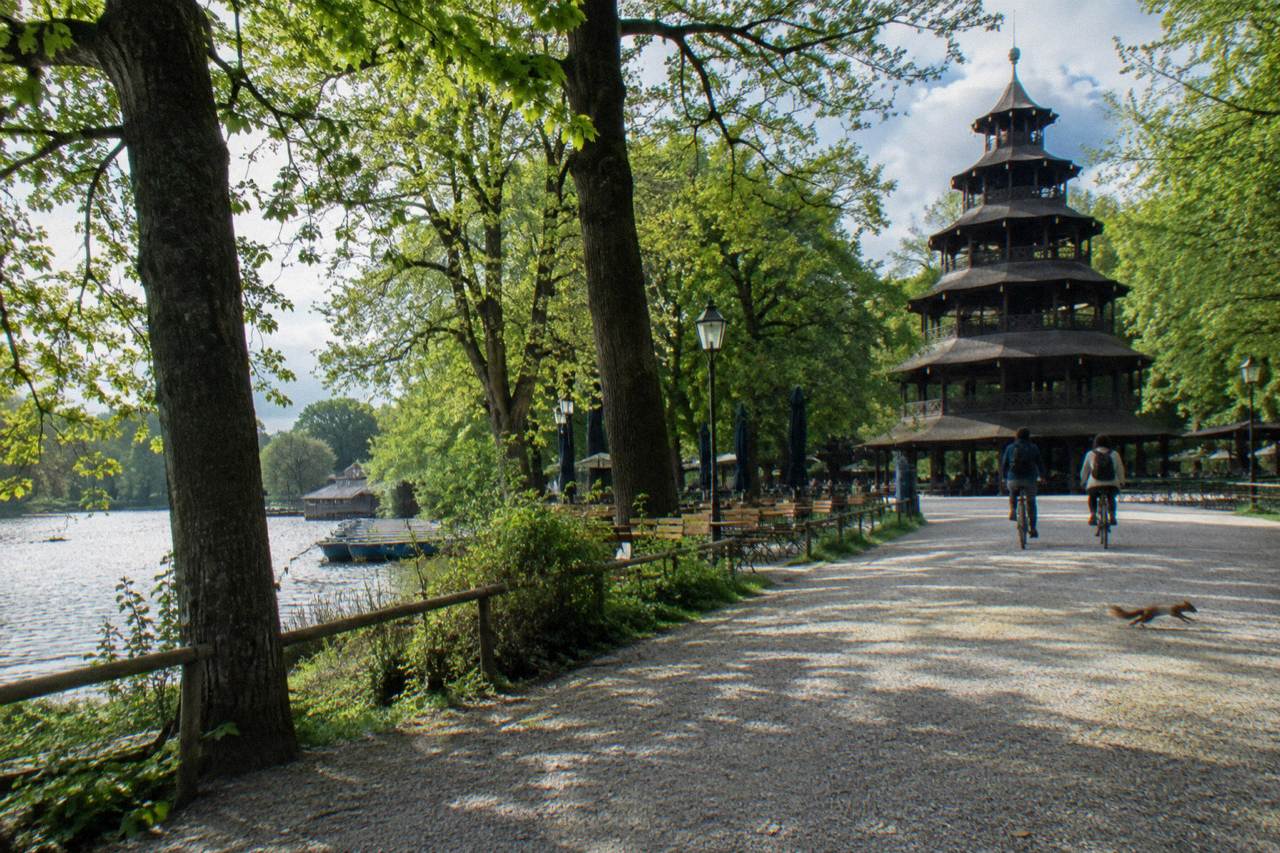
The Chinese Tower is the park's emblem: 25 m tall, built to the 1789 design, with a beer garden at its foot that is reported to hold about 7,000 seats, second in size in Munich only to the Hirschgarten. Brass bands play here in good weather, Wednesday from 16:00, Friday from 15:00, Saturday from 14:00 and Sunday from 12:00, per the operator's site. The tower's beer garden opens at 11:00 on weekdays and 10:00 at weekends in dry, warm conditions; in cold or uncertain weather only the kiosk opens, from 12:00. Opening details live on the operator's own page, and beer garden hours are weather-dependent everywhere in the park, so treat any spring or late-autumn ride as a maybe on the garden seats.
The Seehaus sits on the Kleinhesseloher See at the garden's mid-point, listed with hours of 12:00 to 24:00 on weekdays and 11:30 to 24:00 on weekends and holidays, with the kitchen keeping its own times. The lake itself is the picture stop: rowing boats, ducks, and the moment the park flips from city-icon Munich to woodland Munich.
The Monopteros is the viewpoint. A short climb up an artificial hill puts a small round temple above the treeline, with the meadows of the southern park laid out southwards and the Alps visible on clear days. Lock the bike at the foot of the hill and walk up; the last stretch is not a riding path.
| Stop | What it is | Best for | Watch out for |
|---|---|---|---|
| Eisbach wave | Standing surf wave on the park's southern stream | Free spectacle, two minutes from the centre | Crowds on the bridge; walk the bike here |
| Chinesischer Turm | 25 m tower of 1789 design with a beer garden at its foot, ~7,000 seats reported | Beer, brass bands, the postcard view | Weather-dependent opening; kiosk only in poor weather |
| Seehaus | Beer garden and boating lake mid-park | A long lunch break half-way | Kitchen hours differ from bar hours |
| Monopteros | Hilltop temple with a park panorama | The one climb worth doing | Dismount; the hill path is for walkers |
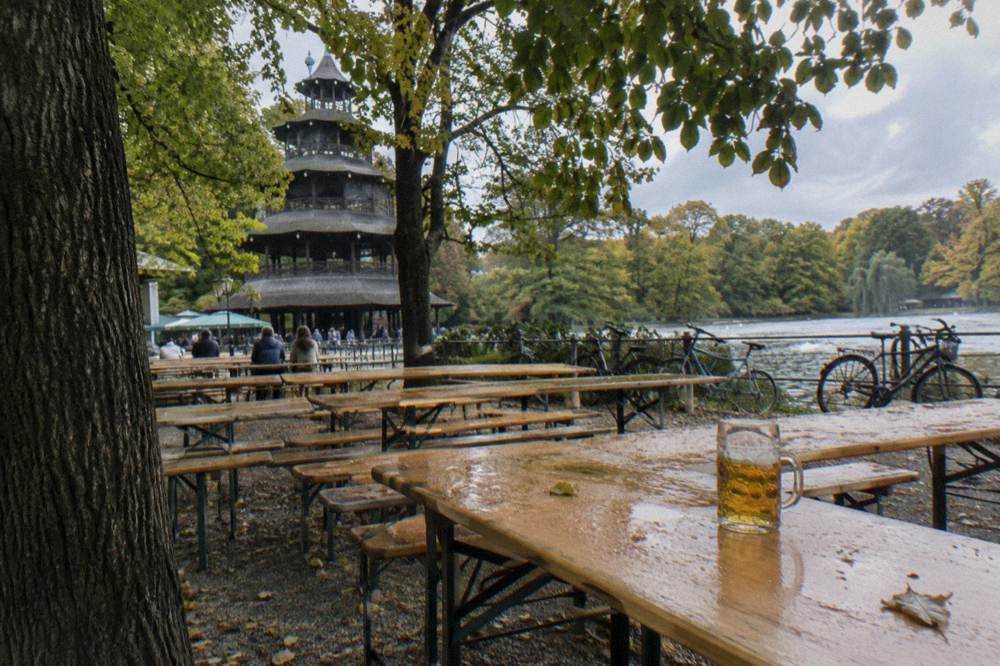
One rule worth knowing before your first beer garden stop: in a true Munich beer garden you may bring your own food and eat it at the tables, as long as you buy your drinks there. It is a tradition with official backing and it makes a bike-and-Brotzeit day remarkably cheap. The full culture, sizes and etiquette are unpacked in Munich beer gardens by bike.
A guided ride changes the stop list. The 3-hour English Garden, Olympic Park and Nymphenburg tour stitches the park together with the 1972 Olympic grounds and the palace park to the west, which assembles distances that are awkward to plan yourself. Inclusions, meeting arrangements and what the guide covers vary, so check the booking page for the current detail before you decide.
What Are The Rules For Cyclists In The English Garden?
Cyclists in the English Garden follow general park rules plus road law: ride on the paths with care and give pedestrians priority, keep dogs leashed if you bring one, never swim in the Eisbach, and observe the bans on barbecues, open fires and camping. Inside the park there are no dedicated bike lanes, so considerate riding is the rule, and at night a properly lit bike is required by German law. Nothing in the park's rules singles out bikes for restriction beyond that, which is unusual for a park this famous and this busy.
The surrounding city law matters too, because you reach the garden on Munich streets. German traffic law requires a type-approved front light, a red rear light and reflectors after dark, plus a bell on the bike. Munich's cycle network is signed, and where a blue sign with a white bike orders a path, using it is compulsory; without such a sign, you choose your lane. The full picture for visitors, including pavement rules for children, is in cycling rules for visitors in Munich.
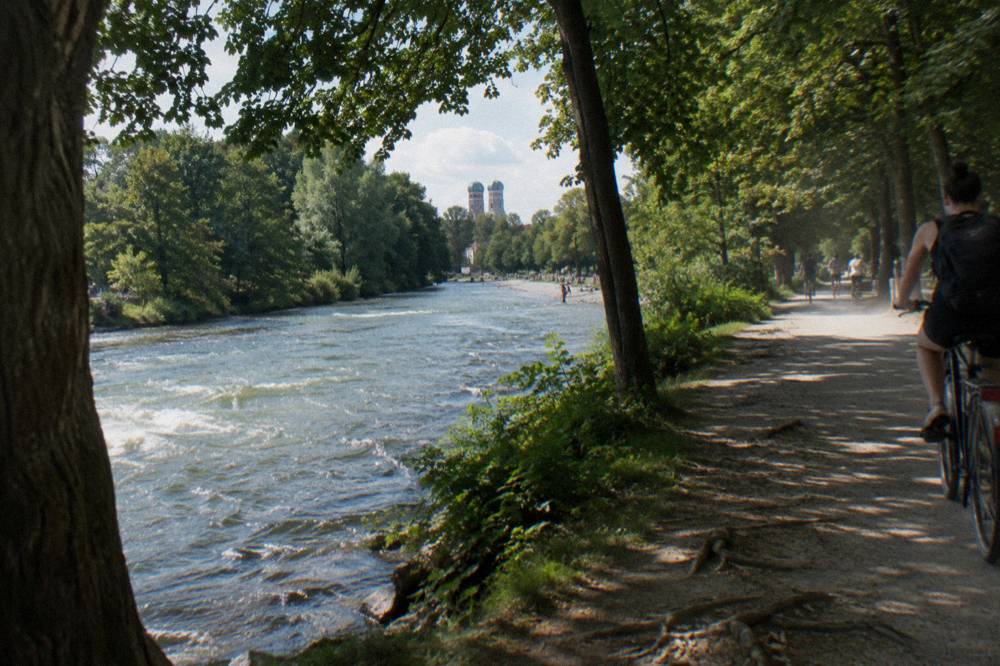
Where to walk the bike is a fair question, and the honest answer is: wherever the crowd wins. The Eisbach bridge area on a summer afternoon, the approach to the Chinesischer Turm, and the stretch past the Seehaus terrace all fall into that category at peak times. There is no published list of walk-your-bike zones, so the working rule is simple, if the path is full of people who are not moving fast, neither should you be.
A note on alcohol, because it will come up: Munich's beer gardens are inside the riding plan, and German law treats cycling under the influence seriously even though the strict motor-vehicle limit does not apply to pedal bikes. One beer with restraint is a local habit; several followed by a fast descent beside a stream is not a plan. The specifics are discussed in drinking beer and cycling in Munich.
Do You Need Your Own Bike Or A Guide For The English Garden?
You do not need a guide: the park is free, the official 15 km loop is published, and rental or shared bikes are easy to arrange. A guided tour adds a licensed local's stories, a bike and helmet supplied per the listing, and the chance to bundle the garden with Olympic Park or Nymphenburg in one ride. Solo riders should budget for the route itself, a lock, and patience with crowds in the south.
The self-guided case is strong. The MyRadl share system launched in May 2026 with classic bikes at EUR 1 per 30 minutes and a EUR 9 day tariff, and e-bikes at EUR 3 per 30 minutes or EUR 18 per day, with stations across the city; the first 30 minutes are free on a classic bike if you hold an eligible transit subscription. Stations sit near the park's edges, though the system is station-based, so you return the bike at a station rather than at the beer garden table. Rental shop options, deposits and pickup logistics are compared in the Munich bike rental prices guide.
The guided case depends on what you want from the ride. A 4-hour tour with a beer garden break strings the garden together with city sights and gives the stop a social hour; the half-day tour with a local guide keeps it tighter at 3 hours; the e-bike Best of Munich ride covers more ground for the same pedalling effort. Prices move with season and demand, and the booking pages carry the current figures, inclusions and cancellation terms, which is where the decision actually gets made.
| Option | Time | What it covers | Best for |
|---|---|---|---|
| Self-guided official loop | ~15 km, ~2 hours | Isar bank, garden north to Aumeister, park return | Independent riders, photographers |
| English Garden, Olympic Park and Nymphenburg tour | 3 hours | The garden plus two western parks in one loop | First visits, big-picture coverage |
| Bike tour with beer garden break | 4 hours | City sights plus a garden-adjacent beer garden stop | Social riders, beer garden culture |
| Half-day tour with local guide | 3 hours | City and garden highlights at a local's pace | Short schedules, first-time visitors |
Families should know the park works well with children: the paths are flat, traffic-free for most of the route, and the Seehaus lake gives kids a natural reward stop. Child seats, trailer arrangements and age policies are per operator, so ask on the booking page; the bike tours with kids guide goes deeper.
Is The English Garden In Munich Worth Visiting By Bike?
Yes, and by bike is the best way to visit it. The park is free, open year-round and far too long to walk end to end, while a 15 km loop with the Isar delivers the surfers, the Chinese Tower, the Monopteros and two beer gardens in a single morning. Even visitors with no interest in cycling as such find the garden the one place in Munich where a bike earns its rental fee. The only scenarios where it disappoints are a rushed half-hour visit or a peak-summer weekend afternoon in the crowded south, and both are solved by timing. If you're budgeting the rest of the day, our guide to what the English Garden really costs explains which stops inside charge money and how a guided bike ride fits in.
Seasons change the ride but never close it. July averages a high of about 24 to 25 degrees with long evenings, and January a high of about 2 to 4 degrees, which is when the meadows empty and the paths belong to locals. The beer gardens run on weather, not calendars, and the brass bands at the Chinese Tower play only in Biergarten conditions. The seasonal trade-offs, from Isar swimming rules to winter path clearing, are laid out in the best time for a Munich bike tour.
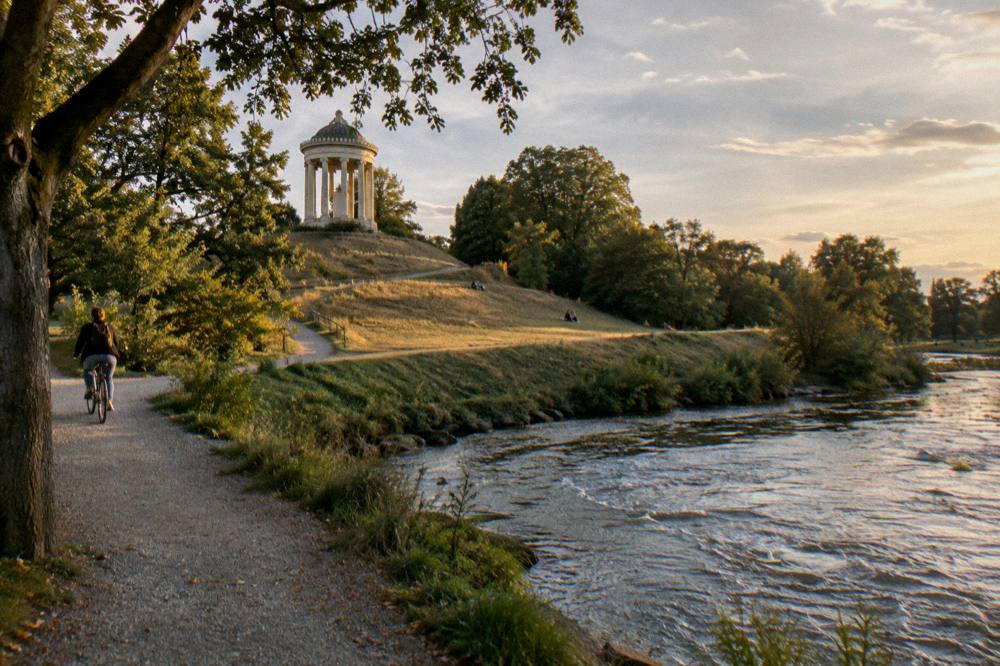
What the ride gives you that a walk cannot is scale. From the Eisbach wave to Aumeister the park unfolds as one continuous landscape, meadow into woodland into beer garden into meadow again, and the northern half, which most visitors never see, is where the garden becomes genuinely quiet. Riders who finish the full loop consistently describe the north as the surprise; the postcard sights are all in the south, but the calm is in the north.

For balance, the honest caveats: nothing about the park is curated for tourists, paths are unmarked gravel in places, signage inside the garden is thin, and on a grey Tuesday in February the beer gardens may be shuttered and the meadows sodden. None of that is a flaw. It is a working city park that tolerates millions of visitors a year, and a bike is simply the tool that fits its size.
Before the final word, the three rides that fit the garden best, side by side:
Common Questions About The English Garden By Bike
Is The English Garden In Munich Worth Visiting?
Yes, and it is Munich's most rewarding bike territory: free entry, open year-round, and a scale, 376 hectares, that makes walking it impractical. A 15 km loop takes in the surf wave, the Chinese Tower, the Monopteros and two beer gardens in about 2 hours of riding.
Can You Ride A Bike In The English Garden?
Yes, cycling is allowed throughout the park's path network, a reported 78 km shared with joggers and pedestrians. Pedestrians have priority, crowded sections call for walking the bike, and posted signs at pinch points must be followed.
How Long Does It Take To Cycle The English Garden?
The official city tourism loop from Marienplatz, along the Isar, north through the garden to Aumeister and back, is about 15 km with roughly 2 hours of riding at a relaxed pace. A southern circuit taking in the main sights is a fraction of that.
Is The English Garden Free?
Yes, the park is free and open year-round. Everything inside it that costs money is optional: beer gardens, boat rental at the Seehaus lake, and any guided tour you book.
Are Dogs Allowed In The English Garden?
Yes, but they must be kept on a leash and their waste removed, per the park's rules. The same rules apply to cyclists bringing a dog along on a ride.
Can You Swim In The Eisbach In The English Garden?
No. Swimming in the Eisbach is prohibited and the city describes it as life-threatening. The Isar itself has seven designated swimming sections outside the park, governed by water-level rules covered in our Isar riding guide.