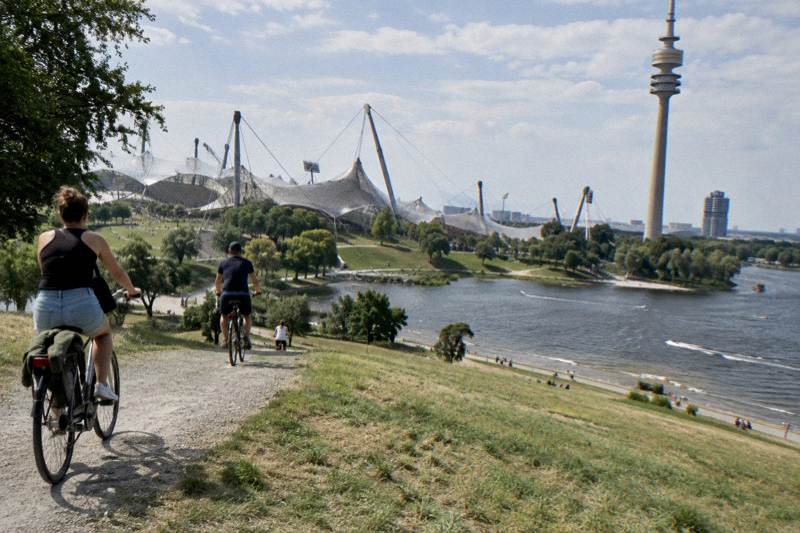
Cycling Rules For Visitors In Munich
Munich runs on bicycles, and German traffic law is strict about where and how you ride. Here is what the rules actually say, sourced from the statutes, and how they play out on Munich streets.
Short answer
German cycling rules come from the StVO and StVZO: ride with caution, use a signed cycle path where signs 237, 240 or 241 order it, keep lights type-approved, and walk your bike in pedestrian zones. Munich adds 103 bicycle streets and 1,200 km of signed routes. A guided ride is the easiest way to absorb all of it on day one.
Roughly one in five daily trips in Munich happens on a bicycle, 21 percent by the city's own count, the highest share among German large cities. That figure carries a consequence for visitors: the streets you will share are full of confident locals who grew up with these rules, and the police who enforce them do not distinguish between a resident and a tourist on a hire bike. The good news is that German cycling law is short, logical and mostly written down in two statutes, the road traffic regulations (StVO) and the vehicle equipment rules (StVZO). This guide walks through what those statutes actually say, how Munich applies them in its pedestrian zones and bicycle streets, and where a guided ride spares you the first-day fumbling. For a sense of where Munich stands among the world's great bike cities, our look at which city deserves the title of cycling capital of the world places it in the same conversation as Copenhagen and Amsterdam.
What Are The Basic Germany Cycling Rules?
The foundation is section 1 of the StVO: constant caution and mutual consideration toward everyone on the road. Section 2 adds the mechanics, bikes ride single file or side by side, follow directional requirements, and observe lane discipline. Everything else, lights, paths, pavements, is a refinement of those two clauses rather than a separate philosophy.
That opening clause matters more than it sounds. German traffic law is built on mutual consideration, which means a cyclist is neither a pedestrian with wheels nor a car without an engine. You have rights, a car must leave at least 1.5 metres when overtaking on a bicycle street and generally elsewhere, and duties. The law spells out the duties precisely; the rights you absorb by watching locals.
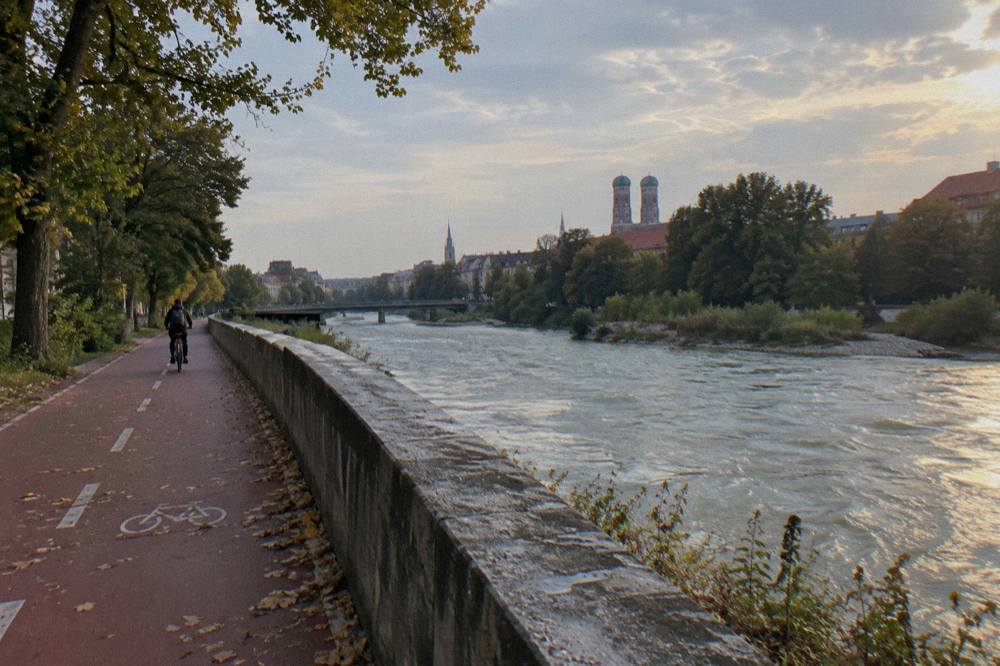
Three habits cover most of what the statutes demand. Ride predictably, signal turns with an extended arm, and never assume a car has seen you. Section 1 of the StVO frames all road use as mutual consideration, and in practice Munich drivers extend it readily to cyclists who ride in a straight, legible line. If you want a fuller picture of how safe the city feels on two wheels, the safety record of cycling in Munich is covered in its own guide.
Visitors who would rather learn the rules from a guide than from a statute book have good options. A shared three-hour ride such as the Munich 3-Hour Guided Bike Tour doubles as a rolling rules lesson, and the format suits first-day riders. If you're still weighing whether the city suits cyclists at all, the plain answer on Munich's bike friendliness lays out the infrastructure and the rules in one place.
Where Must You Use A Bike Lane In Munich?
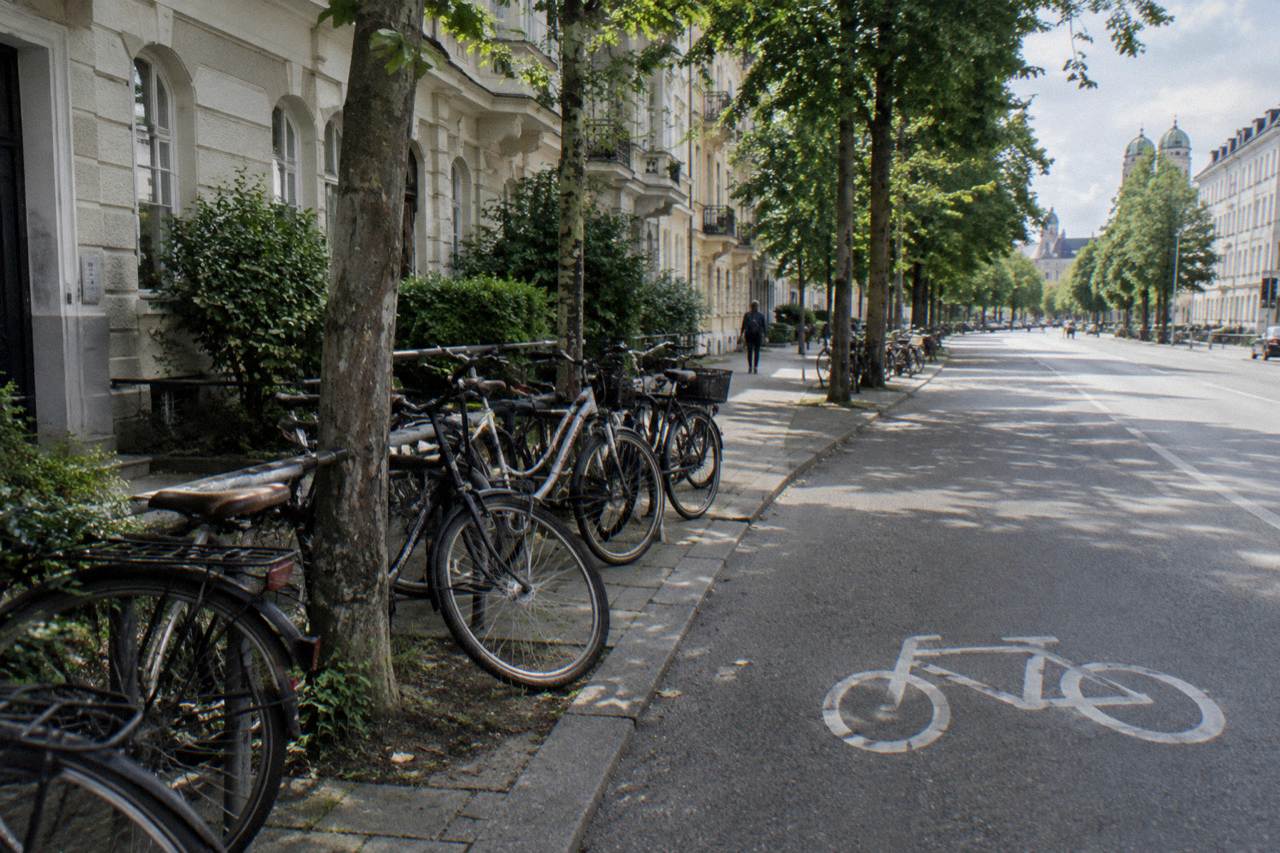
Only where a sign orders it. Cycle-path use is compulsory in Germany exclusively under signs 237, 240 or 241, the blue circular signs showing a bicycle, a bicycle with a pedestrian, or a separated lane. A right-hand strip of asphalt without one of those signs is optional, and you may lawfully stay on the road.
This single distinction resolves most visitor confusion. Munich paints a great deal of red asphalt, but paint alone does not create a duty. The text of section 2 ties compulsory use to the signage, and the city's own cycling pages confirm that signed paths must be used while unsigned ones remain a choice. Riding on a signed path against its direction of travel is forbidden, and side paths on the left may be used only where expressly permitted.
| Sign | What it shows | Duty for a cyclist |
|---|---|---|
| Sign 237 | White bicycle on blue circle | Use this path, this direction only |
| Sign 240 | Bicycle and pedestrian together | Use it, share with pedestrians |
| Sign 241 | Separated bike and pedestrian lanes | Use the cycle side of the divider |
| No sign | Painted lane or plain road | Optional, road riding is legal |
One Munich wrinkle: a signed path that is blocked, badly parked in or uncleared in snow can be left for the road. Winter guidance from the German cyclists' association notes that if a signed bike path is not cleared or gritted, riding on the carriageway instead is accepted, and the city clears bike paths from about 3 cm of snowfall, winter routes within roughly two hours. Between Christmas markets, shorter daylight and cold snaps, Munich in winter on a bike has its own rhythm and its own rules about lights.
How Do Tram Tracks And Pedestrian Zones Work?
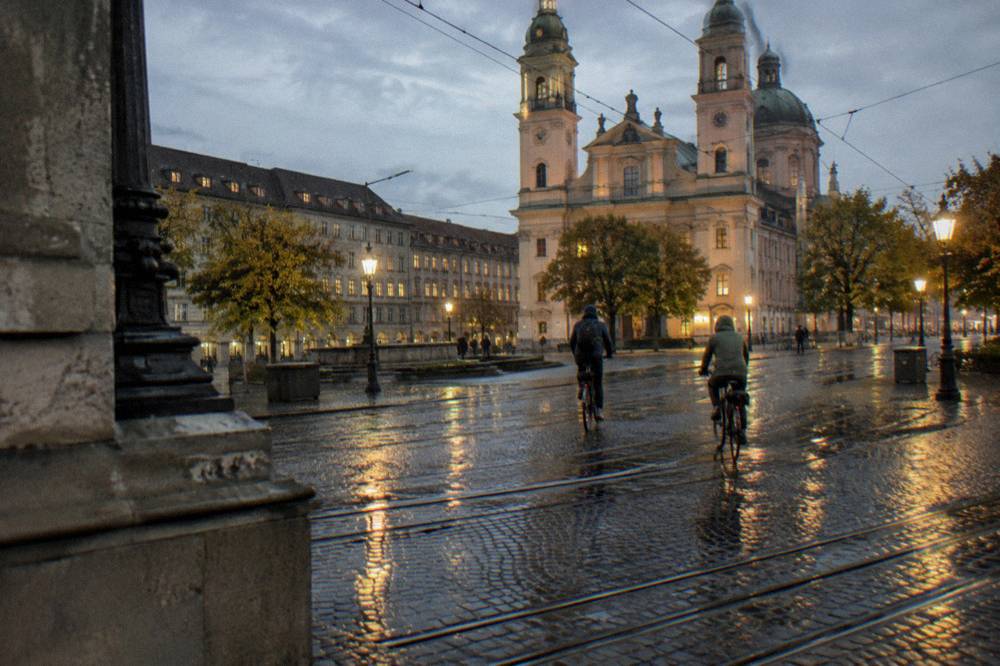
Cross tram tracks at as close to a right angle as you can manage, because a wheel slipping into a rail is the most common solo accident in tram cities. In pedestrian zones, cycling is prohibited by default and allowed only where a supplementary sign says Radfahrer frei, and then at walking pace with pedestrians having priority.
Tram rails are wet-steel slick in rain and invisible hazards at night. The technique is simple: commit to the crossing, angle the bike perpendicular to the rail, and pedal through without braking mid-crossing. Locals do it without thinking; a visitor's first week is when the instinct forms, which is one honest argument for absorbing the first loops of the city behind a guide on a group ride.
Pedestrian zones are the other classic trap. Munich's Old Town pedestrian zone, and Sendlinger Straße, permit cycling between 21:00 and 09:00 only, according to the city's cycling network pages. Outside those hours you walk the bike or push it to the parallel streets. The general German rule is that a Fußgängerzone with a Radfahrer frei add-on may be ridden at adapted speed, with pedestrians dominant over the whole surface, a point the city states plainly. If these local rules have you wondering how Munich stacks up elsewhere, our guide to Europe's most bike friendly cities puts the city in context.
| Zone | Cycling status | Notes for visitors |
|---|---|---|
| Old Town pedestrian zone | Only 21:00 to 09:00 | Walk the bike during the day |
| Sendlinger Straße | Only 21:00 to 09:00 | Same rule, same hours |
| Bicycle street (Fahrradstraße) | Cyclists have priority | Cars limited, 30 km/h cap |
| One-way street with bike exception | Two-way for bikes | Look for the sign at the entry |
Munich counted 103 bicycle streets totalling 47 km at the end of 2025, and on them the whole carriageway belongs to cyclists: riding side by side is explicitly allowed, motor vehicles are guests capped at 30 km/h, and cars must leave 1.5 metres to pass. The network around them is dense, 1,200 km of signed routes radiating from Marienplatz, so the signposting does much of the work once you can read it.
Visitors nervous about local rules are reassured by a guided group ride, and that is the honest upsell of a tour here.
Can You Ride Side By Side And On The Pavement?
Side by side is legal only when traffic is not obstructed; otherwise single file. On pavements the rule is for children: those up to 8 years old must ride there, those up to 10 may, and adults accompanying a child in that age band may ride alongside. Grown-up visitors walk their bikes.
Both clauses come straight from section 2 of the StVO, and both surprise people. The side-by-side right is real, and on a quiet bicycle street or a riverside path it is the natural way to ride as a pair, but the moment a car would have to slow behind you, the duty to fall into line returns. German police read "obstructed" generously toward the motorist.
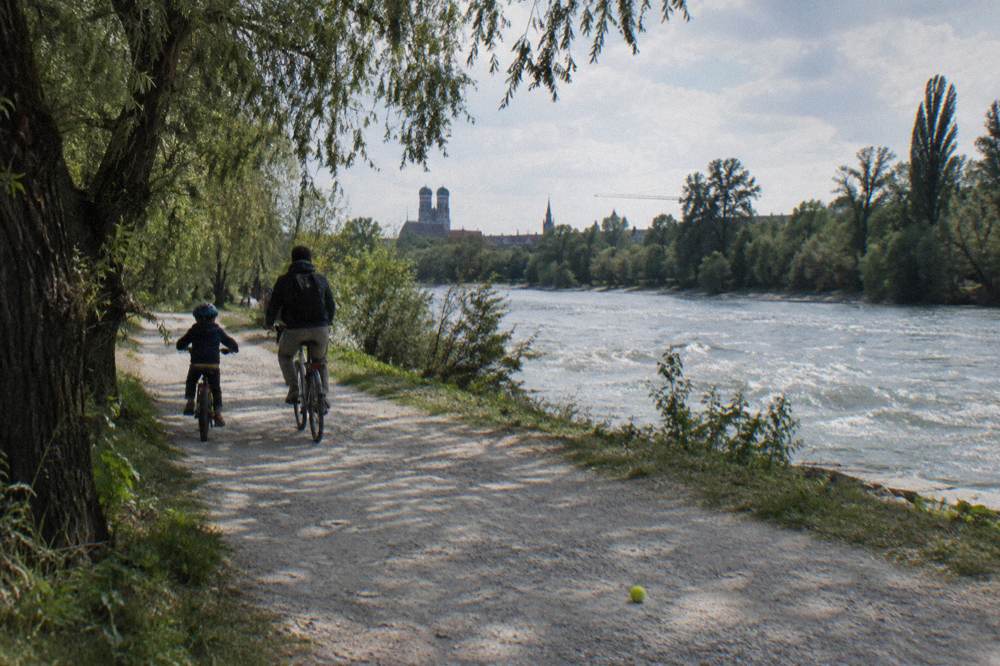
The pavement rule matters most to families. A child of 8 or under must use the pavement where none of the compulsory-path signs applies, a child of 9 or 10 may choose, and one accompanying adult may ride on the pavement with them at walking pace. Families weighing the logistics, from child seats to which routes suit trailers, have a fuller rundown in Munich bike tours with kids and families. For everyone older, pavement riding is a finable offence and, in a city this dense with pedestrians, a social one too.
What Are The Lighting And Equipment Rules?
A bike used on public roads in Germany needs a type-approved headlamp and a red rear lamp with a rear reflector, plus a bell. Lights must be powered by dynamo, battery or rechargeable store, and detachable lamps are allowed if they meet the approval rules; flashing headlamps are not.
The equipment clause is StVZO section 67, and it is the one that catches hire-bike riders at dusk in winter. The statute requires at least one white headlamp for dipped beam, at least one red rear lamp and a red, non-triangular rear reflector, all type-approved. A bell is required under section 64a. Helmets are not legally required for standard bikes or pedelecs, though many operators supply one and recommend it.
| Item | Required by law | Detail |
|---|---|---|
| Headlamp, white | Yes | Type-approved, no flashing |
| Rear lamp, red | Yes | Type-approved |
| Rear reflector, red | Yes | Non-triangular |
| Bell | Yes | Clear-tone, one minimum |
| Helmet | No | Recommended, often supplied |
| Brakes on both wheels | Yes | Standard two-brake rule |
In practice the risk is seasonal. Munich's November evenings darken by late afternoon, and the Christmas market season pulls riders through the centre at exactly the wrong hour. If you are renting rather than riding with a tour, check the lights before you leave the shop; guided rides supply bikes that meet the code, which removes one checklist item. For the broader timing question, the best time for a Munich bike tour weighs season against daylight.
Can You Drink And Ride A Bike In Munich?
Drink and cycling is a genuinely bad combination in German law, and the safe advice is none before riding. Riding while unfit through alcohol is an offense for cyclists too, so simply separate the beer garden from the ride home.
This is deliberately cautious wording. What is firmly established is that riding a bicycle while unfit through drink is a criminal offence in Germany, that it can carry fines, points and a medical-psychological assessment, and that the thresholds for prosecution are lower than most visitors assume.

Munich makes this rule unusually hard to obey, because beer gardens sit at the end of every good ride. The classic solution is the one locals use: ride to the garden, drink, then let the bike travel home on the S-Bahn with you, bikes need the MVV bicycle day ticket and the rush-hour blocks lift at 9 a.m. and again after 6 p.m. How bikes, tickets and restrictions interact is laid out in full in bikes on trains and S-Bahn in Munich. Several guided rides build the beer garden stop into the itinerary, which conveniently leaves the ride home to a professional guide's judgement; the interplay of beer gardens and routes has its own beer gardens by bike guide.
What Fines Apply For Breaking Cycling Rules?
Riding on the pavement starts around a 10 euro fine in the standard penalty catalogue, and skipping a compulsory signed bike path starts around 20 euros, with both climbing steeply if you endanger someone. Fines are the state's, not the city's, so the amounts are the same across Germany.
These are federal fines from Germany's penalty catalogue, and they rise once obstruction or danger enters the picture, and the escalation logic matters more than the euros. Endangering a pedestrian, causing an accident or riding while unfit each multiply the base amount.
| Offence | Base fine (approx.) | Escalates when |
|---|---|---|
| Riding on the pavement | from 10 euros | Obstruction or danger |
| Not using a compulsory path | from 20 euros | With obstruction |
| Riding against a one-way | from 20 euros | Danger to others |
| Running a red light | 60 euros and up | After more than a second red |
The cheaper insurance is structural: on a guided ride the guide picks the lane, reads the signs and calls the turns, and you simply follow. That is a real service for a first-time visitor, and it is why most group rides stick to the classic city sights. Duration is the main variable across the options, from two hours up to a full half day.
Do The Rules Differ Inside The English Garden?
No statute changes inside the park, but the park adds its own code: cycling is permitted on the roughly 78 km of paths shared with joggers, barbecues and open fires are prohibited, swimming in the Eisbach is prohibited, and dogs must be leashed. The Eisbach surf wave carries its own decree, with a 22:00 surfing ban and a mandatory self-releasing leash.
The English Garden is where most visitors do their longest uninterrupted riding, and it rewards the preparation. The park's official pages list the essentials, and the practical reading is that paths are shared, not exclusive: pedestrians spill across them, and on a July afternoon the Chinese Tower end of the park behaves like a pedestrian zone with bicycles permitted. Ride at adapted speed and ring the bell early. The route itself, including the classic Isar-and-garden loop, is mapped in English Garden by bike.
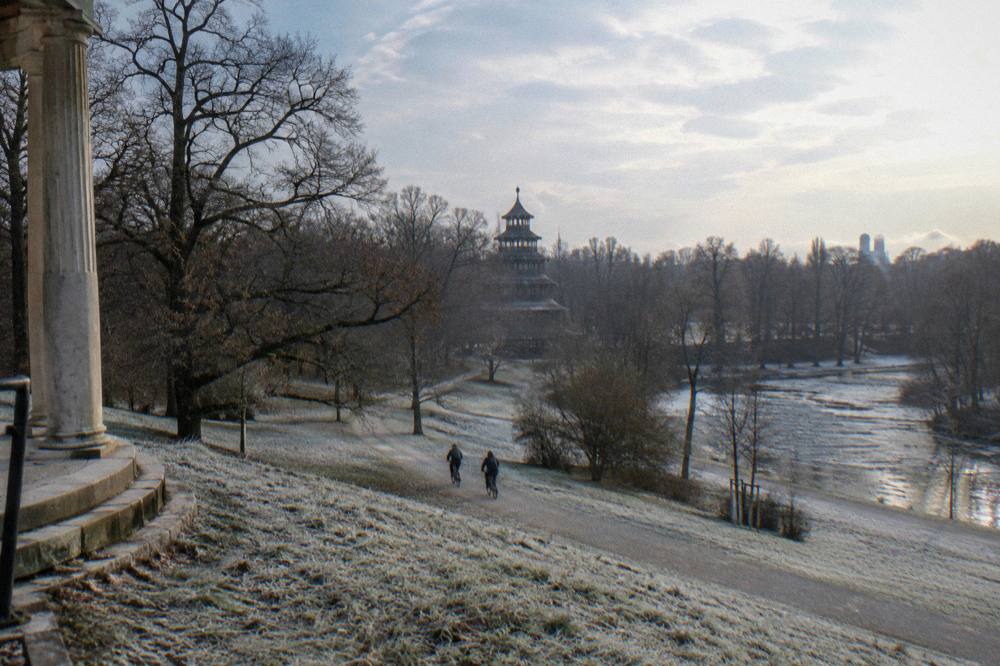
Two specifics deserve their lines. Swimming in the Eisbach inside the park is prohibited and dangerous, and the designated Isar swimming sections sit downstream of it, with a water-level rule closing the river above 1.20 m at the Munich gauge. The surf wave at the park's southern edge is regulated by a city decree: surfing is permitted again under the amended general decree, a self-releasing leash is mandatory, and surfing is banned from 22:00, with on-site signs governing the rest. The backstory sits in the Eisbach wave and surfers.
Is A Guided Ride The Best Way To Learn The Rules?
For a first-day visitor, usually yes. A guided ride outsources the three hardest jobs, reading signage in German, choosing the legal lane at junctions and timing the beer garden stop, to a guide who rides Munich daily. Once the patterns are internalised on one loop, independent riding on the MyRadl share bikes becomes straightforward.
The maths of learning by tour is simple. A three or four hour guided loop passes dozens of signalled junctions, several bicycle streets and at least one beer garden, and each one is a live demonstration. The bike is provided and meets the equipment code, so the lighting and brake questions vanish, and the meeting details and inclusions are on each booking page. Riders who prefer to go alone afterwards can use the MyRadl system, launched on 7 May 2026 with about 1,000 stations and more than 6,700 bikes planned across the region: classic bikes cost 1 euro per 30 minutes with a 9 euro day cap, e-bikes 3 euros per 30 minutes capped at 18 euros, and eligible transit season tickets make the first half hour free or discounted, per the city's launch information.

Choosing between independence and a guide is its own question, weighed in rent a bike or take a guided tour in Munich, and the rental-cost side is laid out in Munich bike rental prices and pickup. Short version: the rules above take an afternoon to read and a week to internalise, and a guided first ride with Bike Tours Munich compresses that week into three hours.
Common Questions About Cycling Rules For Visitors In Munich
Where Must You Use A Bike Lane In Munich?
Only where signs 237, 240 or 241 order it. Painted lanes without those blue signs are optional, and you may legally stay on the road. Riding a signed path against its direction is prohibited.
Can You Ride Side By Side In Germany?
Yes, as long as traffic is not obstructed. Once a vehicle would be slowed behind you, the duty to ride single file returns. On bicycle streets, riding two abreast is explicitly allowed.
Can Children Ride On The Pavement In Munich?
Children up to 8 years old must use the pavement, children up to 10 may, and one accompanying adult may ride there with them at walking pace. Adults on their own may not.
Do You Need Lights On A Bike In Munich?
Yes. A type-approved white headlamp, a red rear lamp, a red rear reflector and a bell are required by the equipment rules, with lights powered by dynamo, battery or rechargeable store. Flashing headlamps are not permitted.
Are Helmets Compulsory For Cyclists In Munich?
No, there is no general helmet obligation for standard bikes or pedelecs. Many tour operators and rental shops supply helmets anyway and recommend wearing one.
Can You Cycle In The Munich Old Town Pedestrian Zone?
Only between 21:00 and 09:00, and the same rule applies to Sendlinger Straße. During the day you walk the bike through the pedestrian zone.