Cycling In Munich: Lanes, Traffic And Safety
Munich is one of Germany's most bike-oriented big cities, but comfort on two wheels depends on knowing where the network is strong, where it is busy, and which local rules actually apply to visitors.
Short answer
Cycling in Munich is broadly comfortable for visitors thanks to 1,200 km of signed routes and 103 bicycle streets where bikes have priority. The challenges are specific: tram rails, mandatory signed bike paths, and rush hour near the Altstadt. Helmets are not legally required, lights and a bell are, and a guided ride is the easiest first outing.
Munich carries the official title Radlhauptstadt, the cycling capital, and the numbers behind that label are the best starting point for any safety question. The city's bike modal share stands at 21 percent of daily trips, the highest among German large cities, according to the city's own mobility department. That share matters to a visitor for a concrete reason: drivers, pedestrians and tram drivers here expect bikes and interact with them constantly, which is a different experience from cycling in a city where bikes are rare.
Expectation is not the same as protection, though. This guide lays out what the network actually looks like, where the friction points are, what the law requires of you, and how a first ride can be set up so that the city does the work for you. Nothing here is a promise about traffic, weather or conduct on any given day; conditions vary, and the honest answer about safety is always a picture of infrastructure and rules, not a verdict.
How Much Cycling Infrastructure Does Munich Actually Have?
Munich operates a signed route network of about 1,200 km, plus 103 bicycle streets with a combined length of roughly 47 km, and the network keeps growing: 2025 alone brought 1,500 new bike parking spaces at 66 locations, and 2026 delivered a 1.85 km separated corridor on the Altstadtring Nordwest. Together these figures describe a city that has spent decades building for bikes rather than tolerating them, which is the single biggest factor in how a visitor experiences traffic here.
The Münchner Radlnetz, the signed network, is organised in a way that is useful to know before your first ride. Fourteen radial routes fan out from Marienplatz, an inner and an outer ring loop the city, and green corridors follow the rivers and canals, including the Isar, the Würm and the Nymphenburg route. For a tourist this structure is practical: if you are heading from the centre to the English Garden, the Nymphenburg park or the Olympiapark, a signed radial or corridor route will carry most of the way, and the signs do the wayfinding for you.

Bicycle streets, Fahrradstraßen, deserve a special mention because they change the hierarchy in your favour. On these streets the whole carriageway counts as a bike path: people on bikes have priority, riding side by side is allowed, and motor traffic is capped at 30 km/h and only admitted where signed. Almost every Munich bicycle street carries the "Kraftfahrzeuge frei" supplement, so you will share them with the occasional car, but on bike-priority terms. The city's cycling network pages, maintained at stadt.muenchen.de, describe the current rules and route signage in detail.
| Infrastructure element | Scale | What it means for a visitor |
|---|---|---|
| Signed route network (Radlnetz) | About 1,200 km | Radial routes from Marienplatz plus ring routes and river corridors |
| Bicycle streets | 103 streets, about 47 km | Bikes have priority, side by side riding allowed, 30 km/h cap |
| New bike parking (2025) | 1,500 spaces at 66 locations | More secure parking, including near stations |
| Altstadtring Nordwest | 1.85 km of separated paths | Wide bike paths clearly separated from pedestrians |
| Bike modal share | 21 percent of daily trips | Traffic routinely expects and accommodates bikes |
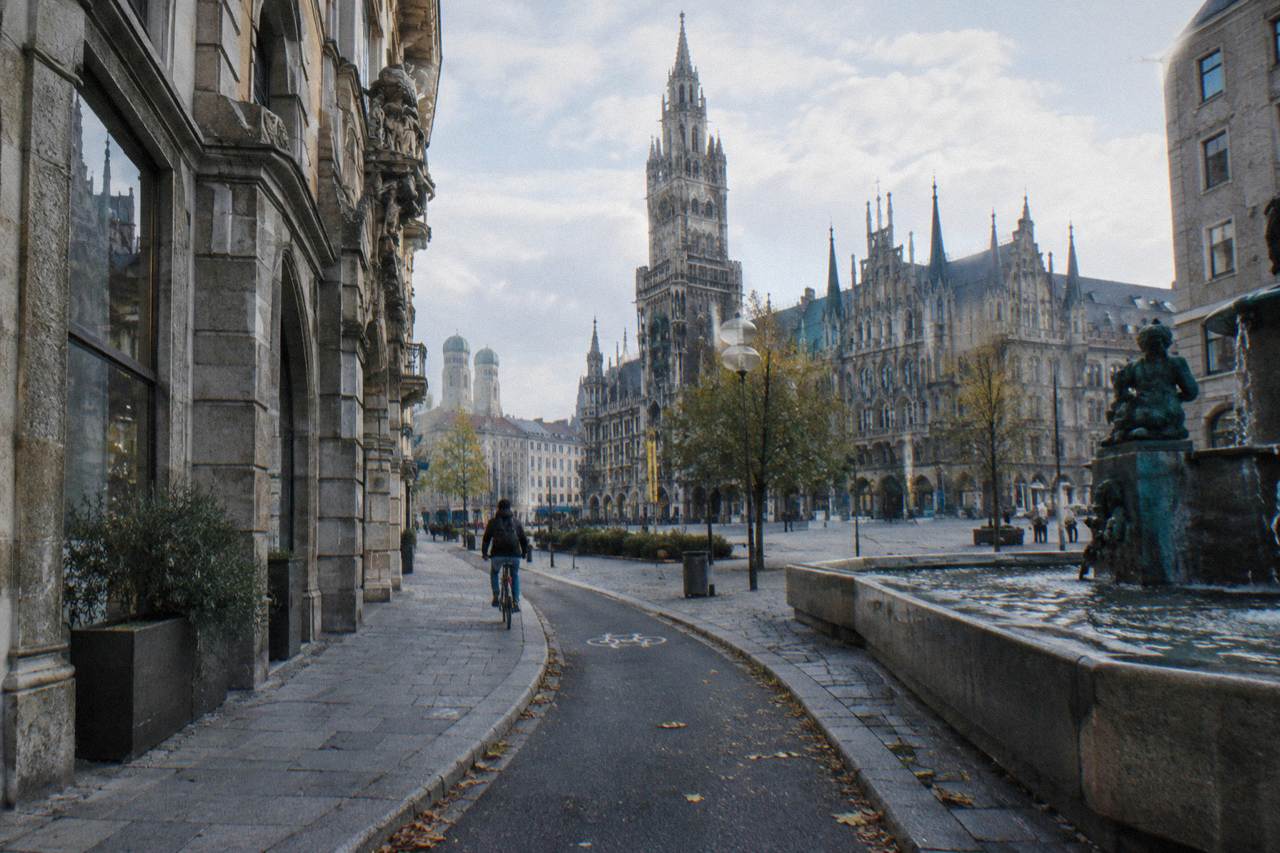
One recent project shows the direction of travel. The Altstadtring Nordwest scheme delivered 1.85 km of wide, separated bike paths with clear separation from pedestrian areas, part of the city's 2026 climate protection programme alongside a two-way upgrade on Gilmstraße and new parking facilities in Freiham. None of this makes the city hazard free, and the sections below cover the genuine friction points, but the baseline is a city engineered around bikes to a degree few visitors expect.
Where Are The Busiest And Trickiest Places To Cycle In Munich?
The friction in Munich is concentrated in a few specific places: tram rails in the Altstadt and along Leopoldstraße, the pedestrian zone around Marienplatz where cycling is banned or restricted by time of day, mandatory signed bike paths that must be used where posted, and rush hour traffic between roughly 6 and 9 in the morning and 4 and 6 in the evening on weekdays. None of these are reasons to skip cycling; they are reasons to know the pattern before you set off.
Tram rails are the classic Munich hazard and worth describing precisely. The rule of thumb, consistent with how German traffic law is applied, is to cross rails at as close to a right angle as possible, because a wheel dropped into a wet rail at a shallow angle can slide out from under you. The intersections around Karlsplatz, Sendlinger Tor and the stretch of road past the Hauptbahnhof combine rails, buses and turning traffic, and they deserve slowed pace and full attention rather than avoidance, since they are also where the sights are.
The pedestrian zone has its own written rules. Cycling in pedestrian zones is generally prohibited, and where a "Radfahrer frei" sign admits bikes, you must ride at walking speed or an adapted speed with pedestrians having priority across the whole area. Munich adds a local nuance: in the Altstadt pedestrian zone and in Sendlinger Straße, cycling is permitted between 21:00 and 9:00, when the shopping crowds are gone. Riding through Marienplatz at midday is not just awkward, it is against the posted rules and can draw a fine.
Then there is the question of which paths you must use. Cycle-path use is compulsory only where the blue signs with a white bike, signs 237, 240 or 241, order it; a right-hand cycle path without those signs is optional. Where the duty applies, skipping the path starts at a 20 euro fine if you obstruct someone, and riding on the pavement starts at 10 euros. Children are treated differently: up to age 8 they must use the pavement, and up to age 10 they may. The full rule set for visitors is laid out in our cycling rules guide for visitors, which goes through each requirement in turn.
For many safety-minded visitors, the honest shortcut past all of these judgement calls is a guided ride. A guide who rides Munich daily takes the lane choices, the rail crossings and the timing decisions, and you follow a wheel. The half-day option with a local guide runs about 3 hours, the small-group alternative runs about 3 hours, and the classic 3.5-hour guided tour covers the same core of city, English Garden edge and beer garden territory; each booking page lists the current price and what is included.
Do You Need A Helmet To Cycle In Munich?
No. German law imposes no general helmet obligation on standard bikes or pedelecs up to 25 km/h, so wearing one in Munich is a personal choice, and most local commuters ride bare-headed; the legal requirements that actually apply to your bike are working lights at night, a bell, and brakes, and many tour operators supply helmets free anyway for anyone who wants one. The distinction matters because visitors often arrive assuming a rule that does not exist, and then ride defensively about the wrong things.
The law is explicit on what a bike must carry. Lighting has to be type-approved and powered by a dynamo, battery or rechargeable store: white headlight and red rear light plus reflectors, and detachable lights are allowed under conditions. A bell is mandatory. None of this is policed aggressively against tourists on rentals, but a rental bike handed over after dark without functioning lights is a bike you should send back, both for the fine and because Munich drivers travel at speed on unlit stretches.
Helmets are a different conversation from legality. Most Munich bike tour operators include a helmet in the booking or offer one at pickup. Check the listing for your chosen ride to confirm what is provided. If you are renting independently for several days and want a helmet, ask the shop directly, because availability varies. Our comparison of e-bikes versus regular bikes for seeing Munich covers what each format demands of a rider, including the extra weight and speed considerations that make helmet preference a real decision rather than a formality.
The related tour on this page, Munich by Bike: Half-Day Tour with Local Guide, is a good fit for exactly this hesitation. The listing states about 3 hours with a local guide, which is long enough to cross the city properly and short enough that a nervous rider is not committed to a full day, and the booking page shows the current price basis, inclusions and cancellation terms.
Riding with a guide also resolves the helmet question in practice: the operator states what is provided, and you can decide before you commit rather than negotiating at the pickup point. Between the guided and self-guided options, the deciding factors are usually confidence in traffic and how much of the network you want to figure out alone on day one.
What Do Beginners And Nervous Riders Need To Know First?
Beginners should start on the car-free or near-car-free corridors: the English Garden with its 78 km of paths, the Isar river routes that run downstream from the centre, and the Nymphenburg canal routes, all of which keep you away from tram rails and junction traffic while you settle into the bike; the official English Garden loop from Marienplatz runs about 15 km and 2 hours on quiet paths. These are the places Munich families ride, and the safety profile is a different category from the Altstadt.
The English Garden is the obvious first ride and the numbers support it. The park holds about 78 km of paths shared between cyclists and joggers, it is open year-round with free entry, and the official tourist-board route from Marienplatz follows the Isar downstream, cuts into the garden and returns via Aumeister, about 15 km in total. Rules are simple and posted: dogs on leashes, no barbecues or open fires, no swimming in the Eisbach. Our English Garden by bike guide maps the practical details, including where to enter and which beer garden makes a natural stop.
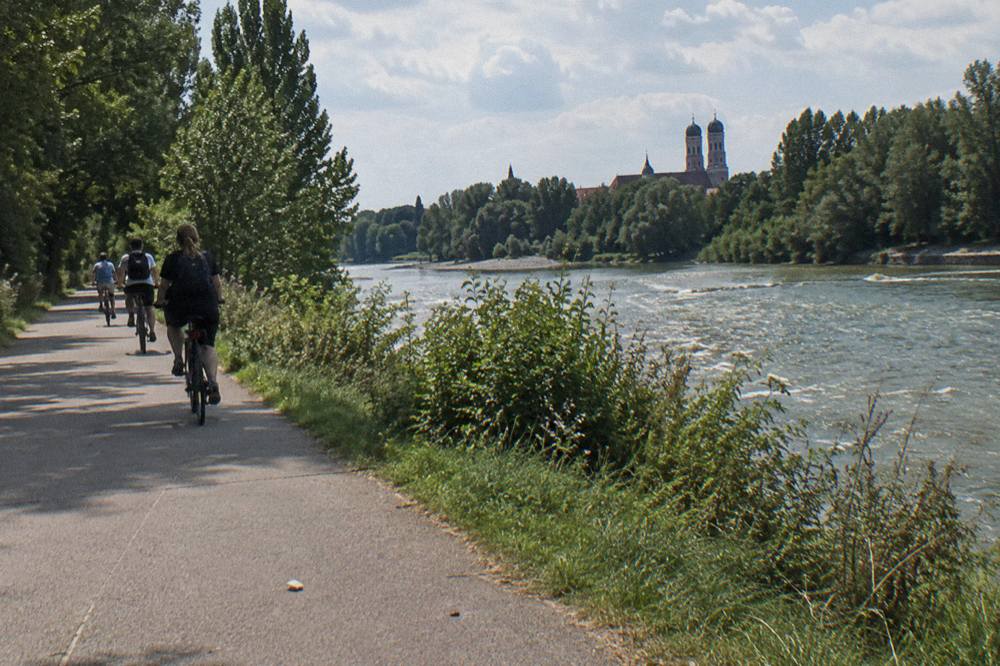
The Isar paths extend the same experience south and north of the garden. They are flat, separated from motor traffic for most of their length, and carry a steady stream of local riders, which makes them self-policing: behaviour normalises to the crowd. If you want a destination rather than a wander, the canal routes towards Nymphenburg offer about 10 km one way to Blutenburg or 16 km to the Hirschgarten beer garden, on low-traffic waterside paths the whole way.
For a beginner who wants the traffic parts handled too, the classic 3.5-hour guided bike tour is a sensible middle: it spends time in the park network and the city streets in one outing, so you experience both environments with someone else choosing the moment for each. Check the booking page for the meeting point details and what the price includes, since inclusions such as the bike itself, and any refreshment, vary by listing.
| Riding environment | Traffic exposure | Best for |
|---|---|---|
| English Garden paths (78 km) | None to minimal, shared with pedestrians | First ride, families, nervous riders |
| Isar corridors | Separated from roads most of the way | Longer flat rides, river scenery |
| Bicycle streets (103 streets) | Shared, bikes have priority, 30 km/h cap | Getting across districts calmly |
| Radlnetz radial routes from Marienplatz | Mixed, signed the whole way | Reaching specific sights |
| Altstadt streets and tram intersections | Highest, rails plus turning traffic | Confident riders, off-peak hours |
Timing changes everything in the busier environments. The commuter peaks on weekdays, roughly 6 to 9 and 16 to 18, are when the bike lanes fill with locals travelling at speed, and an uncertain rider wobbling through that flow is the least comfortable combination. Mid-morning, early afternoon and weekends present a completely different city, and the same Altstadt streets that feel hurried at 8:00 on a Tuesday are relaxed at 11:00 on a Sunday.
Is Bike Theft A Problem And Where Should You Park?
Bike theft exists in Munich, as in every large city, and the practical response is infrastructure rather than worry: the city opened a free, video-surveilled 24-hour bike garage on Hirtenstraße near the Hauptbahnhof in January 2026, added 1,500 parking spaces across 66 locations in 2025, and plans a further garage with more than 300 spots at Arnulfstraße for 2027. Lock your bike to a fixed rack whenever you leave it, and use both the frame lock and a chain on a rental worth keeping.
No reliable current figure for Munich bike theft is published, so focus on the practical steps. A good lock, a sensible parking spot, and a bit of care do more for your bike's safety than any shaky number would. What can be said concretely is procedural. If a rental bike disappears, report the theft to the police first, because the city's lost property office will only release a found bike after a theft report exists, and rental operators generally require the report number for their insurance process. Found bikes are handled by the police and collected from the lost property office on Ruppertstraße by appointment.
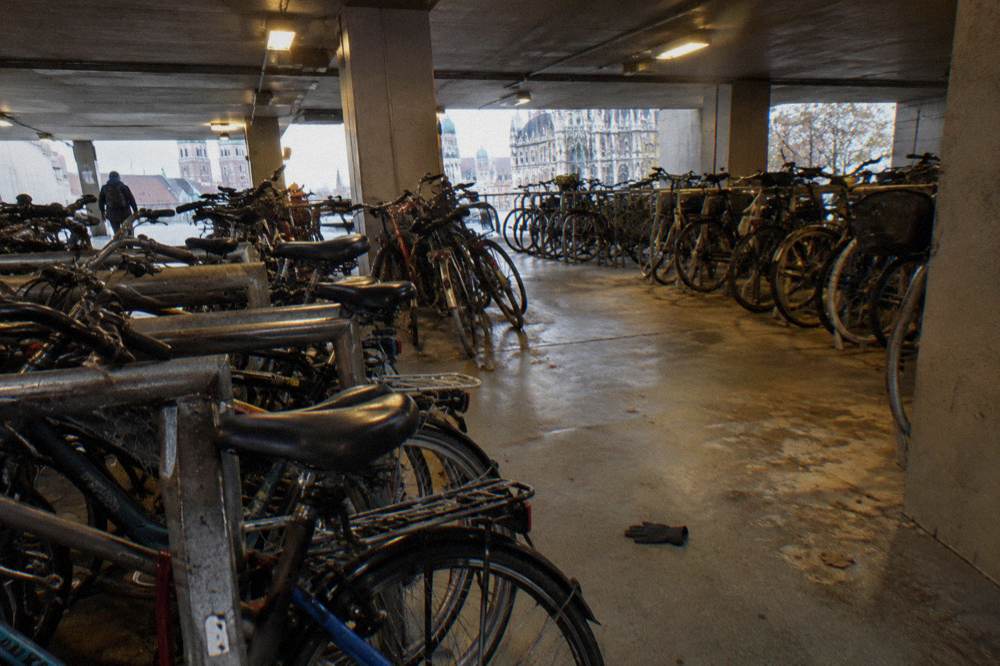
Parking has genuinely improved in recent years, and the improvement is documented rather than promotional. Beyond the new garage near the Hauptbahnhof, the street racks along Arnulfstraße hold well over a hundred bikes on each side of the street, though construction work has temporarily removed some spots, and the 2025 programme added capacity at 66 locations citywide. The city's winter and parking pages at stadt.muenchen.de list the current facilities.
For share bikes the question answers itself: MyRadl, the system that replaced MVG Rad after it ended on 30 September 2025, is station-based, so the bike is returned to an official fixed station and locked there, with a fee if you leave it elsewhere. That structure removes theft worry from the rider entirely, at the cost of planning your route between stations. Our guide to Munich bike rental prices and pickup points compares the share and shop-rental options with their current tariffs.
What Rules Are Visitors Most Likely To Break?
Visitors most often break the rules by riding on the pavement when a bike path does not exist, cycling through the pedestrian zone during the day, renting a bike without lights or a bell at night, and crossing tram rails at too shallow an angle; fines start at 10 euros for pavement riding and 20 euros for skipping a mandatory bike path, while the widest-reaching rules are mandatory use of signed paths and walking speed wherever pedestrians have priority. Almost all of it is avoidable with two habits.
The habits are this. First, when you see a blue sign with a white bike, use the path it marks; when you do not see one, the road is your default place, not the pavement, unless you are riding with a child under 10. Second, whenever you enter a space where people are walking, shopping or queueing, drop to walking speed and treat every pedestrian as having priority. Between them, those two habits cover the large majority of the situations in which visitors collect fines or hostility.
| Rule | What the law says | Typical fine from |
|---|---|---|
| Mandatory bike paths | Blue signs 237, 240, 241 make use compulsory | 20 euros with obstruction |
| Riding on the pavement | Not permitted; children up to 8 must, up to 10 may | 10 euros |
| Pedestrian zones | Banned generally; where signed, walking speed, pedestrians have priority | Varies by situation |
| Lighting and bell | Type-approved lights and a bell required on the bike | Equipment fines |
| Side by side riding | Allowed only when traffic is not obstructed | Warning or fine |
| Alcohol | Riding unfit is a criminal offence; do not drink and ride | Case by case |
On alcohol: riding while unfit is itself an offence for cyclists. The framing is simple and matches the beer garden reality of a Munich ride: riding while unfit through drink is a criminal offence in Germany, at thresholds the courts set, so plan a beer garden stop as a stop, not a mid-ride refuel. Our post on drinking beer and riding a bike in Munich works through the scenarios visitors actually face.
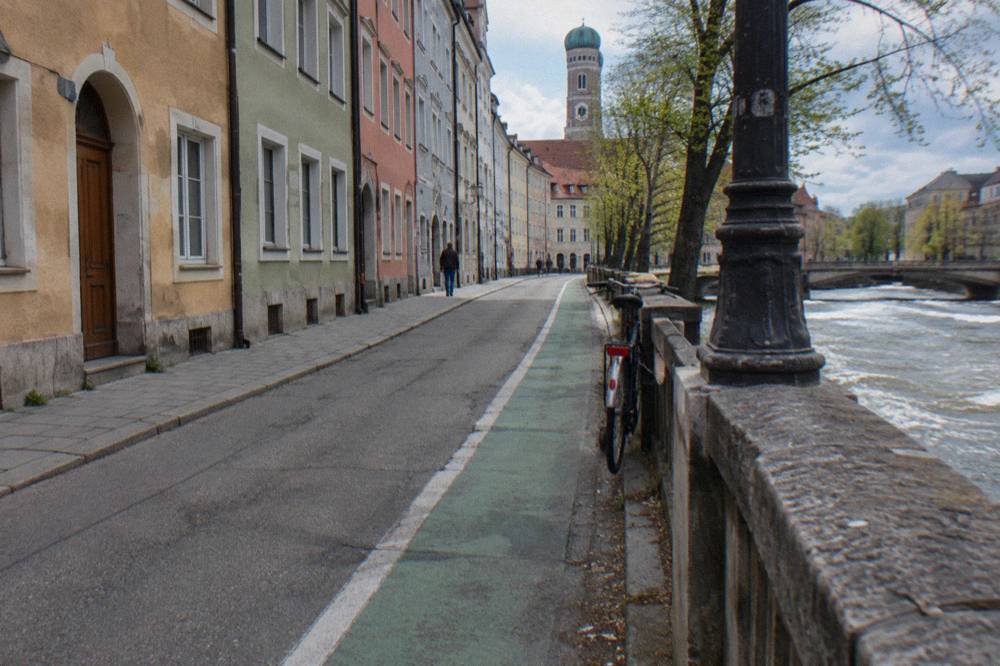
The small-group bike tour format is worth a mention in this context precisely because rules are local. On a shared guided ride of about 3 hours, the guide sets the pace and the position in the lane, calls the rail crossings, and knows which Altstadt streets admit bikes at which hour. For a visitor with one or two days in the city, that is less about hand-holding and more about compressing a week of local judgement into a single outing.
Does Winter Change The Cycling Safety Picture?
Yes, materially: the city clears all bike paths, including bicycle streets, from 3 cm of snow, with winter routes of about 155 km cleared within 2 hours and the rest within 3, but daylight is short, temperatures sit between roughly minus 2 and 4 degrees on average in January, and the ADFC notes there is no winter tyre obligation for bikes, so the choice of when and where to ride in winter is genuinely different from summer. None of that makes winter riding unsafe; it makes it a planning exercise.
The clearing policy is unusually strong and worth knowing in detail. Munich's winter service operates from 2:00 to 22:00 and treats the designated winter route network of roughly 155 km as the priority, clearing it within two hours of snowfall, with the remaining paths following within three hours. There is also a rider's escape clause: if a signed bike path has not been cleared or gritted, you may legally ride on the road instead. That single rule resolves the worst winter dilemma, the icy mandatory path.
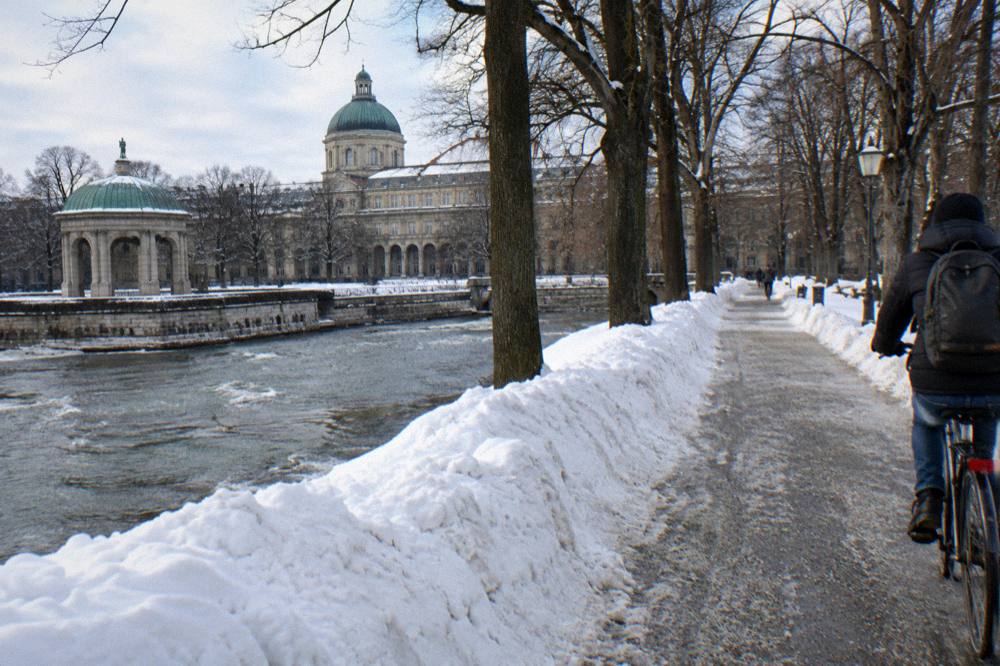
Lights matter more than tyres. StVZO section 67 requires type-approved lighting, and in a city at the latitude of Munich, the November to February afternoon ends early, so a bike ridden after about 17:00 is a night ride whether it feels like one or not. Studded winter tyres are permitted for bikes, unlike the rules for cars, and the ADFC recommends them for regular winter riders, but a visitor on a short stay is better served by simply choosing daylight hours. Our Munich in winter on a bike guide covers the seasonal picture, including which tours still run.
For guided rides in the colder months, check the booking page for departure times and seasonal availability, because winter schedules are typically reduced rather than cancelled. A guide in winter also carries local knowledge of which paths were cleared at dawn, which is knowledge no visitor can replicate, and the cancellation terms on the booking page tell you exactly what happens if a forecast turns.
How Do You Decide Between Riding Alone And A Guided Ride?
If you are confident holding a line in mixed traffic and happy to read signage, ride alone and start on the English Garden and Isar corridors; if any part of this article made you hesitate, the tram rails, the mandatory paths, the timing, a guided ride converts that hesitation into someone else's judgement, and the choice costs roughly the difference in price between a rental day and a tour, with the tour including the bike. The decision is about where the cognitive load sits, not about ability.
Riding alone in Munich rewards preparation. The network is signed, the corridors are pleasant, and bike share removes even the rental logistics. The trade-off is that every junction, rail crossing and time-restricted street is yours to read, in a country whose signage conventions differ from home for many visitors. Riders from the Netherlands or Denmark will find Munich familiar; riders from countries where bikes are marginal traffic often find the first hour absorbing and the second hour easy.
A guided ride front-loads the local knowledge. The Munich by Bike half-day tour with a local guide, the classic 3.5-hour guided tour and the small-group ride all put an experienced local at the front of a group, and the differences between them are duration and group style rather than safety quality. Whichever you lean towards, the booking page states the current price, the inclusions such as bike and helmet, and the cancellation window, which on typical city rides is generous enough to book ahead without locking yourself in.
A simple pattern works well for first-time visitors: take a guided ride on day one, then set off on your own from day two if the first day felt good. You leave the tour with the network in your head, the rules in context, and a realistic sense of your own comfort in Munich traffic, which is worth more than any amount of advance reading, including this page. Bike Tours Munich is here to make that first day easy.
Common Questions About Cycling Safely In Munich
Is Cycling In Munich Safe For Beginners?
Yes, conditionally: beginners should start on the English Garden's 78 km of paths and the Isar corridors, where motor traffic is absent or separated, and treat the Altstadt streets and tram intersections as a second step. A guided first ride handles the traffic parts entirely.
Do I Have To Wear A Helmet In Munich?
No. There is no general helmet obligation for standard bikes or pedelecs up to 25 km/h in Germany. Helmets are a personal choice, and many tour operators provide one; check the booking page of your specific ride.
Where Is Cycling Prohibited In Central Munich?
In pedestrian zones generally, with cycling permitted in the Altstadt pedestrian zone and Sendlinger Straße only between 21:00 and 9:00. Where a "Radfahrer frei" sign admits bikes, ride at walking speed with pedestrians having priority.
Are Bike Paths Mandatory In Munich?
Only where the blue signs 237, 240 or 241 order it. Without those signs, a right-hand cycle path is optional and the road is a legal choice. Skipping a mandatory path starts at a 20 euro fine if you obstruct someone.
How Dangerous Are Tram Rails For Cyclists?
Tram rails are the most common physical hazard. Cross them at as close to a right angle as possible, especially in the wet, because a wheel caught in a rail at a shallow angle can slide out. The busy rail intersections cluster around Karlsplatz and the Hauptbahnhof.
What Happens If My Rental Bike Is Stolen In Munich?
Report the theft to the police first; the lost property office only releases found bikes against a theft report, and your rental operator will want the report number. Park in racks or the free surveilled garage on Hirtenstraße near the Hauptbahnhof, and lock the frame, not just a wheel.