Best Time For A Munich Bike Tour By Month
Munich's cycling season is long but uneven: beer garden weather, festival crowds and winter gritting all shift the experience month by month. Here is how the calendar reads for a rider.
Short answer
The most reliable window for a Munich bike ride is May to early October, when beer gardens are open and tours run daily. July is the warmest month with average highs around 24 to 25 C, January the coldest at 2 to 4 C. Avoid late September if you dislike crowds: Oktoberfest drew about 7.4 million guests in 2026.
Munich sits at the northern edge of the Alps, and that geography shapes everything a cyclist feels: warm, thundery summers, genuinely cold winters, and a long shoulder season in between. The city has a 21 percent bike modal share of daily trips, the highest among German large cities, so the infrastructure does not shut down when the weather turns. What changes month by month is the comfort, the crowds and what is open at the end of the ride. That same seasonal rhythm matters even more once you leave the city, and our guide to planning a Starnberger See bike day trip by train covers which months give you the calmest lake roads and open beer gardens at the far end.
The practical answer to timing has three moving parts. First, temperature and rain, which follow the alpine pattern rather than a maritime one. Second, the festival calendar, dominated by Oktoberfest but also the spring and Christmas festivals that fill the Theresienwiese and the Marienplatz. Third, the beer garden season, which is weather-dependent rather than fixed to a date, and which anchors most guided rides' rest stops. Once your dates are set, the next question is what to ride to, and our guide to the Munich highlights no first-time visitor should skip covers everything from Marienplatz to the beer gardens.
This guide walks through those three parts in order, then matches them to the tour formats actually on offer: the 3.5-hour city highlights ride, the 4-hour beer garden break tour, and the longer e-bike options that extend the range into the alpine foothills. Where a figure is not published here, the booking page is the place to confirm it.
What Does Munich Weather By Month Look Like?
Munich's climate is continental with alpine edge: July is the warmest month with average highs around 24 to 25 C and lows near 14 to 15 C, while January averages highs of just 2 to 4 C and lows of minus 2 to minus 5 C. May is the wettest month, with roughly 92 to 108 mm of rain across 16 to 17 rain days, so the warmest months are not automatically the driest.
Those three data points, drawn from long-term climate records, tell most of the story. July delivers about 11.6 to 11.8 sunshine hours a day at the peak; January drops to roughly 4.3 to 4.7 sunshine hours and 8.4 to 8.8 daylight hours total. For a cyclist that difference is enormous: a July evening ride can comfortably start at 18:00, while a January one ends in the dark and near freezing.
The rainfall pattern matters more than visitors expect. May leads the year in precipitation, and summer rain often arrives as short, heavy afternoon thunderstorms rather than all-day drizzle. A morning departure is the standard defensive move, and it is no accident that the classic city tours depart around 11:30. For more on how operators handle wet days, see do Munich bike tours run in the rain.
| Climate marker | Figure | What it means for a rider |
|---|---|---|
| July average high / low | ~24-25 C / ~14-15 C | Warm afternoons, light clothing, sunscreen |
| January average high / low | ~2-4 C / ~-2 to -5 C | Full winter kit, short daylight |
| May precipitation | ~92-108 mm, 16-17 rain days | Wettest month, pack a layer |
| July sunshine | ~11.6-11.8 hours/day | Longest useful riding days |
| January daylight | ~8.4-8.8 hours/day | Plan rides before 15:00 |

What the averages hide is speed of change. Alpine influence means a warm spring day can flip to sleet within hours in March or April, and the first proper heat of June often arrives abruptly. Riders booking far in advance should treat the monthly figures as a base rate, not a forecast, and check the weather service two or three days out, when forecasts actually mean something.
When Is The Best Time For A Munich Bike Tour?
The best window is mid-May through early October: beer gardens are in season, every shared tour format runs, and daylight lasts past 20:00. Within that window, June and September offer the best balance of warmth and moderate crowds, provided you steer clear of the two Oktoberfest weekends, when the city absorbs several million extra visitors.
Late September to early October is the one stretch where good weather and bad crowding collide. The 191st Oktoberfest ran 19 September to 4 October 2026 on the Theresienwiese and drew about 7.4 million guests, including 447,000 at the Oide Wiesn heritage section. Riding near the festival grounds in that fortnight means negotiating dense foot traffic, and several tours adjust meeting logistics accordingly, so check the booking page for those dates. For a full picture of how the festival changes cycling in the city, from rerouted paths to the rules on riding after a beer, our guide to cycling Munich during Oktoberfest has you covered.
The 3.5-hour guided city tour is a natural fit for the peak window: long enough to reach the river and the park, short enough that a hot July afternoon does not exhaust anyone. If your dates fall in the shoulder months, the 4-hour tour with a beer garden break gives the rest stop more weight, and the small-group classic morning tour at 11:30 follows the same logic with a fixed midday start.
Spring deserves a stronger defense than it usually gets. April and May bring the English Garden into full green, the Eisbach surfers back on the wave, and the Frühlingsfest to the Theresienwiese from 17 April to 10 May in 2026, a smaller, calmer sibling of the autumn festival. The trade-off is the May rainfall: a flexible booking with free cancellation up to 24 hours before, as some listings offer, takes the sting out of a wet forecast.
Autumn after the festival is the insider pick. From mid-October the crowds thin sharply, chestnut leaves cover the canal paths, and the Isar trails are quiet. Beer gardens begin closing or reducing to kiosk service as weather turns, but the ride itself is at its most photogenic. The trade-offs are cooling temperatures and shorter days, so book the morning departure.
Should You Plan Around Beer Garden Season?
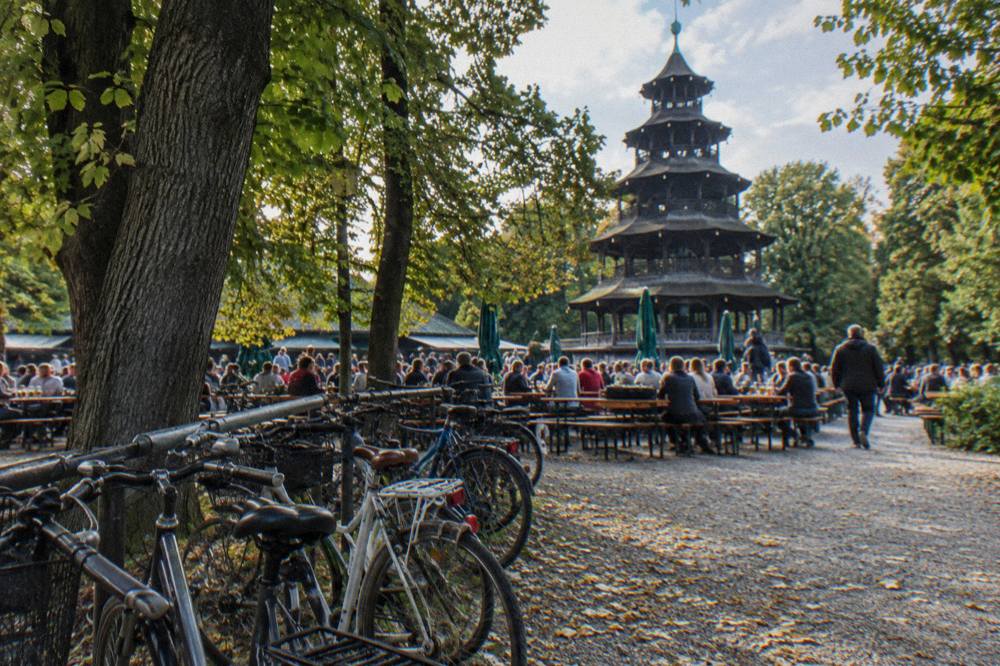
Yes, because beer gardens are the rest stop on most Munich bike routes, and they are weather-dependent rather than calendar-fixed: the Chinese Tower garden opens at 11:00 on dry weekdays from spring through autumn, while at cold or uncertain weather only its kiosk runs from 12:00. The season effectively runs May to early October.
The big gardens publish their patterns plainly. The Chinese Tower beer garden in the English Garden, about 7,000 seats at the foot of the 25 m tower designed in 1789, opens Monday to Friday from 11:00 and weekends from 10:00 in proper beer garden weather, with a brass band on Wednesday from 16:00, Friday from 15:00, Saturday from 14:00 and Sunday from 12:00. The Seehaus on the lake runs Monday to Friday 12:00 to 24:00 and weekends from 11:30. The Hofbräukeller on the Wiener Platz is open daily 12:00 to 22:00.
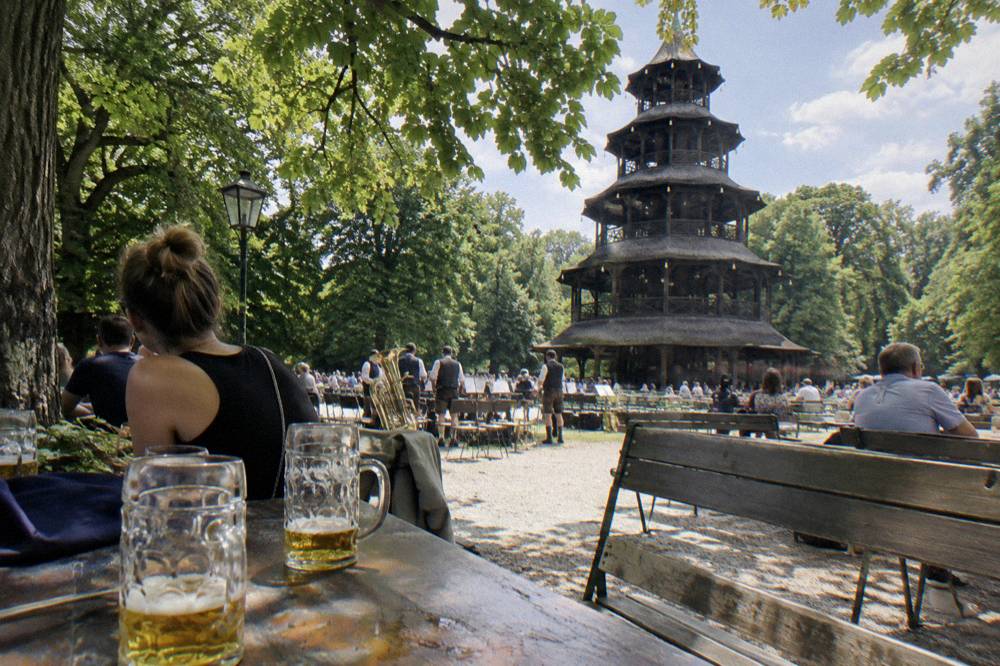
Two of these gardens sit directly on classic riding routes. The Chinese Tower sits mid-way through the English Garden loop, and the Hirschgarten, about 8,000 seats and the largest in Bavaria, sits on the Nymphenburg canal route about 16 km from Olympiapark via the canals. A ride that ends at a garden that is actually open beats a ride that ends at a shuttered kiosk, so timing matters. More detail on routes is in the beer gardens by bike guide.
| Beer garden | Seats (approx.) | Typical opening | Notes for cyclists |
|---|---|---|---|
| Hirschgarten | 8,000 | ~11:30-24:00 in good weather | Largest in Bavaria, on the canal route |
| Chinese Tower | 7,000 | Mon-Fri 11:00, Sat-Sun 10:00 in dry weather | Mid English Garden, brass band days |
| Augustiner-Keller | 5,000 | ~11:00-24:00 self-service in fine weather | Near the Hauptbahnhof side |
| Seehaus | garden on the lake | Mon-Fri 12:00-24:00, weekends 11:30 | Northern English Garden |
| Hofbraukeller | Wiener Platz | Daily 12:00-22:00 | Haidhausen, near the Isar |
One genuinely local rule: in a true beer garden you may bring your own food, the Brotzeit, and buy only the beer. That is official city guidance, tied to a royal decree of 1812 that first allowed the breweries to serve bread-time guests. It makes the garden stop cheaper and faster than a restaurant lunch, which is exactly what a group on a timed ride wants. Beer prices themselves vary and change; treat the menu at the counter as the source.
The listing for the tour with a beer garden break describes the stop as a pause rather than a full meal, so check the booking page for whether food is at your own expense. In shoulder months, when garden service is patchy, the operator may substitute a café stop; that is a weather call made on the day, not a downgrade.
A note on the drink itself: one Mass is a full litre, and alcohol plus traffic is a poor mix on a bike. Munich law treats riding unfit as a criminal offence, and the safest planning rule on any tour day is to make the garden stop the last one before the short ride to the end point. The drinking and riding question has its own full treatment.
How Does Oktoberfest Change A Ride?
Oktoberfest compresses about 7.4 million visitors into sixteen days, running 19 September to 4 October in 2026 and 18 September to 3 October in 2027, all on the Theresienwiese. Central Munich stays rideable, but the festival perimeter, the U-Bahn and the main station area get dense, and some tours shift routes or times in that fortnight.
The dates matter for booking strategy. The 2027 edition runs 18 September to 3 October, so if you want festival and ride in one trip, book the tour for a weekday morning and the festival for the afternoon or evening. If you want neither the crowds nor the festival, the weeks immediately after the first Sunday of October are among the calmest, prettiest riding days of the Munich year. Browse all Munich bike tour guides on Bike Tours Munich.
For cyclists the festival's biggest effect is on transit. Bikes need a separate day ticket on the MVV, and U-Bahn carriage is blocked in weekday rush hours, which matters more when trains are packed with dirndls and lederhosen. The rules for taking a bike on S-Bahn and U-Bahn are covered in full in bikes on trains and S-Bahn in Munich. The official festival site publishes the current year's opening hours and dates.
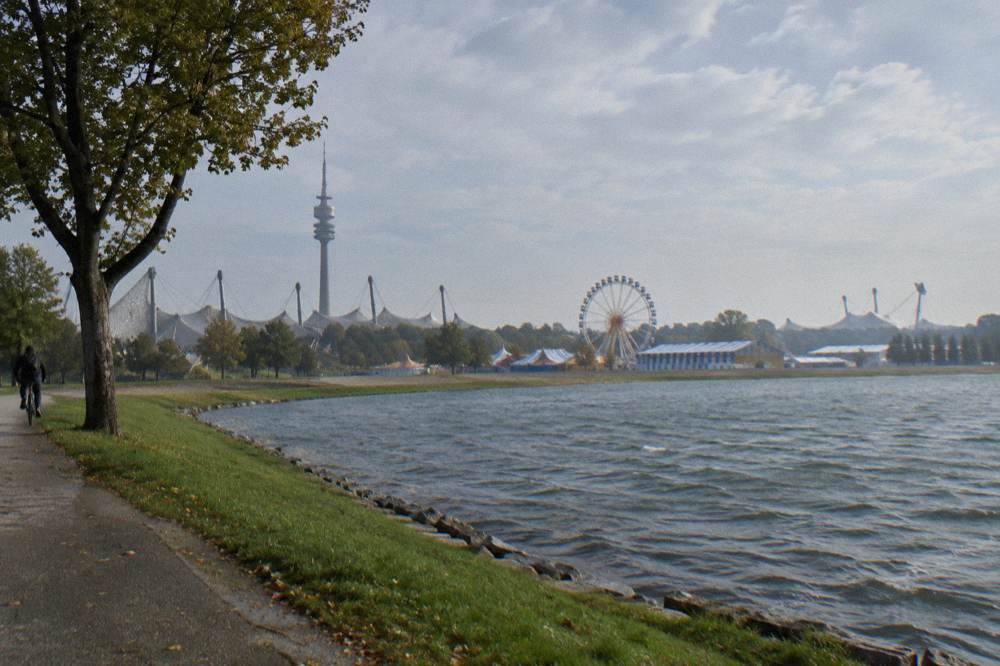
Ride-wise, the smart Oktoberfest-fortnight move is to point north. The English Garden, the Isar paths and Olympiapark sit well away from the Theresienwiese and absorb festival-season visitors easily. The e-bike formats shine here: the Best of Munich Electric Bike Tour covers ground at a pace that keeps you ahead of pedestrian flow, and the full-day Isar e-bike ride leaves the city almost entirely, trading festival noise for alpine panoramas.
Families and cruise-ship day-trippers should simply avoid the first festival Saturday, traditionally the busiest single day of the Munich year. The same applies to the two Sundays. A tour booked for the middle Tuesday of the festival often has the city to itself in the morning before the tents open at midday.
Is Winter Cycling In Munich Realistic?
Yes, with adjustments: Munich's winter service clears all bike paths, including bicycle streets, from 3 cm of snow, with about 155 km of priority winter routes cleared within two hours and the rest within three, operating 02:00 to 22:00. January averages just 2 to 4 C highs and under five sunshine hours a day, so it is a short-ride season, not a lost one.
German law imposes no winter tyre obligation on bicycles, and studded tyres are permitted, unlike on cars. There is a practical escape clause too: if a signed bike path is uncleared or ungritted, cyclists may ride on the road instead. The city's own guidance, published by the cycling advocacy community, sets out these winter riding rules clearly.
Tours keep running in winter, though the format narrows. The shorter options make more sense in December's roughly 8.4 to 8.8 hours of daylight: the 2-hour private highlights ride with a licensed guide fits entirely inside the bright window, and the 3-hour half-day tour with a local guide leaves margin for a warm stop. The Munich in winter on a bike guide covers the season in depth.
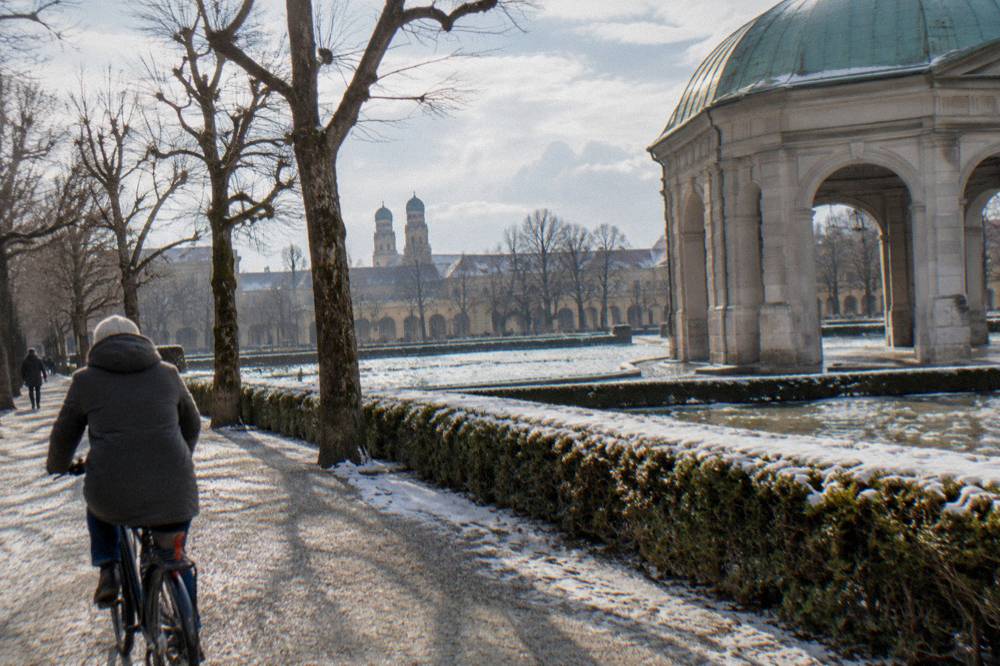
Winter also brings the Christmas calendar, which turns evening rides into market crawls. The Christkindlmarkt on the Marienplatz runs 20 November to 24 December in 2026, Monday to Saturday 10:00 to 21:00 and Sundays to 20:00. Tollwood on the Theresienwiese follows from 24 November to 23 December, with free market access. Neither is a cycling event, but both sit at the end of a short ride and both serve hot food, which in January is the point of leaving the hotel.
The honest winter caveat is ice, not cold. Fresh snow gets cleared fast; a refrozen melt at 07:00 does not. Morning departures after a thaw-freeze cycle deserve extra caution on bridges and canal paths, where black ice lingers. If a booking page offers a weather-dependent cancellation or a reschedule, read that clause before a December booking rather than after.
What About Spring And The Shoulder Months?
Spring runs late in Munich: March is still winter-cold, April turns variable, and by mid-May the beer gardens, the Eisbach surfers and the tour calendar are all fully back. The Frühlingsfest, 17 April to 10 May on the Theresienwiese in 2026 for its 60th edition, marks the psychological start of the outdoor season, though May remains the wettest month of the year.
April is the gambler's month. It can deliver 20 C afternoons or sleet, sometimes in the same week, and the gardens open only on the days that behave. What April reliably offers is emptiness: the English Garden's 78 km of paths carry a fraction of July's traffic, and the chestnuts along the canal avenues flower late in the month. Riders who pack layers and accept a chance of rain get the city close to its best ratio of beauty to crowds.
The Eisbach wave is a useful spring marker. Surfing there reopened on 8 May 2026 under an amended general decree, with a mandatory self-releasing leash, a ban from 22:00, and posted signs to follow; watching the surfers from the bank is free, and it is one of the stops several city tours point toward. The full story is in Eisbach wave and surfers.
| Season | Character | Best tour fit | Main drawback |
|---|---|---|---|
| Spring (Apr-May) | Fresh, empty paths, Frühlingsfest | 3.5-hour classic city tour | May rain, cool starts |
| Summer (Jun-Aug) | Warm, long days, full beer garden season | 4-hour beer garden break tour | Heat, afternoon storms, crowds |
| Early autumn (Sep-Oct) | Golden light, festival peak then calm | Small-group morning classic | Oktoberfest crowds late Sep |
| Late autumn (Nov) | Grey, quiet, market season begins | 2-hour private highlights ride | Short days, closed gardens |
| Winter (Dec-Mar) | Cold, cleared paths, Christmas markets | Half-day tour with local guide | Ice, roughly 8.4 to 8.8 hours of daylight |
Late October and November are the underrated gap. The festival is gone, the trees along the Isar are at peak colour in October, and the first Christmas market opens in late November. The e-bike tours keep long rides feasible even as temperatures fall, since the motor takes the edge off cold-weather effort; the Isar full-day e-bike tour runs 5 hours and reaches toward the alpine foothills, which is exactly where the autumn light is best.
Does Rain Ever Cancel A Munich Bike Tour?
Rarely in absolute terms: operators run in light rain and supply or rent rain gear, and cancellation calls are made by the operator close to departure, not days ahead. What actually moves bookings is the free-cancellation window, typically up to 24 hours before, which lets you rebook a sodden morning onto a better afternoon or the next day.
The climate data supports a relaxed attitude. May, the wettest month, still averages only 16 to 17 rain days, and summer rain tends toward short convective bursts. A ride that starts grey often finishes bright, and Munich's flat terrain means rain does not compound into a safety problem the way it does in hillier cities. The English Garden's gravel paths drain quickly.
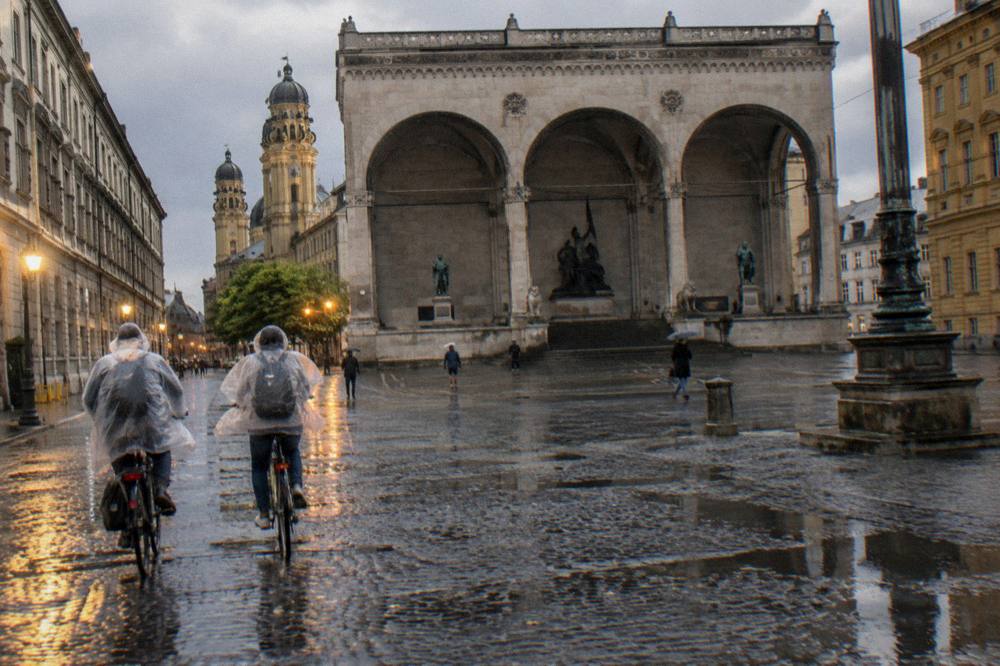
The one genuinely unpleasant combination is a cold rain in November or March, when there is no beer garden to dry out in and the compensations, markets and greenery, are absent. That is the fortnight-type where the private formats earn their premium: a private guide adjusts pace and stops to the weather in a way a shared departure cannot. Confirm what the listing says about weather cancellations and refunds before booking the shoulder edge.
Season by season, the decision mostly writes itself. Book May to early September for the safest combination of warmth, open gardens and daily departures; book the post-festival fortnight in October for calm and colour; book December for markets on a short private ride; and read the cancellation terms carefully in April and November, the two months the calendar gives you the least for free. Whatever the month, the booking page states the departure times and inclusions that match it.
For everything the weather does not decide, how much ground you want to cover does.
If your dates stretch across seasons, one more option earns a look: the 3-hour tour combining the English Garden, Olympiapark and Nymphenburg Palace packs three of the city's big open spaces into a single ride, which is the right shape for a crisp bright day in late October or April, when each stop is worth the kilometres but the daylight budget is tight.
Common Questions About Munich Weather By Month
What Is Munich Weather By Month?
July is the warmest month, averaging highs of 24 to 25 C; January the coldest at 2 to 4 C highs and minus 2 to minus 5 C lows. May is the wettest month at roughly 92 to 108 mm of rain, and daylight swings from about 11.7 sunshine hours a day in July to under 5 in January.
Which Month Is Best For A Munich Bike Tour?
Mid-May through early September is the safest choice: warm, beer gardens open, daily tour departures. June and September balance warmth against crowds best, except for the two Oktoberfest weeks from mid-September.
Does Oktoberfest Affect Bike Tours?
Yes, in the fortnight it runs. Oktoberfest 2027 is set for 18 September to 3 October, and the festival brings several million visitors to the Theresienwiese area. Tours still run, but expect denser traffic downtown and possibly adjusted routes; check the booking page for festival-period logistics.
When Do Munich Beer Gardens Open For The Season?
Beer gardens open by weather, not by date. In fine weather the Chinese Tower garden opens weekdays from 11:00 and weekends from 10:00, roughly May to early October; in cold or uncertain weather only its kiosk runs from 12:00.
Can You Bike In Munich In Winter?
Yes. The city clears all bike paths from 3 cm of snow, priority routes within two hours, and there is no winter tyre obligation for bikes. January limits you to roughly 8.4 to 8.8 hours of daylight, so short morning tours are the practical format.
Is May Too Rainy For A Munich Bike Tour?
May is the wettest month, averaging 16 to 17 rain days, but rain often comes in short bursts. A morning departure and a booking with free cancellation up to 24 hours before covers most of the risk.