Can You Drink Beer And Ride A Bike In Munich?
Beer garden stops are part of cycling culture in Munich. Here is what the law says. Here is what the law says, how guided tours handle beer garden stops, and how to plan a ride that ends well.
Yes, in the sense that beer garden stops are a normal, scheduled part of Munich cycling culture, and several guided tours build one into the route. No, in the sense that riding a bike while unfit through alcohol is a criminal offence in Germany. The workable plan: make the beer garden the last stop, then walk, take the S-Bahn, or hand the bike back before you drink. If your trip overlaps with the Wiesn, the guide to biking Munich during Oktoberfest covers how the festival changes cycling in the city and which guided rides still operate.
Munich is one of the few cities where this question is not hypothetical. The city's bike modal share sits at 21 percent of daily trips, the highest among German large cities, and the beer garden is a civic institution rather than a tourist trap. Put those two facts together and you get a genuine daily question for visitors: is the classic Munich day of cycling to a beer garden actually legal, sensible, or both?
The honest answer is that the culture and the law pull in slightly different directions. Nobody in Munich will look twice at a group of cyclists parked outside a beer garden with a bike lock through the frame and a litre mug on the table. That is the intended use of the city's 1,200 km signed cycling network, which includes green corridors along the Isar that lead almost directly to several of the largest gardens. What the culture does not do is change the legal position, and the legal position is stricter than many visitors assume. So the two halves of this article deal with the two halves of the question: what the law actually says, and how to structure a day, guided or self-planned, where the beer and the riding never mix.
If you want the guided version of this exact day, three rides in particular pair a city loop with a proper beer garden stop:
Each of these builds the stop into the schedule rather than leaving it to chance, which matters here for a reason that has nothing to do with comfort. A scheduled stop of an hour or more gives the group a real rest before the ride home, and the guide, not the rider, is the one watching the clock. Self-planned riders have to do that discipline themselves, and Munich's beer gardens are expert at making an hour feel like twenty minutes.
What Does German Law Actually Say About Cycling After Beer?
German law treats riding a bicycle while unfit through alcohol as a criminal offence, full stop, and it gives cyclists no relaxed threshold to lean on. The strict statutory drink-drive limits people often quote apply to motor vehicles, not bicycles, but that creates no loophole. The safe advice is not to ride after drinking at all, and to check the official police and ADFC guidance before your trip.
The detail that catches visitors out is the absence of a number. For motor vehicles, German law sets explicit limits, and those are what most people remember from home. For bicycles, the situation works differently: the offence is riding while unfit, and the courts assess unfitness rather than reading it off a breath test the way a driver might. That means there is no safe number of beers you can assign to a ride home, and any local who tells you otherwise is guessing.
The practical reading of all this, and the one Munich's own cycling culture follows, is sequencing. Beer gardens in Munich are destination rides: you cycle there while sober, you stay as long as you like, and then you do not cycle back. The city makes that easy. The S-Bahn and U-Bahn take bicycles outside rush hours with a bike day ticket, the English Garden and the Isar paths are pleasant to walk a bike along, and MyRadl share bikes can be returned at any of the roughly 1,000 stations and picked up again the next day. For the rules on taking a bike on the S-Bahn, see the guide to bikes on trains and S-Bahn in Munich, which covers the restricted hours and ticket requirements in full.
Official guidance is worth reading directly rather than relying on secondhand summaries, because the legal detail matters. The Bavarian police publish their position at polizei.bayern.de, and the German Cyclists' Association, the ADFC, covers the same ground for riders at its Munich pages. Both are more conservative than pub folklore, and both are the versions worth going by.
Which Guided Tours Pair Cycling With A Beer Garden Stop?
Three shared tours in the city-highlights family build a beer garden stop into the route: a 4-hour ride with a dedicated break, a 3.5-hour daily ride with a stop at 11.30 departures, and a morning ride finishing near surfers and a garden. All three are shared group rides on regular bikes, and all describe the stop as a break or lunch stop, so a guide manages the pace.
The reason guided tours are the tidy answer to this article's question is structural. A guide plans the stop at the point in the route where the group has earned a rest, keeps the visit to a defined length, and leads a gentle ride afterwards with the whole group's condition in mind. You are not finding your own way home after two litres, because you are following a guide at conversational pace through parks, and the ride back is part of the itinerary rather than an improvisation. For a fuller weighing of the two approaches, see rent a bike or take a guided tour in Munich.
The standout pick is the Munich Bike Tour with Beer Garden Break: a 4-hour shared classic-bike ride whose listing names the beer garden break as a defining feature of the day. The 4-hour length matters, because it means the stop is a real interval in the middle of the itinerary rather than a ten-minute photo pause, and the route is built so the calmest riding comes after it. Food and drinks at the beer garden stop are not included in the tour price. You pay separately for whatever you order, so bring some euros along for the break.
Is A Scheduled Stop Really Safer Than Riding To A Garden Alone?
A scheduled stop removes the two decisions that get self-planned riders into trouble: how long to stay and how to get home. On a guided ride, both answers are fixed before the first beer is poured, the guide sets the departure time, and the return route is planned for a group at rest pace. Riders heading out alone keep full freedom but also full responsibility for those calls.
That is not a legal distinction, it is a planning one, and it is the honest reason guided beer garden rides are popular with visitors. A group ride also spreads the navigation load: the guide watches for the cycle-path signage, the tram tracks and the bike streets, while the guests watch the scenery. Munich has 103 designated bicycle streets totalling about 47 km where cyclists have priority, and mixing those with car traffic is exactly the kind of task you want someone else handling while you digest a pretzel. The same logic applies once you leave the city behind, and if you fancy trading beer gardens for a lakeshore, our guide to cycling from Munich to Starnberger See by train covers the route, the best seasons and the guided e-bike alternatives.
If you would rather ride the classic city loop without the beer theme, the half-day local-guide ride covers the core sights in 3 hours and lets you find your own garden afterwards, on foot.
That format suits riders who want the beer garden to be entirely separate from the cycling, perhaps an evening visit to a garden near the hotel with no bike involved at all. It is the cleanest separation the law could ask for.
Where Do The Beer Garden Stops Actually Happen?
The gardens that Munich rides naturally empty into are the big ones inside or beside the parks: the Chinese Tower and Seehaus in the English Garden, the Hirschgarten west of the centre, and the Augustiner-Keller near the Hauptbahnhof. All are reachable on flat park paths, all are large enough that a tour group finds space without a reservation, and all follow the true beer garden rule that lets you bring your own food and buy only the beer.
That last rule deserves emphasis because visitors rarely know it. In a proper Munich beer garden, you may bring your own Brotzeit, bread, cheese, radishes, whatever you carried, and eat it at the tables while buying your beer from the kiosk, as the city's own guidance states. That matters for cyclists twice over: it makes the stop cheaper and lighter, and it makes the stop shorter if the group only wants one beer with its own snacks. A guide will usually point this out; solo riders can just do it.
| Beer garden | Where the ride takes you | Size and setting | Opening pattern |
|---|---|---|---|
| Chinese Tower (Chinesischer Turm) | Heart of the English Garden, on the park's path network | Around 7,000 seats at the foot of the 25 m tower, a design of 1789 | Weekdays from 11:00, weekends from 10:00 in beer garden weather |
| Seehaus | North end of the English Garden at the lake | Beer garden at the water, Mon to Fri 12:00 to 24:00, weekends from 11:30 | Open late, kitchen hours separate |
| Hirschgarten | West of the centre, reachable via the Nymphenburg canal corridors | About 8,000 seats, the largest in Bavaria, with deer enclosure beside it | Typically 11:30 to 24:00 in good weather |
| Augustiner-Keller | North of the Hauptbahnhof, minutes from the station | Around 5,000 seats under chestnut trees | Garden opens in fine weather, restaurant daily |
The Augustiner-Keller row is the one that should interest anyone planning their own sequencing, because its position next to the Hauptbahnhof and its S-Bahn links means you can end a ride there and take the train home with the bike, no riding after the beer required. That is the pattern the locals use, and it works exactly because the garden sits on top of the transit rather than at the end of a long car-free stretch.
For riders extending the beer garden theme into a full route, the guide to Munich beer gardens by bike strings the major gardens into a day plan. The operator of the Chinese Tower garden posts its own current hours and music schedule at chinaturm.de, worth a look because brass band afternoons change the character of the stop entirely.
How Do You Plan A Ride So The Beer Comes Last?
The pattern that works is: ride the sights first, reach the beer garden with the longest stretch of cycling already behind you, and treat the garden as the terminus of the ride rather than its midpoint. From there you walk the bike, hand it back at a rental or share station, or take the S-Bahn home with the bike day ticket outside the rush-hour blocks. Decide the ending before the first order.
Munich's geography cooperates with this plan. The classic visitor loop, Marienplatz up the Isar banks and back through the English Garden past the Eisbach surfer wave to the Chinese Tower, runs roughly 15 km and about two hours at touring pace, all of it on park paths where the only hazards are joggers and, in the designated zones, sunbathers. Doing that loop before the beer garden means the navigation-heavy city centre happens while you are fresh, and the after-beer leg, if any, is a flat park roll or a short walk.
The end-of-ride toolbox is bigger than most visitors expect:
| Way to end the ride | How it works | What to know |
|---|---|---|
| Walk the bike | English Garden and Isar paths are pleasant on foot | No ticket, no rules, unlimited time |
| S-Bahn or U-Bahn with the bike | Bike day ticket covers zones M to 12 until 6 a.m. next day | Blocked weekday 6 to 9 and 16 to 18 on the U-Bahn, 6 to 9 on the S-Bahn |
| MyRadl share bike | Return at any of about 1,000 stations across the region | Classic bikes EUR 1 per 30 minutes, day tariff EUR 9; e-bike EUR 3 per 30 minutes, EUR 18 day |
| Guided tour return | Guide leads the group back at rest pace | Timing and route fixed by the itinerary |
One detail from that table deserves a second mention because it is the single most useful fact in this article for beer-planning purposes: the MyRadl day tariff caps a classic bike at EUR 9 for 24 hours, so returning the bike at a station beside the beer garden and walking home costs nothing extra. You can even collect a different bike in the morning. The rental price landscape, including private shops near the station, is covered in the Munich bike rental prices guide.
For riders who want motor-assisted distance without any alcohol in the equation, the e-bike options are a separate family. The Best of Munich Electric Bike Tour covers the city over 4 hours on pedal-assist bikes, with no beer garden stop named in its listing, which makes it the choice for a morning when the beer garden is booked for later, on foot, in the evening.
What Else Should You Know Before Mixing Cycling, Beer And Munich?
Three things carry most of the weight: beer gardens are seasonal and weather-governed, so the outdoor experience you are picturing may be a kiosk in November; the true beer garden lets you bring food, which turns an expensive lunch into a cheap one; and the cycling rules that apply on the way there, bells, lights, cycle-path signs, apply exactly the same on the way back, which is one more argument for not riding back at all.
Weather decides more than the calendar. The big gardens open their full outdoor operations in dry, warm conditions and fall back to reduced kiosk service when it turns cold, so a ride planned around a long garden sit in shoulder season should check the garden's own page that morning. The city itself cycles year-round: the municipal winter service clears bike paths from 3 cm of snow, with the roughly 155 km of winter routes cleared within about two hours, so a winter visit loses the beer garden atmosphere but not the riding.
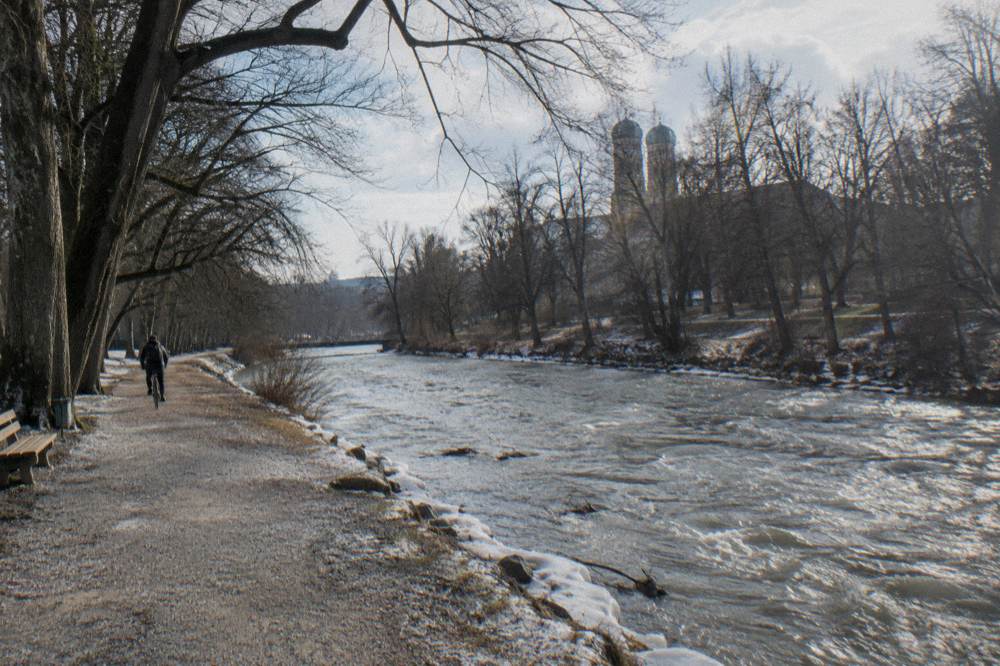
On the riding side, the rules are unfussy but real. Bikes must carry a bell and prescribed lighting for darkness; cyclists use signed cycle paths where the blue signs order it; and children up to 8 ride on the pavement. If a beer garden lunch stretches into dusk, the lighting point stops being theoretical. The full rule set for visitors, including pavement and pedestrian-zone details, is in cycling rules for visitors in Munich, and the law text itself is published at gesetze-im-internet.de.
Finally, the cultural framing. Munich does not treat the beer garden stop as a compromise between hedonism and exercise; it treats it as the point of the ride. The gardens exist because the city has always cycled to them, sat down, and cycled home hours later with the day's riding behind them. A visitor who copies that sequence, ride first, beer last, transit home, gets the authentic version of the day and stays on the right side of the law without ever having to think about a number.
If a guided version of that day appeals, these three rides each build the beer garden into the itinerary:
Common Questions About Drinking Beer And Cycling In Munich
Can You Drink Beer And Ride A Bike In Munich?
Culturally, one beer at a scheduled beer garden stop is a normal part of Munich cycling, and guided tours build such stops into their routes. Legally, riding a bike while unfit through alcohol is a criminal offence in Germany, so the safe plan is to make the beer garden the last stop of the ride and walk, take the S-Bahn, or return a share bike afterwards.
Is Cycling To A Beer Garden A Good Idea?
The classic pairing works when the order is right: cycle to the garden sober, drink there, and do not cycle afterwards. Munich makes the ending easy with bike-friendly S-Bahn and U-Bahn outside rush hours, MyRadl stations beside most big gardens, and flat park paths that are pleasant to walk a bike along.
Do Guided Munich Bike Tours Include A Beer Garden Stop?
Several do, including a 4-hour ride with a dedicated beer garden break, a 3.5-hour daily city ride with a stop, and a morning classic tour finishing near the surfers and a garden. The stop is part of the itinerary, with the guide setting the departure time and an easy pace afterwards.
Can You Bring Your Own Food To A Munich Beer Garden?
Yes. In true beer gardens you may bring your own Brotzeit and buy only the beer, a rule the city states openly and one that dates back to a decree of 1812. It makes a cycling lunch stop cheaper, lighter and quicker.
How Do You Get Home From A Beer Garden Without Riding?
Walk the bike along the park paths, return a MyRadl share bike at any of the roughly 1,000 stations, or take the S-Bahn or U-Bahn with a bike day ticket outside the weekday rush-hour blocks. The Augustiner-Keller, next to the Hauptbahnhof, is purpose-built for this pattern.
Are Beer Gardens Open All Year?
The outdoor gardens are weather-governed: full service in dry, warm conditions, and reduced kiosk service in cold or uncertain weather. Riding stays possible year-round, since the city clears bike paths from 3 cm of snow, but the long outdoor sit is a fair-weather pleasure.