What Should You Not Miss In Munich?
The sights and experiences first-time visitors to Munich should not miss, from Marienplatz and the Viktualienmarkt to the English Garden, the Eisbach wave, Nymphenburg and the beer gardens, with a guided ride that links them.
The short list is Marienplatz and the old town core, the Viktualienmarkt, the English Garden with the Eisbach surfers, Nymphenburg Palace, and at least one true beer garden. Munich is flat and compact, and its bike modal share of 21 percent of daily trips is the highest of any German large city, so a great deal of this list sits comfortably within one or two rides. Even better, many of these stops cost nothing, and our guide to the free side of Munich shows how to fill an entire day without spending anything.
That figure comes from the city's own mobility reporting in late 2025, and it shapes what a first visit can realistically cover. The distances that look spread out on a map are short in the saddle. The old town, the park and the palace belt around it are linked by 1,200 km of signed cycle routes in the Münchner Radlnetz, including radial routes that start at Marienplatz itself.
One honest framing before the list: Munich rewards depth over breadth. You could sprint between two dozen sights in three days and remember none of them. The five sections below, old town, market, park, palace and beer garden, each can fill an hour or a full afternoon, and each has a free public side as well as a paid one.
The first is the classic shared city ride at 3.5 hours. The third is another shared classic at 3 hours with a local guide. Prices, meeting points and what is included sit on each booking page, so check those before committing; the listing describes each one in full.
Marienplatz, Viktualienmarkt And The Old Town Core
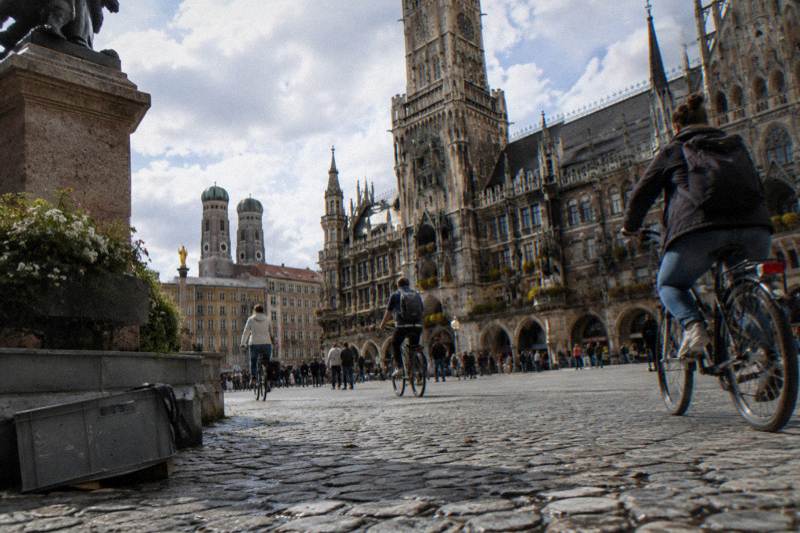
Start at Marienplatz, the city's central square, then walk five minutes to the Viktualienmarkt for its food stalls, and work outward to the Feldherrnhalle, the Residenz and Königsplatz. The square's New Town Hall and its glockenspiel anchor every first visit, and the market gives the old town its daily pulse. Both cost nothing to see.
Marienplatz is the fixed point of the city, the place every metro line and every footpath seems to lead back to, and the natural meeting spot for guided rides through the centre. The surrounding pedestrian zone holds the Old Town Hall, the tower of St. Peter if you want stairs, and a dense web of lanes that open onto smaller squares most visitors never reach. Cycling in the Altstadt pedestrian zone is restricted: the city permits bikes there only between 21:00 and 9:00, and in Sendlinger Straße on the same night hours, so treat the core as walk-first territory and ride its edges.
The Viktualienmarkt sits one block south. Regulations set minimum selling hours of 10:00 to 18:00 Monday to Friday from April to October, an hour earlier in the winter half, and 10:00 to 15:00 on Saturdays, though individual stalls choose their own hours within that and most of the market rests on Sundays. Come for the bread, cheese, fruit and the beer fountain of sorts at its centre, the maypole, and the standing snack culture around it.
Two honest notes for 2026 and beyond. The Feldherrnhalle on Odeonsplatz is in the middle of a major renovation, scaffolding and all, with work that began in spring 2025 expected to run about three years, so you will see it partly wrapped. And Königsplatz, five minutes north on the bike, pairs the Glyptothek with the NS-Dokumentationszentrum, which is free to enter, open Tuesday to Sunday, and runs a free English-language guided tour of its Munich and National Socialism exhibition every Sunday at 13:00 with no registration. Our companion piece on Munich's darker history by bike covers that ground with the seriousness it deserves.
| Old town stop | What it is | Cost to see | Note for 2026 |
|---|---|---|---|
| Marienplatz and New Town Hall | Central square, glockenspiel | Free | Pedestrian zone, bikes only 21:00 to 9:00 |
| Viktualienmarkt | Daily food market | Free to browse | Stalls Mon to Sat, closed most of Sunday |
| Feldherrnhalle | Loggia on Odeonsplatz | Free to view externally | Renovation to about 2028 |
| NS-Dokumentationszentrum | Documentation centre on the Nazi era | Free entry | Free English tour Sundays 13:00 |
| Residenz | Former royal palace and treasury | Paid, under-18s free | Hours shift summer to winter |
The English Garden And The Eisbach Wave
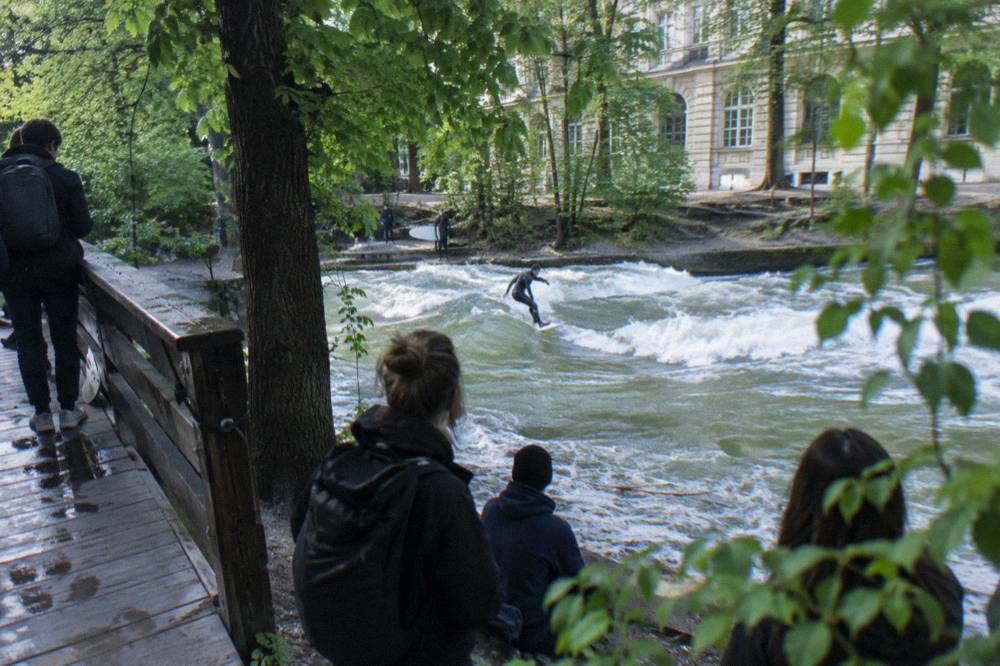
Do not miss the English Garden, Munich's 376-hectare central park, free to enter and open year-round, with 78 km of paths shared by cyclists and joggers. At its southern tip the Eisbach canal sends surfers across a standing wave that reopened for surfing on 8 May 2026 under an amended city decree. Watch from the bank; the water is closed to swimmers.
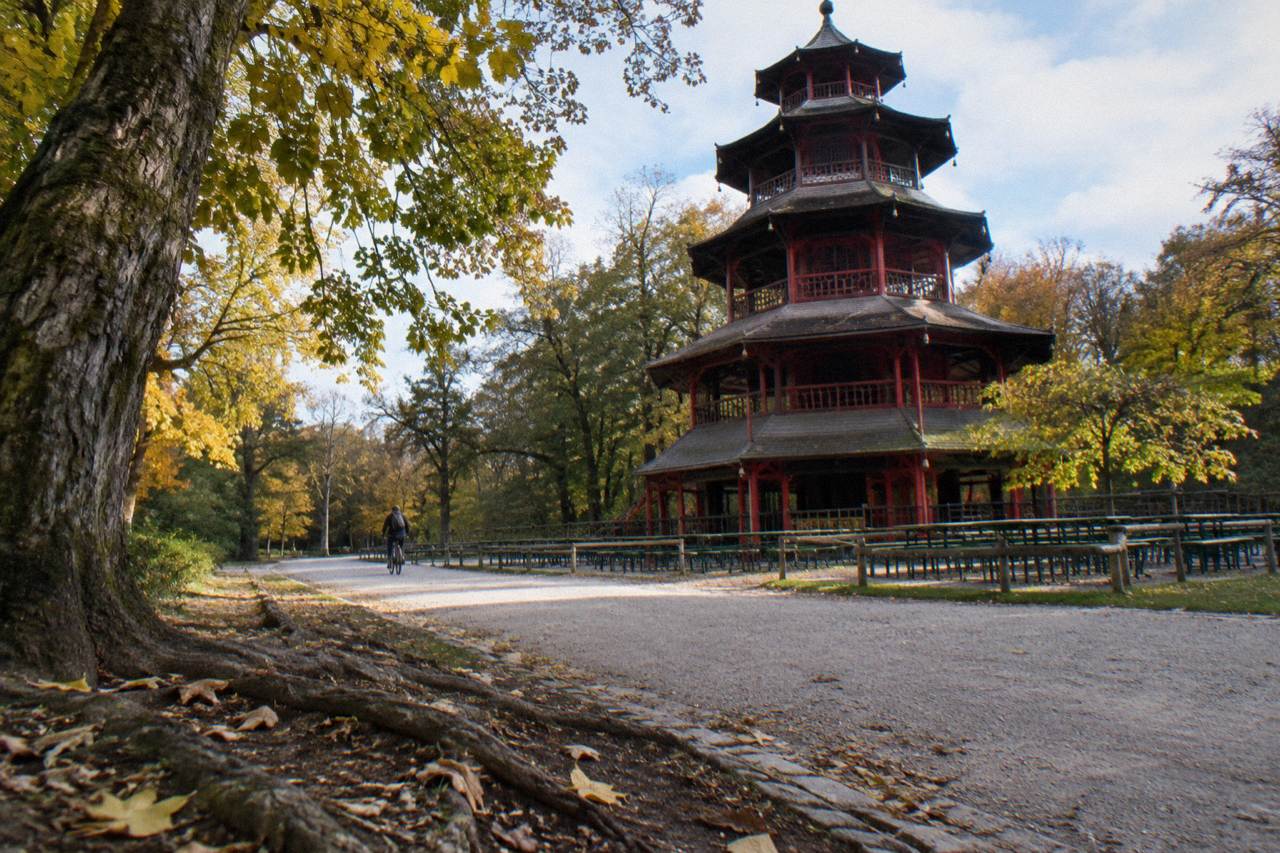
The park is larger than New York's Central Park and costs nothing, which is why locals treat it as an extension of the city rather than a sight. The Chinese Tower, a 25-metre wooden structure on a design of 1789, stands at its heart with a beer garden of roughly 7,000 seats at its foot, the second largest in the city. Further north, the Seehaus beer garden sits on the Kleinhesseloher See. Both are covered in detail in our guide to beer gardens by bike; here it is enough to say the tower's garden opens at Biergarten weather, Monday to Friday from 11:00 and weekends from 10:00, while the Seehaus runs 12:00 to 24:00 on weekdays and from 11:30 on weekends and holidays.
The Eisbach wave is the park's strangest and most famous sight. Surfing is permitted again under the amended general decree, with a mandatory self-releasing leash, a ban from 22:00, and a requirement to follow the signs posted at the bank. Riding the wave is for experienced surfers at their own risk; everyone else gets the better deal, watching from the bridge and the bank a few steps from Haus der Kunst. Swimming in the Eisbach itself is prohibited and the city warns it is life-threatening. Our page on the Eisbach wave and its surfers goes deeper.
Two park rules matter to cyclists. Barbecues, open fires and camping are all prohibited, dogs must stay leashed, and there are designated nude sunbathing zones at the Schönfeldwiese and the Schwabinger Bucht, none of which affects the main riding routes but all of which surprises first-time visitors. The park's paths are shared, so the etiquette is plain caution: the city's traffic law puts mutual consideration first, and bikes may ride side by side only when they do not obstruct others.
The official city tour of the park by bike, published by the tourist board, runs about 15 km and about 2 hours from Marienplatz, following the Isar downstream and looping through the garden to Aumeister and back. If you would rather have someone else lead it, the English Garden, Olympiapark and Nymphenburg ride covers the park as one third of a 3-hour guided loop; the booking page lists what is included and where it starts.
Nymphenburg Palace And The Canal Side
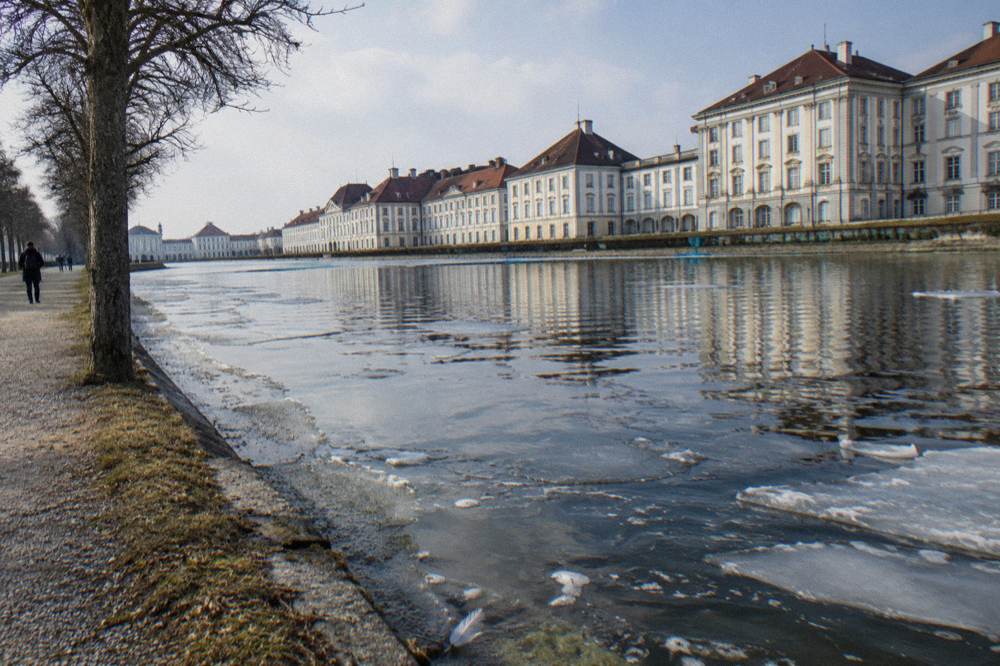
Nymphenburg Palace is the unmissable royal sight, a baroque summer residence west of the centre whose park canals make a fine bike corridor. A combined ticket covers the palace and its museums at EUR 20 in summer and EUR 16 in winter, and the park fountains run from Easter to mid-October, daily in late morning and mid-afternoon slots.
The palace opens daily 9:00 to 18:00 from April to 15 October and 10:00 to 16:00 through the winter half, with last admission 30 minutes before closing. One interior note from the palace administration: the Lacquer Cabinet, room 13, is closed for restoration until the end of 2027, while the other state rooms are open without restriction. The interiors are ticketed, as our overview of Nymphenburg by bike explains in detail, but the approach itself is free and lovely: the Nymphenburg and Biedersteiner canals carry a documented waterside route of 10 km one-way to Blutenburg, or 16 km out to the Hirschgarten.
That Hirschgarten deserves its line here, since it is the largest beer garden in Munich and Bavaria at around 8,000 seats, with a deer enclosure beside the tables that makes it a favourite with families. It pairs naturally with a palace visit, both sitting on the city's western green corridor.
The guided option that reaches Nymphenburg by bike is the 3-hour English Garden, Olympiapark and Nymphenburg ride, which strings all three big green and royal sights into one loop. Check the booking page for its meeting point and inclusions.
One closure to plan around: the Olympic Stadium itself has been closed to visitors since September 2025 for a renovation expected to last two to three years, though the wider Olympiapark grounds, its paths and the Olympiaberg viewpoint remain accessible. Our Olympiapark by bike page covers what still works there.
Beer Gardens, Museums And The Kunstareal
Beyond the headline sights, do not miss a true beer garden, where bringing your own food is part of the custom, and at least one museum. In a genuine beer garden you may bring your own Brotzeit and buy only the beer, a tradition the city traces back to a royal decree of 1812, and the Kunstareal district packs the Glyptothek, Lenbachhaus and more within a short walk of Königsplatz.
The Brotzeit rule is the detail most visitors miss. In a real beer garden, the self-service area under the chestnuts, you can spread your own bread, cheese and radishes on the tables and buy the beer by the litre Maß from the counter. That is what separates a true Biergarten from a restaurant with outdoor tables, and muenchen.de states the rule plainly for the city's genuine gardens. Exact Maß prices vary and are not printed on official pages, so expect to pay at the counter and check the board.
The museum district rewards a half day. The Glyptothek opens Tuesday to Sunday, 10:00 to 17:00 and until 20:00 on Thursdays, with a combined ticket with the Antikensammlungen at EUR 6 regular and Sundays costing EUR 1 per museum. The Lenbachhaus, ten minutes south, opens the same Tuesday-to-Sunday pattern at EUR 10, with free entry on the first Thursday of the month from 18:00 to 22:00. Haus der Kunst at the park's edge runs late, Wednesday to Monday 10:00 to 20:00, and is free the last Friday of the month in the evening.
For December visitors, the Christkindlmarkt on Marienplatz runs 20 November to 24 December 2026, Monday to Saturday 10:00 to 21:00 and Sundays to 20:00, opening earlier than in past years. The winter riding conditions, cleared bike paths from 3 cm of snow and the right to use the road when a signed path is uncleared, are covered in our Munich in winter on a bike guide.
How A Guided Ride Ties The List Together
**A guided bike ride is the efficient way to convert this list into one morning: the classic shared city tour runs 3.5 hours and covers the city-highlights set, while a 3-hour half-day version with a local guide adds the storytelling. Between them and the green-and-royal loop, the old town, park, palace and beer garden all get their moment.
The value is orientation first, sights second. On a first day, a guided loop teaches you the geography, which bridges matter, where the pedestrian zone starts, and how the Isar splits the city, so every self-guided ride after it is easier. The Munich: 3-Hour Guided Bike Tour fits the classic format: a shared group ride, with the price, meeting point and inclusions set out on the live booking page. Our wider comparison of renting versus taking a guided tour weighs when each makes sense.
For riders who want the guide but not the group, there are also private options in the city-highlights family, and our family riding guide covers what changes with children aboard. The half-day tour with a local guide below is the lower-commitment shared option at 3 hours.
Booking practicalities are simple across all of these. Prices are per person on the shared rides, on the listing rather than printed here, and the booking page states what is included, from the bike to any beer garden stop, along with the meeting point. Weather is the one variable no listing can promise away: rides in the Munich style generally run in light rain and stop for storms, but check the operator's policy on the day.
Prefer to set off on your own loop first? Our route guides here on Bike Tours Munich cover every area on this list. For a longer primer, the official tourist board maps an English Garden loop of about 15 km starting from Marienplatz at munich.travel. The park's own rules, from leashed dogs to the fire ban, sit on the city's English Garden page, and the palace's tickets and hours on the palace administration's site.
Common Questions About Munich
What Should You Not Miss In Munich?
Marienplatz and the old town, the Viktualienmarkt, the English Garden with the Eisbach surfers, Nymphenburg Palace, and at least one true beer garden. A 3.5-hour guided bike ride covers the city-highlights set and links most of these in one loop.
What Should I Not Miss In Munich If I Only Have One Day?
Walk the old town and market in the morning, ride or stroll the English Garden to the Chinese Tower in the afternoon, and end at a beer garden such as the Chinese Tower, Seehaus or Hirschgarten. If time allows, add the Eisbach wave on the park's southern edge, five minutes from Haus der Kunst.
Is The English Garden Worth Visiting?
Yes. It is free, open year-round, larger than Central Park at 376 hectares, and holds the Eisbach wave, the Chinese Tower and two major beer gardens within walking and riding distance. Cyclists share its 78 km of paths with joggers.
Can You Watch Surfers On The Eisbach Wave?
Yes, from the bank and the bridge beside Haus der Kunst, and it costs nothing. Surfing itself reopened on 8 May 2026 under an amended decree requiring a self-releasing leash and banning surfing from 22:00. Swimming in the Eisbach is prohibited.
Do You Need Tickets For Nymphenburg Palace?
The interiors are ticketed, EUR 20 in summer and EUR 16 in winter for the combined Nymphenburg ticket, while the park and canal approach are free. The Lacquer Cabinet is closed for restoration until the end of 2027.
Is Munich Good For Seeing Sights By Bike?
Very. The city is flat and compact, has the highest bike modal share of any German large city at 21 percent, and a signed network of 1,200 km. Guided shared rides of 3 to 3.5 hours cover the city-highlights set, and several longer loops add the big parks and palaces.