Is The English Garden Free?
Yes, the English Garden in Munich is free to enter and open year round. Here is what actually costs money inside the park, and how a guided bike ride fits in.
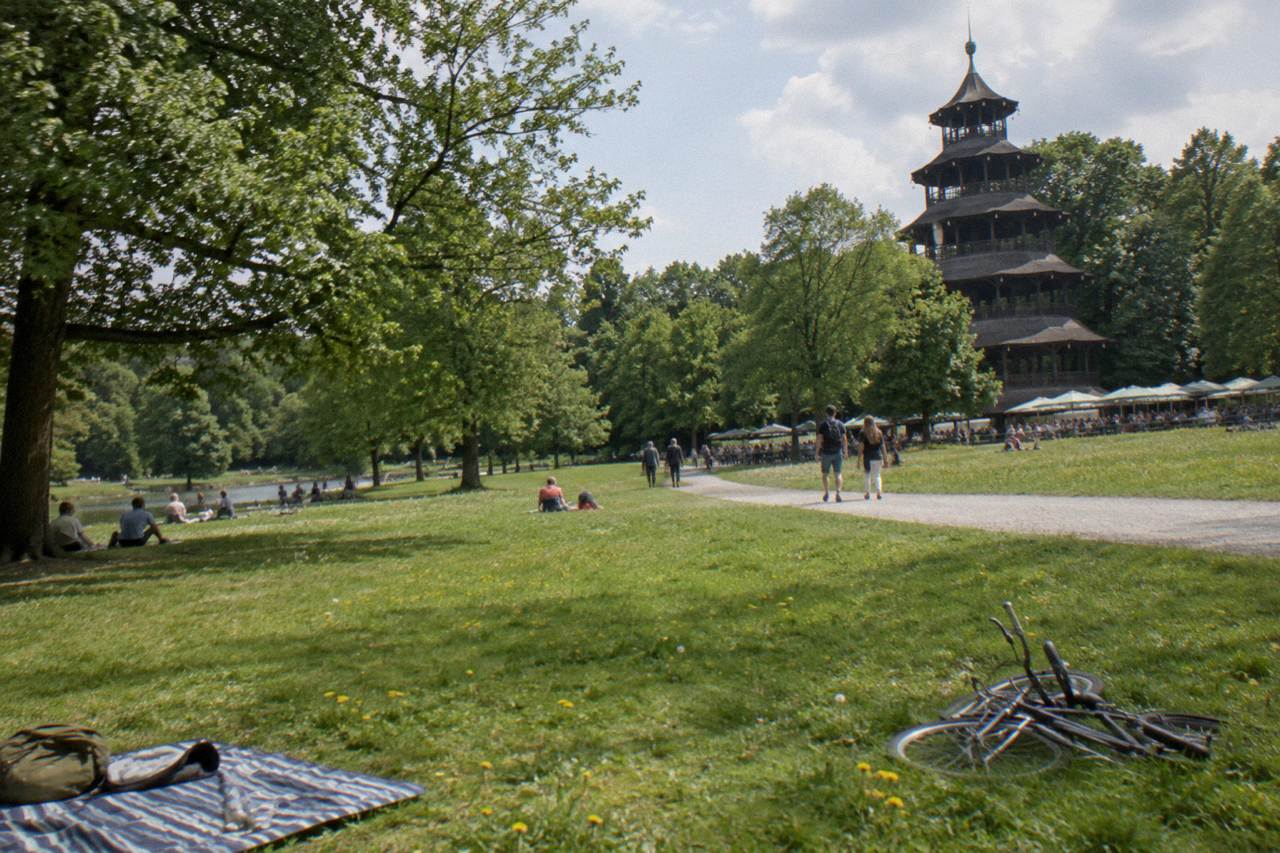
Yes, the English Garden in Munich is completely free to enter. The park is open year round with no gate, no ticket booth and no closing time, and it covers 376 hectares along the Isar. Every path, meadow and viewpoint inside costs nothing. The only money you will spend is on the beer gardens, bike hire or a guided tour, all of which are optional and sit outside the park's own offer. If you hire a bike anyway, our Olympiapark by bike route guide shows how to ride there from the city centre and what you can still see now that the stadium has shut.
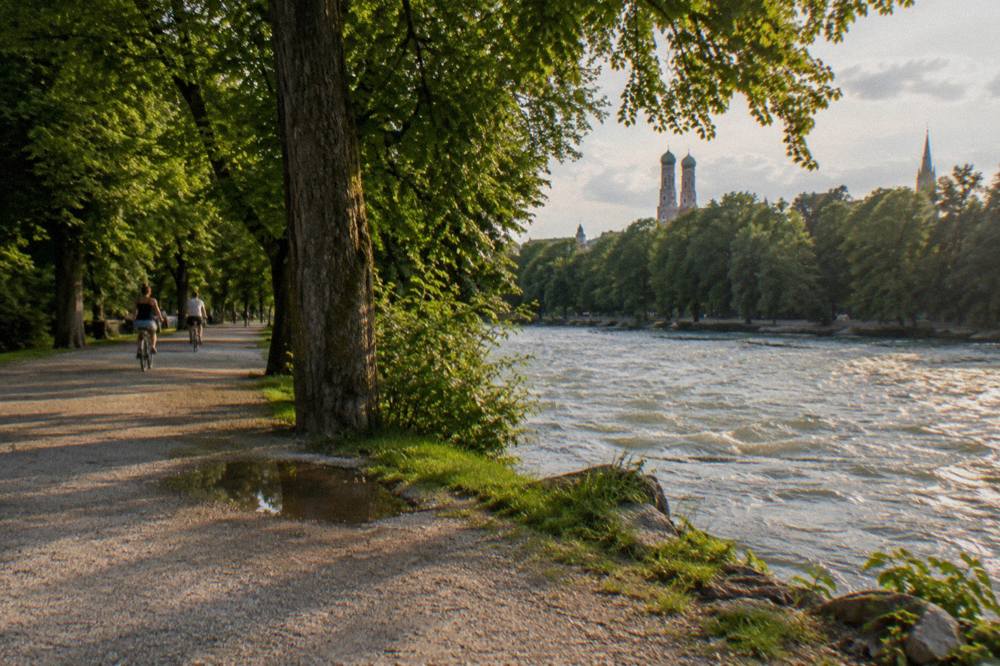
That answer surprises some first-time visitors because European parks sometimes carry a summer entry charge or a fee for the formal sections. The English Garden does not. It is a public landscape park created from a design of 1789, and the city and state keep it open to everyone, every day of the year, at no cost. You can walk in at dawn, spend the whole afternoon on a meadow, and walk out at midnight without paying a cent.
The scale matters as much as the price. At 376 hectares the park is one of the largest urban green spaces in the world, stretching from the very edge of the Altstadt up to the northern city limits. That size is why so many people experience it by bike rather than on foot: the walk from the Eisbach wave at the southern end to the Aumeister at the northern end is a serious outing, while the same distance on a bicycle is a pleasant half hour. The park's layout, with long straight gravel avenues cut through forest and meadow, was made for exactly this kind of movement.
The practical question is therefore not whether entry costs money but where the optional spending sits. A family can have a full free day here, and many locals do exactly that every weekend. A visitor who wants a beer at the Chinese Tower, a rented bike under them or a guide in front of them will spend money, and the amounts are worth knowing before you go. The rest of this article breaks down each of those costs, what the park gives away for nothing, and how a guided ride fits into the picture. Since a rented bike is one of the easiest ways to cover the park from end to end, our guide to Munich's public bike share explains how the system works and what it costs.
| Item | Free or paid | What to expect |
|---|---|---|
| Park entry | Free | Open year round, no gate or ticket |
| Paths and meadows (78 km of paths) | Free | Cycling and walking allowed |
| Eisbach surf wave viewing | Free | Watch from the bank at no cost |
| Nude sunbathing zones | Free | Designated areas, no charge |
| Beer gardens | Paid | Food and drinks at operator prices |
| Bike hire (MyRadl) | Paid | Classic EUR 1 per 30 minutes, day tariff EUR 9 |
| Guided bike tour | Paid | Price on the booking page, bike typically included |
If a bike is part of your plan, three rides pair naturally with a park visit, and the comparison below is the fastest way to see which fits your day.
What Actually Costs Money Inside The Park?
Three spending categories exist inside or beside the English Garden: the beer gardens, bike hire and guided tours. Nothing else requires payment. The Chinese Tower beer garden, the Seehaus and the beer garden at the Aumeister end are independent operators with their own prices, and their opening hours depend on the weather. There is no entrance charge anywhere in the park itself, and no ticket price exists to print.
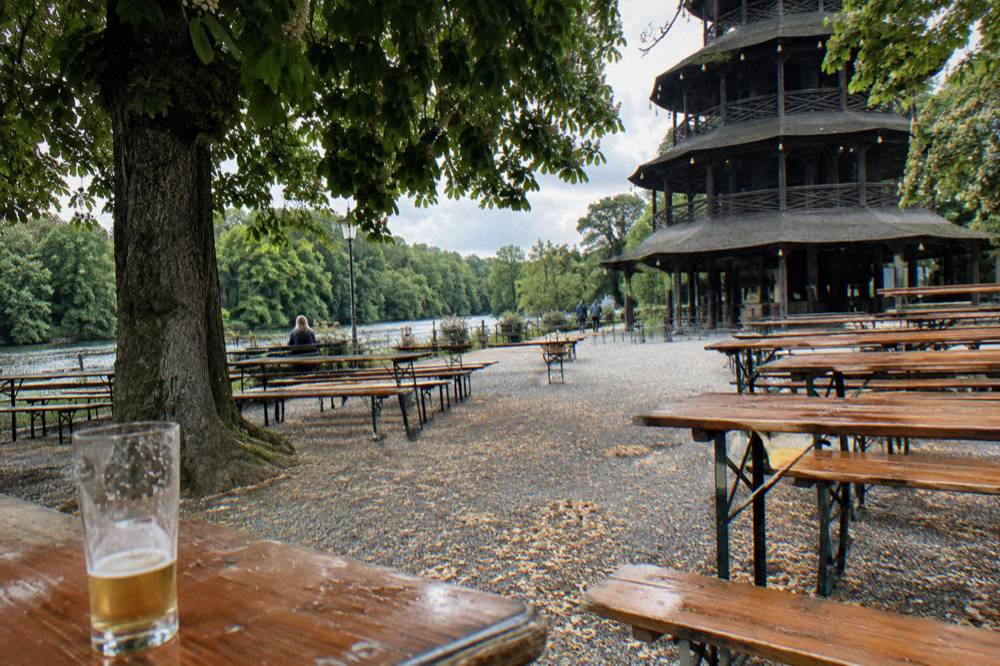
The beer gardens are the biggest draw and the biggest cost. The garden at the foot of the Chinese Tower, a 25 m tower built to a 1789 design, holds roughly 7,000 seats, making it the second largest in Munich after the Hirschgarten, which seats about 8,000. Its operator opens the garden Monday to Friday from 11:00 and weekends from 10:00 in good weather, with only a kiosk from 12:00 in colder or uncertain conditions. Brass bands play Wednesday from 16:00, Friday from 15:00, Saturday from 14:00 and Sunday from 12:00 when the weather cooperates. The Seehaus at the Kleinhesseloher See opens Monday to Friday from 12:00 to midnight and weekends from 11:30.
One genuinely money-saving rule deserves wider knowledge: in true Munich beer gardens you may bring your own food and eat it at a table while buying your drinks there. The city's own guidance on muenchen.de confirms the Brotzeit rule for proper beer gardens. So even the park's paid corner can shrink to the price of a drink if you plan ahead. Pick up bread, cheese and radishes at the Viktualienmarkt on your way north, and the most famous beer garden experience in the city costs you one glass. Visitors who prefer the full table service, or who want hot food from the kitchen, pay normal restaurant-level prices, which vary by operator and season.
Bike hire is the second cost, and it is smaller than many visitors expect. MyRadl, the public bike-share system that launched on 7 May 2026 and replaced the old MVG Rad scheme, runs classic bikes at EUR 1 per 30 minutes with a EUR 9 day tariff, and e-bikes at EUR 3 per 30 minutes with a EUR 18 day tariff. Holders of eligible transit subscriptions get the first 30 minutes free on a classic bike or for EUR 1.50 on an e-bike. The system is station-based, with about 1,000 stations planned across Munich and 36 surrounding municipalities, and registration is free through the MVV app. For the English Garden specifically, a day tariff classic bike at EUR 9 is usually the simplest option, because a full loop with beer garden stops easily runs past two hours. Our guide to Munich bike rental prices and pickup covers the full tariff picture, including private shops near the main station.
The third cost is a guided tour, and that is the one worth weighing carefully, because the free park plus a guide adds context that a map cannot. A guide also removes the small frictions of a self-planned day: where to enter, which path runs where, when the beer gardens fill up, and how to thread the garden together with other sights without backtracking.
Can You Cycle In The English Garden?
Yes, cycling is allowed in the English Garden, on the park's network of paths. The park offers around 78 km of paths shared between cyclists and joggers, and general park rules apply rather than any special cycling ban. Riders should stay on paths, keep clear of meadows and expect pedestrians everywhere, especially near the Chinese Tower and the Eisbach on busy afternoons.
The park is one of the most pleasant pieces of cycling terrain in the city precisely because it is car-free and huge. There are no traffic lights, no tram tracks and no intersections inside the park boundary, only gravel and tarmac avenues crossing open ground between tall trees. Munich's bike modal share of 21 percent of daily trips, the highest among German large cities, owes a great deal to corridors like this one. An official city tourism route starting at Marienplatz follows the Isar downstream, enters the garden and rides north to the Aumeister before returning, covering about 15 km in roughly 2 hours. That loop, described on munich.travel's English Garden tour page, is a good do-it-yourself template if you have your own bike or a MyRadl rental.
Riding with a guide instead changes what you get out of the same kilometrage. A guide threads the garden into the wider city story, points out the surfers, the monopteros viewpoint and the beer garden timing, and removes any navigation doubt. Guided rides also supply the bike itself, which matters for visitors who have not registered for MyRadl or who arrive without a transit subscription.
For visitors weighing the two approaches, our comparison of renting versus taking a guided tour in Munich breaks down the trade-offs in detail. The short version: solo riding suits confident cyclists with time, a guided ride suits anyone who wants the garden explained rather than just traversed. Families with children may find a guide especially useful, since the park's northern section is far less signposted than the south, and our page on Munich bike tours with kids covers the family angle in full.
Two rules matter for cyclists here. First, the park administration prohibits unnecessary use of meadows and woodland, so riding stays on the path network. Second, dogs must be leashed, which matters on shared paths where loose dogs and fast bikes mix badly. Neither rule affects the cost of anything, but both affect how welcome your ride feels.
What Can You See For Free Inside The Garden?
The free list is long: the Eisbach surf wave watched from the bank, the Monopteros hill viewpoint, the Kleinhesseloher See, 78 km of paths, the meadows and the designated nude sunbathing zones at Schönfeldwiese and Schwabinger Bucht. All of it costs nothing. The only hard rules from the park administration are no barbecues or open fires, no camping, no swimming in the Eisbach, and dogs must stay leashed.
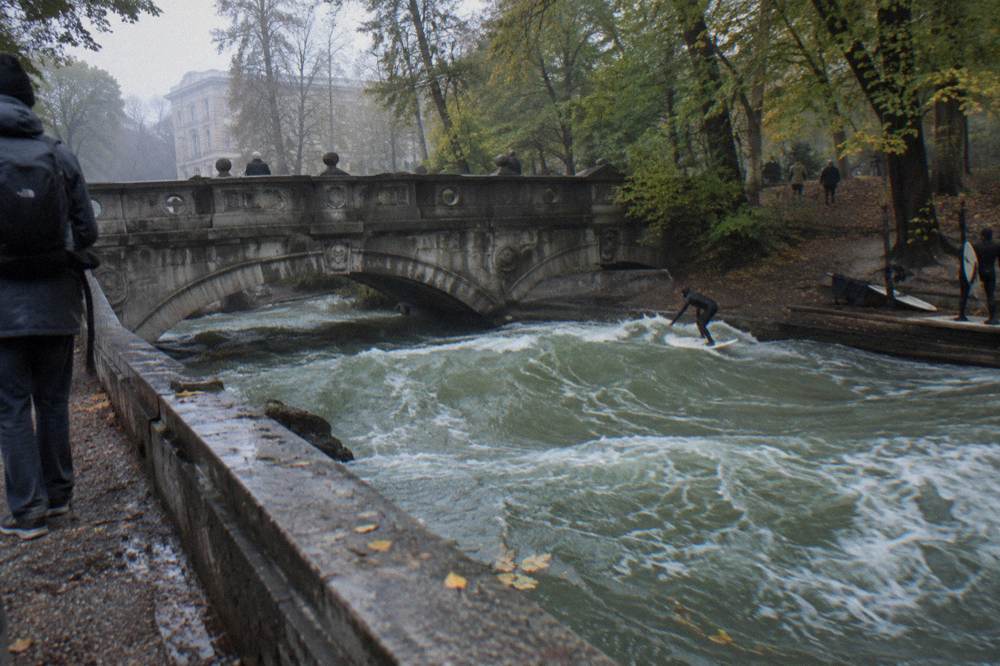
The Eisbach wave is the headline free spectacle. Standing on the Prinzregentenstraße bridge or the bank, you can watch experienced surfers ride the standing wave a few hundred metres from the opera house, and surfing itself is permitted again under an amended general decree from Lord Mayor Dominik Krause. Surfers at the Eisbach wave need a self-releasing leash, may not surf after 22:00, and should follow the posted signs. The wave runs continuously, so there is no schedule and no ticket; you simply stand there and watch, and on a warm evening a crowd always gathers. Our page on the Eisbach wave and its surfers goes deeper on the rules and the viewing spots.
The Monopteros, a small circular temple on an artificial hill in the park's southern half, gives the best free panorama over Munich's rooftops toward the Alps on clear days. The climb takes a few minutes from the main avenue, and the hillside below it is one of the park's most photographed meadows. Further north, the Kleinhesseloher See is a small lake with the Seehaus beer garden on its shore; walking or riding around the water costs nothing, and only the terrace beside it takes money.
The nude sunbathing zones are a Munich institution and fully free. The city's official page lists the two designated areas in the park, Schönfeldwiese behind the Haus der Kunst and the Schwabinger Bucht in the park's northern section. Nobody is required to undress; the zones simply formalise where it is accepted, and families regularly picnic on neighbouring lawns without incident. The tradition dates back generations in this park, and it surprises visitors from more reserved countries more than anything else here.
| Free sight | Where it sits | Notes |
|---|---|---|
| Eisbach surf wave | Southern edge near Prinzregentenstraße | Watch from the bank; leash rule applies to surfers |
| Monopteros viewpoint | Central-southern hill | Panorama over the rooftops |
| Kleinhesseloher See | Middle of the park | Seehaus beer garden beside it is paid |
| Schönfeldwiese | Behind Haus der Kunst | Designated nude sunbathing zone |
| Schwabinger Bucht | Northern park section | Second designated zone |
| Aumeister meadows | Northern end | Open grassland near a beer garden |
One caution worth repeating: swimming in the Eisbach is prohibited and the park administration describes it as life-threatening. The river channel looks calm in places and is not. The current is strong year round, the banks are stepped with stone, and the prohibition is posted. Swimming in the Isar itself outside the park is a separate matter governed by its own water-level rules, with a ban when the level exceeds 1.20 m at the Munich measuring point and swimming permitted only in seven designated sections.
When Is The Best Time To Visit?
May to September offers the most reliable park weather, with July the warmest month at average highs around 24 to 25 C. May is statistically the wettest month, at roughly 92 to 108 mm of rain over 16 to 17 rain days. Winter visits work too, because the park stays open and free year round; the trade-offs are bare trees, short daylight and beer gardens that close or shrink to kiosks in cold weather.
The beer garden calendar follows the thermometer rather than the calendar. The Chinese Tower garden opens its full operation only in dry, warm conditions, and in uncertain weather runs a kiosk from 12:00. That makes a warm weekday evening in June or July the classic English Garden experience: a ride up the paths, a beer under the chestnuts, and the wave on the way back south. Spring and autumn sit in between, with the gardens open on good days and the paths quieter than in high summer.
Winter has its own quiet appeal. Paths stay accessible, the city clears bike paths from 3 cm of snow, and winter routes of roughly 155 km are cleared within two hours, other paths within three. If a signed bike path is not cleared or gritted, cyclists may legally ride on the road instead, a rule the German cyclists' association confirms for winter riding. Frosty mornings in the park, with bare chestnuts and the wave still running, are a genuinely local experience that costs nothing. Our piece on Munich in winter on a bike covers the cold-season details, and our page on the best time for a Munich bike tour treats the seasons in depth.
Does A Guided Ride Change The Value?
A guided ride does not buy you access to anything paid, because nothing inside the park is ticketed. What it buys is interpretation, route design and logistics: a bike provided, a guide who times the beer garden stop, and a loop that links the garden to landmarks most visitors reach by metro. For the English Garden specifically, a guided ride compresses the park's full north-south length into one manageable outing.
The natural pairing is the English Garden, Olympic Park and Nymphenburg Palace by Bike tour, a three-hour shared ride that the operator lists as covering the garden plus two further landmark sites. Three sights of that spread in three hours would be ambitious by public transport, and the park alone would swallow most of the time on foot. Because the park itself is free, the tour price is entirely about the guide, the bike and the route, which is the honest way to evaluate it: check the booking page for the current price and meeting details.
The English Garden costs nothing to enter, and a good guided ride takes care of the rest of the day. The worst outcome is arriving uninformed, skipping the Eisbach wave or missing the beer garden timing. Whether you ride solo on a EUR 9 day-tariff bike or join a guide, the garden charges you nothing at the gate and gives you the whole park.
For another angle on the same question, our blog piece on whether the English Garden is worth visiting weighs the park against Munich's other sights, and our overview of what a Munich bike tour covers explains what a typical guided loop includes. Timing matters too, and the season-by-season look at the English Garden explains which months bring out the park's best side.
Common Questions About The English Garden
Is The English Garden Free?
Yes. Entry is free, the park is open year round and there is no gate, ticket or closing time. The only costs inside are optional: beer gardens, bike hire and guided tours.
English Garden In Munich
The English Garden is Munich's largest park, 376 hectares stretching along the Isar from the city centre to the northern edge, with 78 km of paths, the Chinese Tower, the Eisbach surf wave and several beer gardens.
Is The English Garden In Munich Worth Visiting
For most visitors, yes. It combines a free surf spectacle, wide car-free cycling paths, historic beer gardens and viewpoint hills in one space, and it costs nothing to enter.
Is The English Garden Worth Visiting In Winter?
The park stays open and free all year, and the city clears bike paths from 3 cm of snow. Expect bare trees, short daylight and reduced beer garden service, with the Chinese Tower running a kiosk only in cold weather.
Can You Bring Your Own Food To The Beer Gardens?
In true Munich beer gardens you may bring your own food and buy your drinks there, a custom documented on the city's own beer garden pages.
How Big Is The English Garden?
The park covers 376 hectares and holds roughly 78 km of paths shared by cyclists and joggers, running the full length of the Isar's eastern bank through the city.