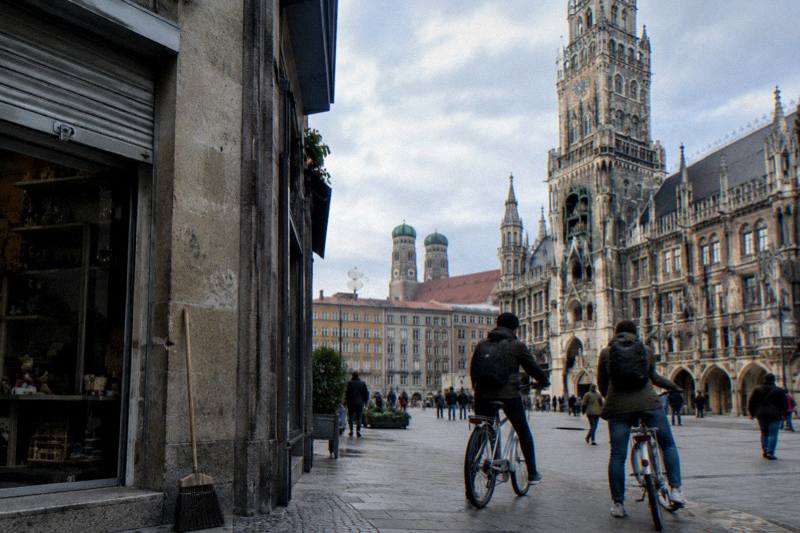
Why Is The Eisbachwelle Closed?
The Eisbachwelle is open again under an amended city decree, with a leash rule and a 22:00 cut-off. Here is what closed it, what the rules now say, and how to see the wave by bike.
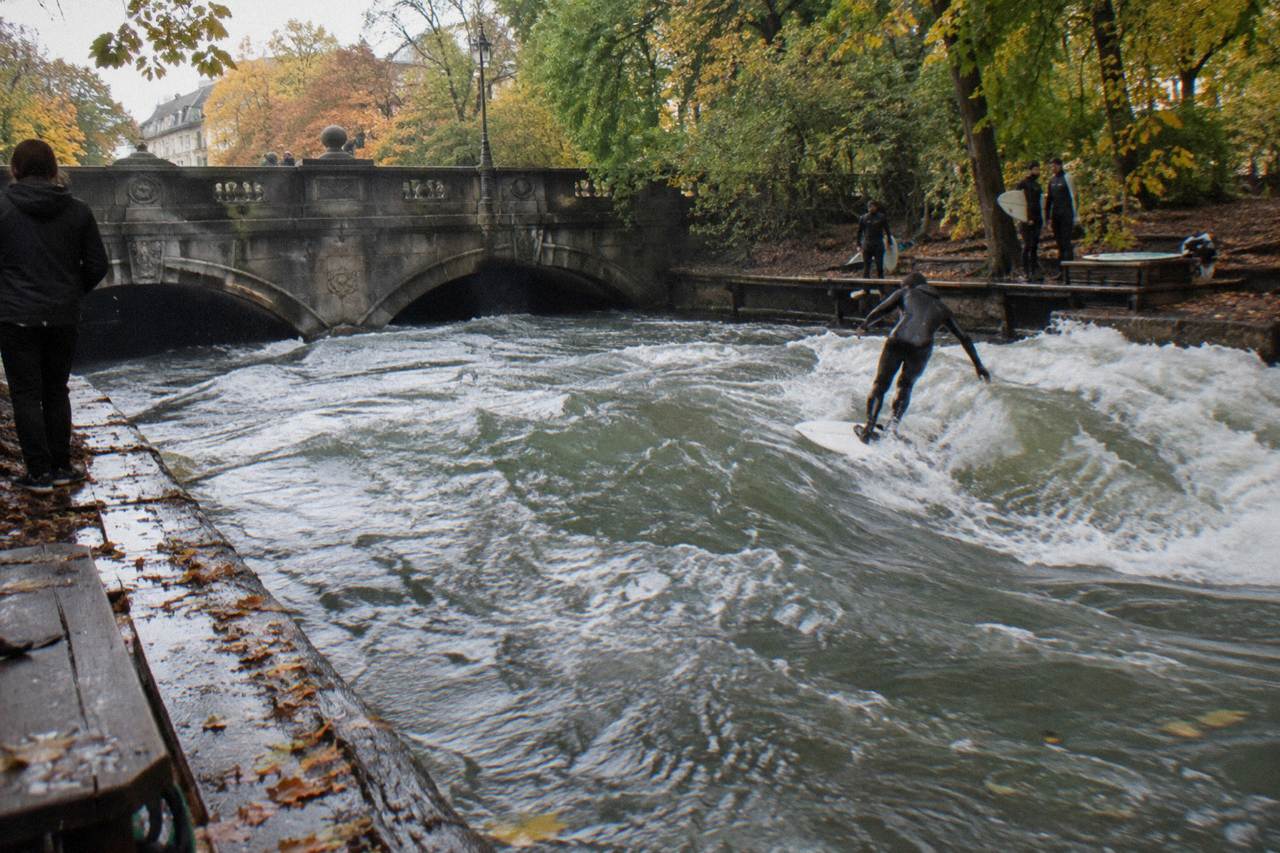
The Eisbachwelle is not closed at the moment. Munich's Lord Mayor Dominik Krause signed an amended general decree that allows surfing again under conditions, and the wave has carried surfers since it reopened on 8 May 2026. The conditions are a mandatory self-releasing leash, a surfing ban from 22:00, and a duty to follow the signs posted at the bank.
That one-line status comes with a history worth understanding, because the Eisbachwelle has never been a permanent, guaranteed fixture. It is a standing wave on a man-made channel at the southern edge of the English Garden, a metre or so of fast water that someone first rode with a board decades ago and that the city only ever tolerated rather than promoted. Whenever incidents pile up, or the legal framework needs rewriting, the tolerated status quo breaks and the wave pauses.
The recent pause was exactly that kind of pause. The city used the closure to draft a new Allgemeinverfuegung, a general decree that spells out who may surf, with what equipment, and until what hour. The result is the framework in force now. The key points on the city's official page are simple: surfing is permitted again, the leash must be self-releasing, the water is off-limits from 22:00, and whatever signs stand at the bank govern on the day.
If you are standing at the Prinzregentenstrasse bridge today and see nobody in the water, the likeliest explanations are mundane. It may be past 22:00, the light may be poor, or the conditions simply do not suit anyone that hour. The city's own wording notes that surfing there is connected with dangers and happens at the surfer's own risk, which is also part of why the rules exist in the first place.
The question is common enough that it has become a small genre of its own. Travellers arrive having read that the wave is off-limits, expect a fenced-off channel, and find surfers in the water instead. The mismatch comes from the gap between news of the suspension, which travelled widely, and news of the reopening, which travelled less far. The status also genuinely shifts over time as decrees are amended, so an article written one year can describe a situation that no longer holds the next.
Several guided rides route past the wave as a highlight stop, which is how most visitors actually see it. The Munich Classic Bike Tour at 11.30am is built around exactly this: surfers, the English Garden and a beer garden stop over 3 to 4 hours. Its price and availability are on the booking page, as they change with the season.
Why The Wave Was Ever Restricted At All
The Eisbachwelle sits on a narrow outflow channel where the water is fast, cold and shallow, and every rider enters at their own risk. Because the city never built it as a sport facility, it exists in a grey zone between a natural hazard and an attraction, and each time that grey zone produced incidents or legal questions, the response was a closure followed by a new decree.
The wave itself is a by-product of engineering. Water pushing through the channel hits a submerged obstruction and stacks into a permanent standing wave, rideable year round because the flow barely stops. Surfers adopted it quietly, the scene grew, and photographs of people riding a wave in a landlocked city travelled far. What did not change is the underlying fact: the channel is not a swimming pool, the Eisbach within the English Garden is officially off-limits for swimming, and riding the wave has only ever been a specifically permitted exception.
That exception has always been conditional. A general decree is the legal tool the city uses to set those conditions, and when a decree lapses, is challenged, or needs updating, the permission it created pauses until a replacement exists. That is the honest, boring answer to the closure question: no single dramatic event, but a regulatory reset that left the water empty for a stretch of time until the amended decree under Lord Mayor Krause took effect.
What the current decree fixes is equipment and hours rather than identity checks. The self-releasing leash requirement is the clearest example. A leash that stays attached in a fast current is a drowning hazard, so the decree specifies the type that pops free under load. The 22:00 end time exists for the same reason most river rules exist: darkness on moving water multiplies every risk.
It helps to understand what a general decree is in Bavarian administrative practice, because the word closure suggests a gate and a lock. An Allgemeinverfuegung is a rule addressed to everyone rather than to a named person, and it is how German cities regulate informal uses of public water and land. While one is being drafted, amended or legally reviewed, the activity it governs typically stops, not because anyone fenced anything off but because the legal permission has lapsed. The empty water between the old rules and the new ones is what onlookers record as the closure.
Is The Wave Closed On Any Particular Day?
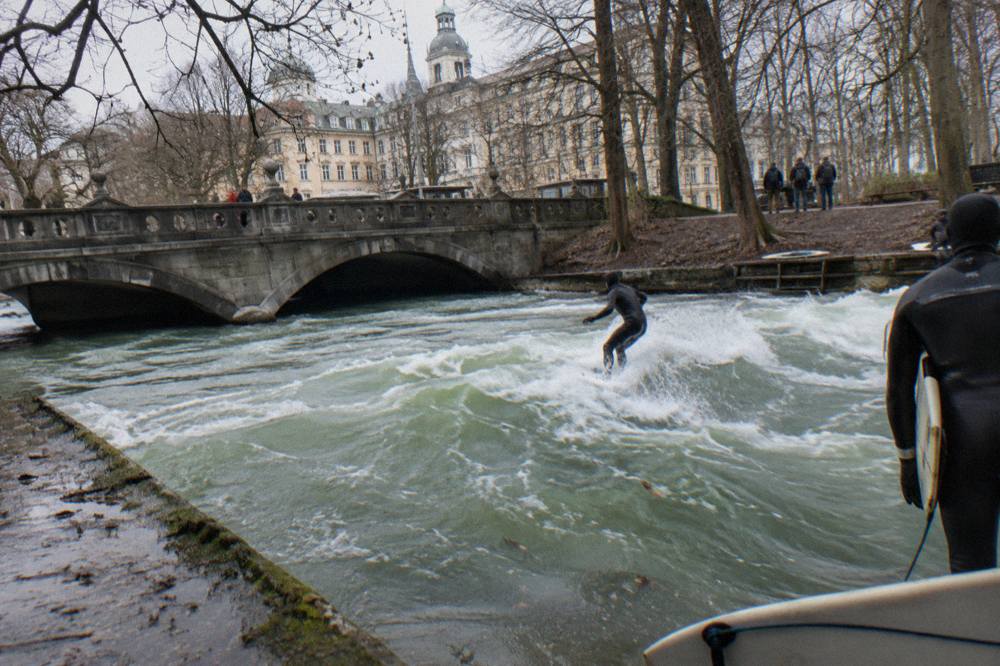
Only the posted signs say for certain. The decree framework is the baseline, but the city can and does adjust access at the site itself, and conditions such as high water change the picture independently. Before you plan a visit around surfing, check the official muenchen.de page on the Eisbach wave, and read whatever stands at the bank when you arrive. For watching rather than surfing, no closure applies to the pavement along the channel.
What The Rules Now Allow
Surfing is permitted again, with three binding conditions from the amended decree: the surfer must wear a self-releasing leash, surfing must stop by 22:00, and the posted signs at the site must be followed. Riding the wave remains at each surfer's own risk, and the city's page says so explicitly.
The honest summary: the framework is equipment, hours and signage.
For spectators, nothing in the decree changes anything. The banks along the channel are ordinary park paths, and watching from the Prinzregentenstrasse bridge or the edge of the English Garden is free and always has been. The wave works when the water flows, which is to say nearly always, and on a reasonable afternoon you will usually find someone in the water.
| Question | Current status | Source of truth on the day |
|---|---|---|
| Is surfing allowed? | Yes, under the amended decree | Signs at the bank |
| Required equipment | Self-releasing leash | Amended general decree |
| Latest surfing hour | Ban from 22:00 | Amended general decree |
| Swimming in the Eisbach | Prohibited in the English Garden | Park rules |
One point worth separating, because visitors mix them up: the surfing exception and the swimming ban are different rules. Swimming in the Eisbach inside the English Garden is prohibited outright, life-threatening according to the park's own rules, while the standing wave is a regulated exception for surfers. Watching from the bank falls under neither restriction. If you still want to cool off nearby, our explanation of the swimming rules for the Eisbach and the nearby Isar covers which stretches are officially open.
The scale of the park around the channel explains some of the confusion too. The English Garden opened as a designed landscape in 1789 and now covers 376 hectares, all free to enter, with 78 km of paths shared by cyclists and joggers. A rule that applies at the wave does not necessarily apply a kilometre north, and vice versa, which is why the on-site signs matter more than any summary read before arrival.
If swimming in the Isar is what interests you rather than the channel, the rules are different again and location-specific, with designated sections and a water-level cut-off; the swimming rules for the Isar and Eisbach are covered separately.
Watching The Surfers From The Bank
The classic viewing spot is the Prinzregentenstrasse bridge directly over the channel, with secondary standing room along the park-side bank a few steps north. Both are free, both are reachable on foot or by bike from the city centre, and the wave sits at the very southern tip of the English Garden, minutes from the Haus der Kunst.
Arriving by bike is the natural way to do this. The wave sits where the city's museum quarter meets the park, and the path network around it is part of the English Garden's 78 km of routes, so you can fold the stop into a longer ride rather than treating it as a destination on its own. Most people watch for ten or fifteen minutes and roll on, which is precisely how the guided tours handle it.
The scene itself changes with the day. On a weekday morning the water may hold one or two surfers taking turns; on a warm weekend the bank fills and the queue for the wave grows. The decree's 22:00 limit means evenings end early, and in winter the spectacle is colder but no less real: the wave does not freeze, the flow continues, and hardy locals have ridden it in every month of the year. Winter adds a practical note for cyclists, since the city clears bike paths from 3 cm of snow and winter routes are serviced within a few hours, so a cold-day ride to the bank stays feasible.
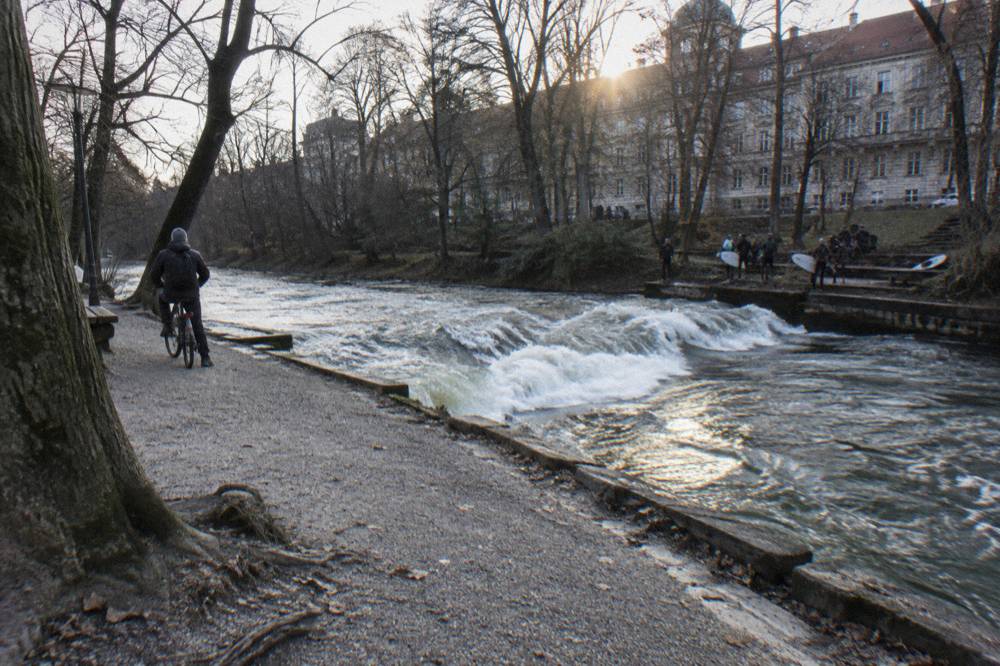
Practical notes for the stop: dogs are allowed in the English Garden but must stay leashed, barbecues and open fires are prohibited, and the broader park rules about staying on paths apply. There is no ticket, no fence and no viewing fee. The nearest beer garden options sit deeper in the park, including the one at the foot of the 25 m Chinese Tower, which is a natural next stop if you arrived on two wheels. That beer garden serves from 11:00 on dry weekdays and from 10:00 at weekends in good weather, with brass band music on several afternoons, so a midday ride that starts at the wave can end under the chestnuts an hour later.
For planning a whole loop, the dedicated guide to the English Garden by bike lays out how the wave stop fits with the park's other sights.
How To See The Wave On A Guided Ride
Nearly every city-highlights bike tour in Munich includes the Eisbachwelle as a stop, because it sits on the shortest line between the old town and the English Garden. The classic morning option is a 3 to 4 hour ride departing at 11.30am that passes the surfers before a beer garden stop; alternatives run 3 to 5 hours with similar routing.
The featured ride on this page, the Munich Classic Bike Tour at 11.30am, is built around that geometry. Its listing describes surfers and a beer garden stop as headline features, the duration is 3 to 4 hours, and it runs as a shared tour. Price and current departure availability sit on the booking page rather than in any static article, which is the right place to check them, since guided-ride pricing moves with the season.
A near-identical format exists on the operator side as the Daily City Bike Tour with Beer Garden Stop at 11.30am, a 3.5 hour shared ride that covers the same territory in the same late-morning slot. Some city rides appear on multiple booking platforms as separate listings of similar routes; treat them as variations on one product rather than as competing experiences, and pick on schedule and price at the time you book.
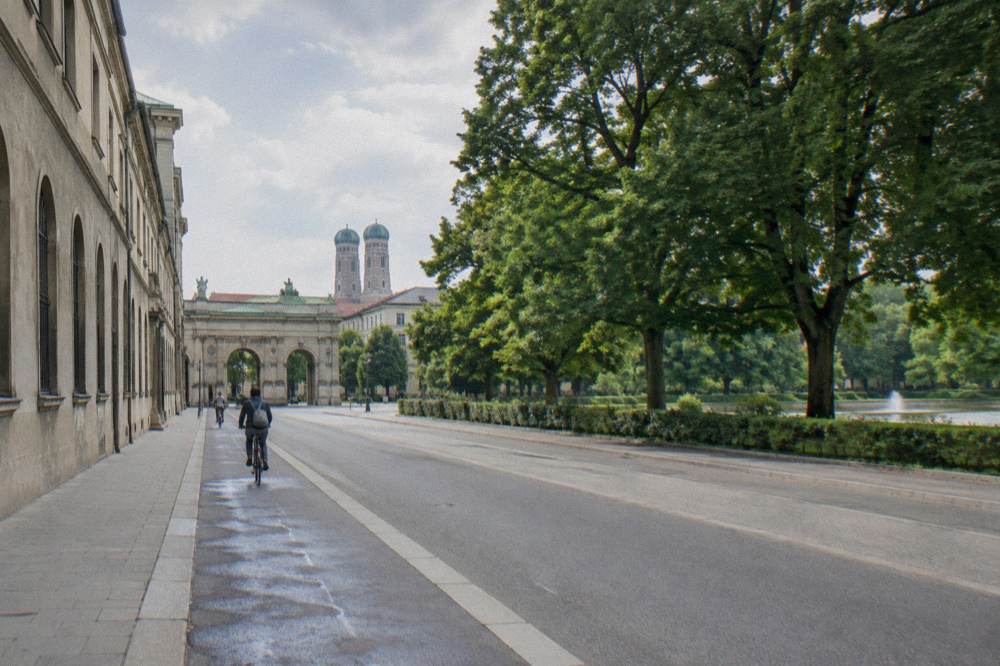
If you would rather not commit to a full guided loop, the wave is a short ride from the centre and easy to reach on a rental. Munich's public bike share, MyRadl, launched on 7 May 2026 with roughly 1,000 stations across the region, charging 1 euro per 30 minutes for a classic bike or 9 euros for a day, with e-bikes at 3 euros per 30 minutes or 18 euros for a day; the first half hour is free for eligible transit pass holders on classic bikes. That makes a spontaneous stop at the channel one of the cheapest sightseeing moves in the city. The trade-offs between renting and riding with a guide are laid out in the guide to renting a bike versus taking a guided tour in Munich. Either way, the wave stop costs nothing and needs no booking.
The dedicated article on the Eisbach wave and its surfers goes deeper on the surfing culture itself, if the ten-minute bank stop leaves you curious.
What Else To Know Before You Go
Bring nothing but patience and a camera for the bank, follow the posted signs, and time your visit for daylight hours before 22:00 if you want to see surfers in the water. The wave is free to watch, reachable by bike in minutes from the old town, and governed by a decree that is short enough to read in one sitting.
A few closing facts round out the picture. The English Garden that hosts the channel opened as a designed landscape in 1789 and now spans 376 hectares, all free to enter. The park's 78 km of paths carry cyclists and joggers alike, and the wave sits at the southern gate of that network, which is why every bike tour in the city seems to pass it. Dogs stay leashed, fires stay unlit, and the Eisbach itself stays unswum, per the park rules. The city's signed cycling network, the Muenchner Radlnetz, totals 1,200 km of routes radiating from Marienplatz, so the short hop from the centre to the wave is the most-travelled corner of a much larger system.
If the closure question has turned into a bigger interest, the Bike Tours Munich guide to the Eisbach and its surfers has the fuller story. For the authoritative word on any given day, the city's own page on the Eisbach wave and the signs at the bank outrank anything written anywhere else, including here.
Common Questions About The Eisbachwelle
Why Is The Eisbachwelle Closed?
It is not closed at present. Surfing was suspended while the city issued an amended general decree, and the wave has been open since 8 May 2026 under conditions: a self-releasing leash, no surfing from 22:00, and compliance with posted signs.
Can You Still Watch The Surfers If The Wave Is Closed To Surfing?
Yes. The bank and the Prinzregentenstrasse bridge are ordinary park paths, and watching is free regardless of whether anyone is in the water.
Is Swimming Allowed In The Eisbach?
No. Swimming in the Eisbach within the English Garden is prohibited. The standing wave is a specifically regulated exception for surfers, not a swimming permission.
Where Do The Rules For The Wave Come From?
An amended general decree issued by Lord Mayor Dominik Krause. It sets the leash requirement, the 22:00 ban and the duty to follow on-site signs, and the city page on the wave carries the current wording.
Can A Bike Tour Take Me To The Wave?
Yes, most city bike tours pass it. The Munich Classic Bike Tour at 11.30am includes the surfers and a beer garden stop across 3 to 4 hours; check the booking page for price and availability.