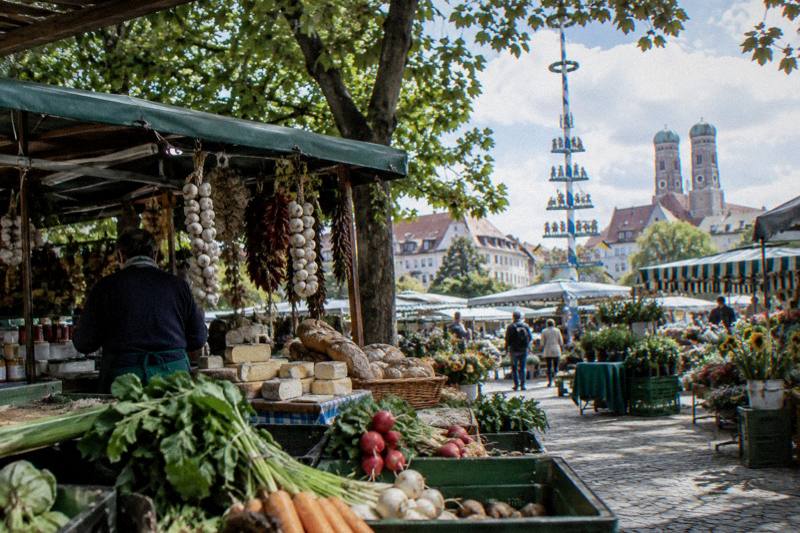
Viktualienmarkt: What To Eat And When To Go
Viktualienmarkt is Munich's daily open-air food market, a few steps from Marienplatz. Here is what to eat, when the stalls are actually open, and how the market fits into a day of riding around the city.
Short answer
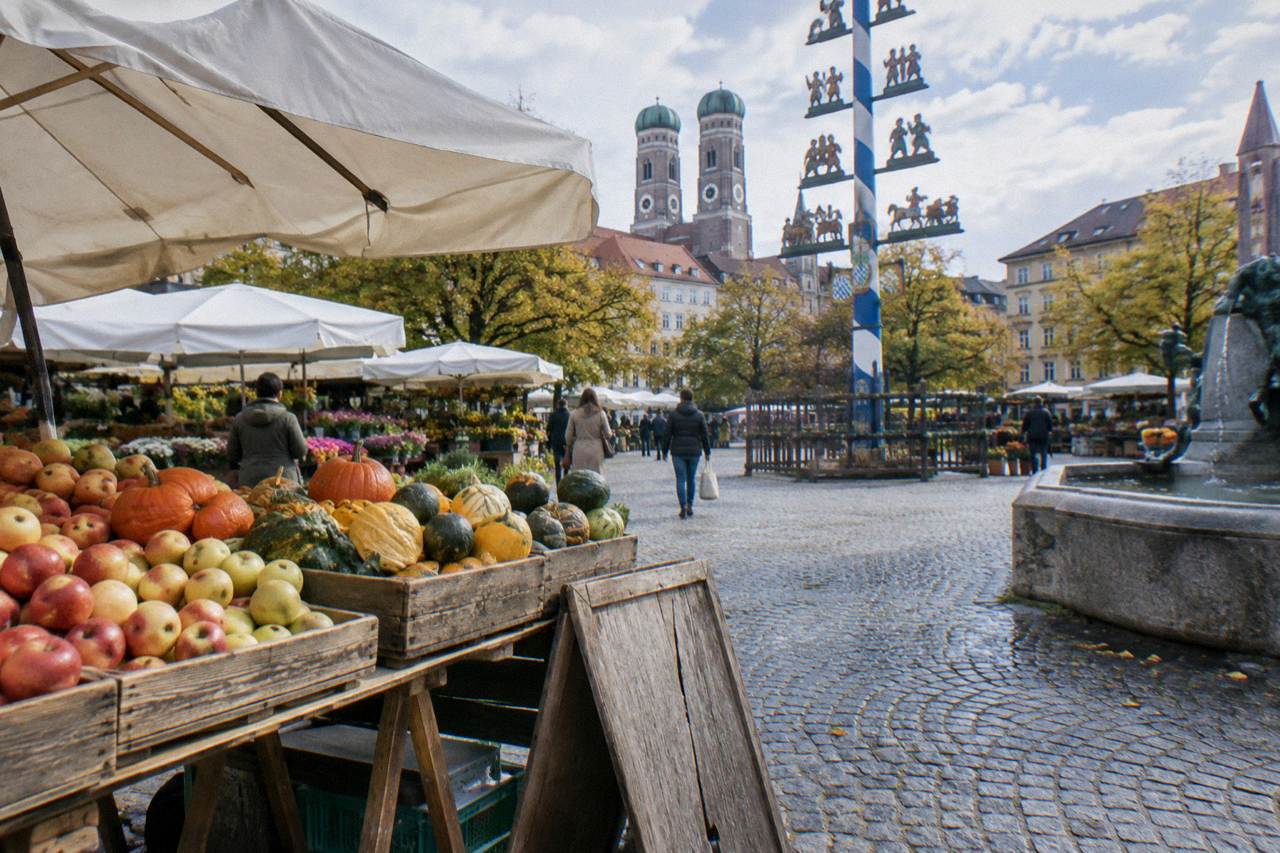
Viktualienmarkt sits a short walk from Marienplatz and runs Tuesday to Saturday, with minimum selling hours of 10:00 to 18:00 April to October and 10:00 to 17:00 November to March, Saturdays to 15:00. Most stalls close Sunday. Expect food stalls, a maypole and a beer garden at the centre.
Viktualienmarkt is the market Munich cooks from. Spread across a square a stone's throw from Marienplatz, it replaced the old market trade of the main square with dedicated stalls that sell vegetables, cheese, bread, fish, meat, flowers and spices six days a week, and it has done the job for two centuries. Tourists come for photos of the maypole and the pretzels; locals come because the produce is genuinely the point. Both crowds are right.
For a cyclist the market is close to ideal. It sits at the southern edge of the old town, within a few minutes' ride of the Isar paths and the English Garden, which makes it a natural fuel stop or finish line for a loop of the city. Munich's signed cycle network alone runs to 1,200 km of routes radiating from Marienplatz, and the market is right at the hub of that wheel. This guide covers what to eat, when the stalls are open, how to work the market into a ride, and where to leave a bike while you browse.
What Is Viktualienmarkt And Why Does It Matter?
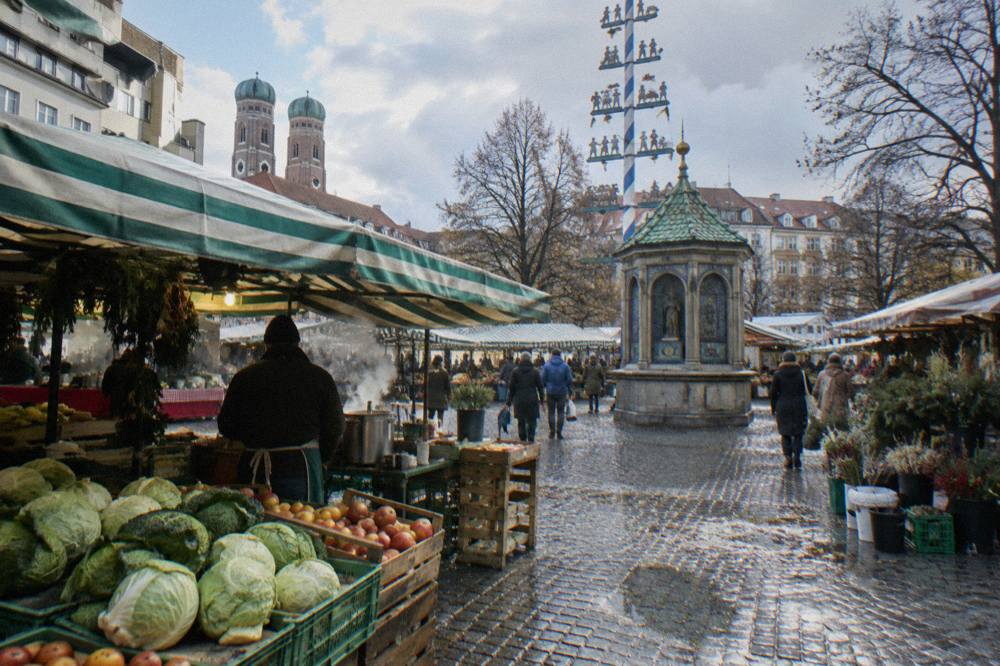
Viktualienmarkt is Munich's daily open-air food market, a short walk from Marienplatz, where independent stalls sell produce, cheese, bread, meat, fish and flowers Tuesday through Saturday. At its centre stand a decorated maypole and a beer garden. It is the city's working larder, not a museum piece, and it anchors the old town's southern edge for anyone touring the centre by bike.
The word Viktualien is simply an old term for food, and the market lives up to it. Rather than one operator, the square holds dozens of separate family and specialist businesses, each with its own counter, its own hours and its own regulars. That structure explains two things visitors often find surprising: the market closes on Sundays and public holidays, and no two stalls keep exactly the same schedule. The individual trader decides when to open within the framework the city sets.
The market square itself is small enough to cross in five minutes on foot and rich enough to fill an hour. A decorated maypole stands near the middle, and a beer garden clusters around it, shaded and busy in warm weather. Around that core, stalls radiate outward in rows: greengrocers with stacked crates, butchers and poultry specialists, cheesemongers, bakers, fishmongers, spice and dried-fruit sellers, honey and preserves, juice bars, and flower stalls that do brisk trade on Saturday mornings.
For riders, the significance is geographic. Marienplatz is the reference point from which Munich's fourteen signed radial cycle routes start, and the market sits at the southern foot of that network, per the city's Radlnetz pages. From the market you can roll south to the Isar in a few minutes, join the riverside path north, and reach the English Garden without ever fighting a major road. Few food markets in Europe sit this conveniently at the join between a historic centre and a major cycling river corridor. The planning basics around riding in Munich generally are covered in how to plan cycling around Munich.
When Is Viktualienmarkt Open Through The Year?
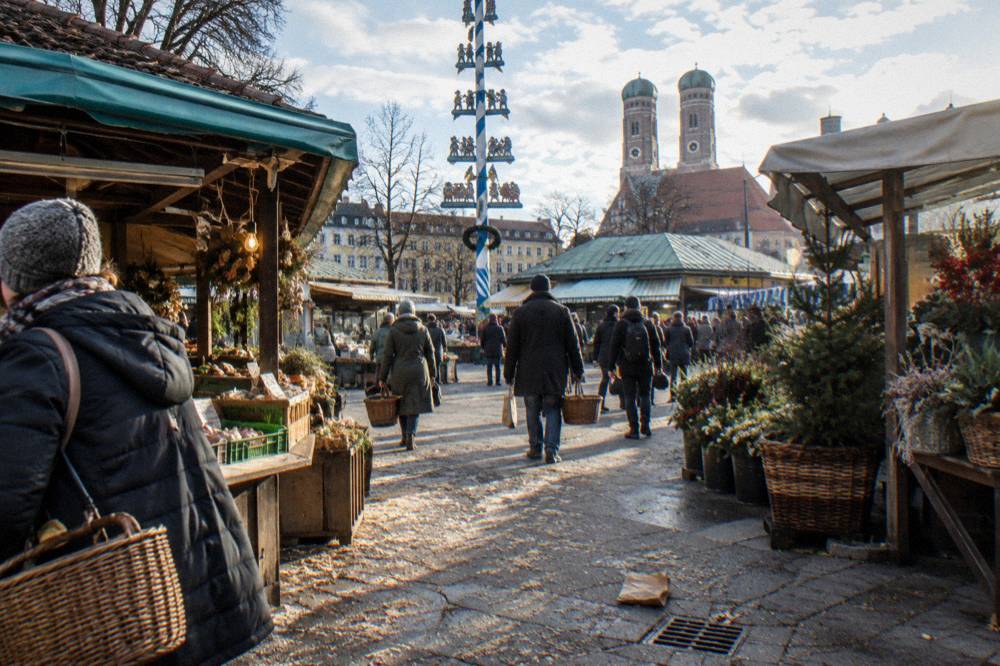
Official minimum selling hours run Monday to Friday 10:00 to 18:00 from April to October, and 10:00 to 17:00 from November to March, with Saturdays 10:00 to 15:00 year-round. Most of the market is closed Sundays and public holidays. Individual stalls set their own hours on top of that, so some counters shut earlier than the official window.
Those minimums are the city's floor, not a promise about any particular stall. In practice the market builds through the morning, is fullest around midday and early afternoon, and thins after about 16:00, and Saturdays have their own rhythm: the flower and fresh-food trade peaks early, then the whole square winds down by mid afternoon. If a specific stall matters to you, a cheese counter or a particular bakery, check its hours locally rather than assuming the full window.
| Period | Monday to Friday minimum | Saturday | Sunday |
|---|---|---|---|
| 1 April to 31 October | 10:00 to 18:00 | 10:00 to 15:00 | Closed |
| 1 November to 31 March | 10:00 to 17:00 | 10:00 to 15:00 | Closed |
Two practical notes follow from that table. First, a winter visit is entirely workable: the November-to-March window is one hour shorter but the stalls run, and the market sits a few hundred metres from the Marienplatz Christkindlmarkt, which runs 20 November to 24 December 2026 with hours Monday to Saturday 10:00 to 21:00 and Sundays to 20:00. Second, market-plus-beer-garden afternoons only really work in the warmer half of the year, because garden seating depends on weather. If a ride and a market browse are the whole plan, the best timing for a Munich bike tour matters as much as the stall hours.
A guided ride is the simplest way to fold the market into a bigger day, since the guide handles timing and route and the bike is included. These three options each work for a first visit:
The daily classic ride among those runs 3.5 hours with a beer garden stop, a format that suits the market well: browse mid-morning, ride, then finish at a garden. Prices are shown on each booking page and vary by date and party, so check the live listing rather than trusting a round number from a search result.

What Should You Actually Eat At The Market?
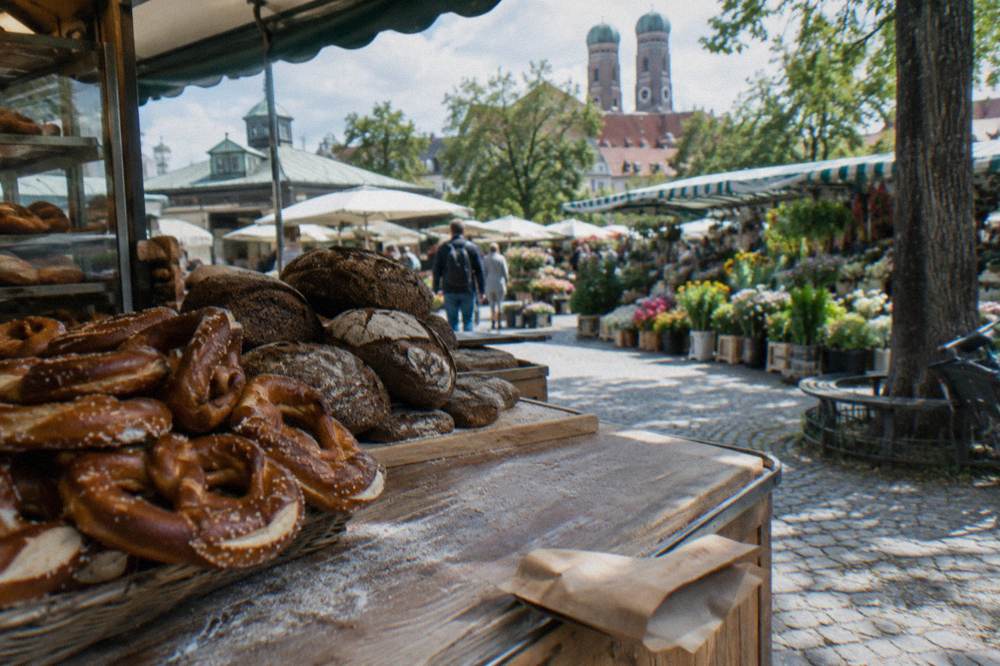
The safe answer is whatever the stalls are carving, baking or grilling in front of you: fresh pretzels and breads, cheeses cut to order, cured and roasted meats, sausages, pickles and olives, seasonal fruit, fruit juices, and a beer from the central garden to wash it down. Viktualienmarkt rewards grazing over ordering one big plate.
The market's strength is the counter culture. Butchers sell sliced ham and sausage by weight; cheesemongers will cut a wedge and often offer a taste; bakers turn out fresh bread through the morning; juice stalls press whatever fruit is in season. A classic move is to assemble a picnic, what locals call a Brotzeit, from three or four stalls and carry it to the Isar bank or a park bench ten minutes away by bike. The market's own beer garden handles the drink side: a beer, a seat under the trees, and the maypole in view.
| Stall type | What you find | How it is sold |
|---|---|---|
| Bakery and pretzel counters | Breads, rolls, pretzels, pastries | By the piece, baked through the morning |
| Butchers and poultry | Cured hams, sausages, roast meats | By weight, sliced or carved to order |
| Cheesemongers | Bavarian and Alpine cheeses | By weight, often with a taste offered |
| Greengrocers | Seasonal fruit and vegetables | By weight or the piece |
| Juice and drink stalls | Fresh-pressed juices, seasonal specialities | By the glass or bottle |
| Spice and dried fruit | Spices, nuts, dried fruit, sweets | By weight, bagged at the counter |
| Flower stalls | Cut flowers, bouquets, plants | By the bunch, busiest Saturday mornings |
Seasonality changes the display more than the structure. Summer brings stone fruit, berries and asparagus-season leftovers in early summer; autumn means mushrooms, game and pumpkins stacked at the greengrocers; winter leans on stored apples, cabbages, citrus and the Christmas trade. Because individual stall names, prices and specials are not published centrally, treat this as a shape of what to expect and ask at the counter: traders are used to visitors pointing and asking, and most speak enough English to name what they are selling.
One beer-garden detail that surprises first-time visitors: in Munich's traditional beer gardens, including market gardens, bringing your own food to eat with a beer bought on site is a long-standing custom, recognised in the city's own beer garden guidance. That custom belongs to true beer gardens rather than restaurant terraces, and the market's own garden is exactly the kind of place it applies. A cheese-and-bread haul from the stalls plus a garden beer is therefore a genuinely local lunch, within the market's posted rules. For a wider tour of the city's gardens by bike, see Munich's beer gardens by bike.
Budget-wise, treat the market as pay-per-item rather than entry-with-menu: stalls price by weight and by piece, so a snack can cost very little while a full picnic adds up. Ask the price before the scale, which locals do without embarrassment. There is no entry fee and no ticket; the only decisions are how many stalls and how big a basket.
How Does The Market Fit Into A Bike Ride Around Munich?
The market works best as either the first stop of a morning ride or the food stop at the halfway turn: it is a few minutes' ride from the Isar path, the gateway to the English Garden's 78 km of park paths and the riverside route north. Stalls are fullest from late morning, so most guided rides time a pass-through before or around midday.
Geography makes the routing easy. From the market, head south a few blocks to the river, where the Isar's riverside paths carry riders north past the Museumsinsel and the Eisbach wave, the standing surf spot at the southern tip of the English Garden, then on through the park itself toward the Chinese Tower, the 25 m structure built to a 1789 design with its own beer garden at the foot. That chain, market, river, wave, park, beer garden, is essentially Munich's greatest-hit loop and can be ridden at a relaxed pace in a morning with a long stop included. The classic route through the city for newcomers is laid out in a first-timer's Munich cycling route.
Guided rides commonly fold the market into exactly this shape. The Munich: Daily City Bike Tour with Beer Garden Stop @ 11.30 runs 3.5 hours, pairs a city loop with a beer garden stop and typically starts mid morning, a schedule that lets riders browse stalls beforehand or ride past the square on the circuit. Bike and helmet come per the listing's inclusions, and the booking page states the meeting point, current price and what else is covered. It suits travellers who want the market as one chapter of a bigger story rather than the whole book. If the ride leaves you curious about heading farther afield, our Dachau Memorial by bike and train guide explains how to pair an S-Bahn trip with a cycling leg to the memorial site.
If beer gardens rather than the market are the priority, the Munich: Bike Tour with Beer Garden Break spends 4 hours on a similar territory with a longer garden pause; the listing carries its price and details. And for riders who want the biggest possible reach without the biggest legs, an e-bike changes the arithmetic entirely: the Best of Munich Electric Bike Tour covers the city in 4 hours with motor assistance, which is worth considering if hills, distance or June heat are concerns. Each tour's current price and availability are on its booking page.
Can You Park A Bike Near Viktualienmarkt?
Yes: the square sits inside the pedestrianised old town fringe where riding is restricted, so the practical pattern is to arrive by bike, park at racks in the surrounding streets, and walk the last stretch. The old town's pedestrian zones forbid cycling except where signs permit it, and outside those zones the standard rules on signed paths apply.
The details matter here. Munich's old-town pedestrian zone bans cycling in general, with a local exception that permits riding in the Altstadt pedestrian zone and Sendlinger Straße only between 21:00 and 09:00, per the city's cycling network pages. During the day, then, you walk the market's lanes, and bikes stay at racks outside the zone. Munich keeps adding bike parking. In January 2026 a free, video-surveilled garage opened in Hirtenstraße by the Hauptbahnhof, open around the clock, and more street racks have gone in along Arnulfstraße. For the market square itself, plan on a side street nearby. Look for racks on the streets just south and east of the market, and check the city's cycling pages for current locations.
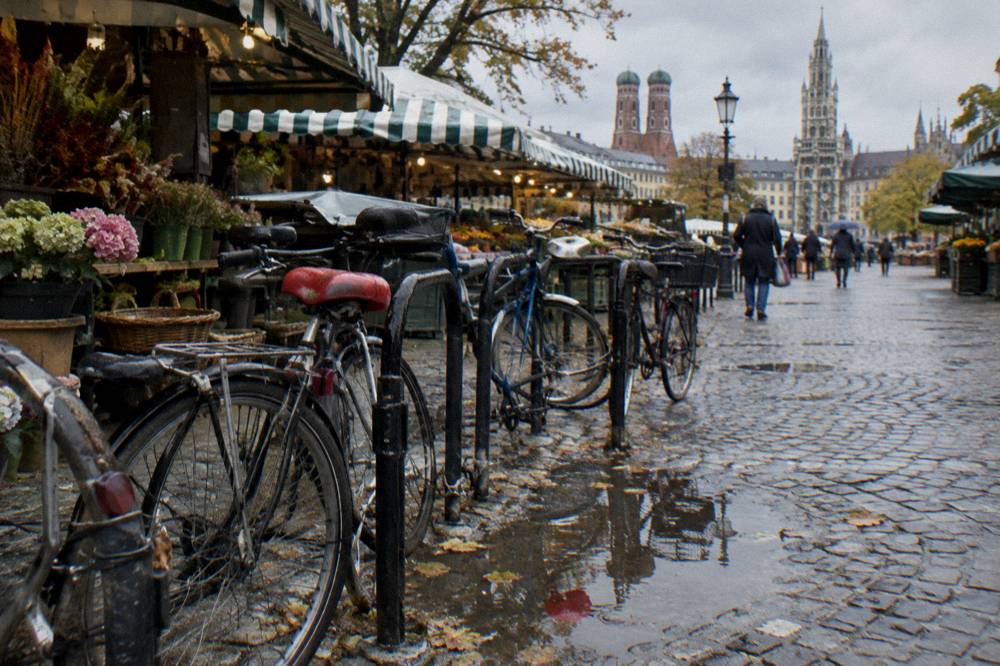
Riders using bike share have a further wrinkle: the city's system, MyRadl, is station-based, so a borrowed bike must go back to an official station, and dropping it anywhere else incurs a EUR 20 service fee. MyRadl launched on 7 May 2026 with roughly 1,000 stations and more than 6,700 bikes planned across the region, classic bikes at EUR 1 per 30 minutes with a EUR 9 day cap, e-bikes at EUR 3 per 30 minutes capped at EUR 18. The station map lives in the app, so check for a station near the market before assuming one. The full picture on rentals, including public bike options, is in does Munich have public bikes.
Bring your own lock regardless of how you arrive. Munich is a serious cycling city, with bike share of 21 percent of daily trips, the highest among German large cities, which also means ordinary bike theft is a known nuisance. Lock the frame to something fixed, not just the wheel, and take bags with you rather than leaving them in a basket.
What Else Is Within Easy Riding Distance?
The short answer is most of central Munich: the Eisbach surf wave, the English Garden's paths and beer gardens, the Max-Joseph-Platz opera house quarter and the Residenz are all within a ten-minute ride, and the Isar path connects south to quieter gravel banks within half an hour. The market is effectively the hinge of a central-Munich loop.
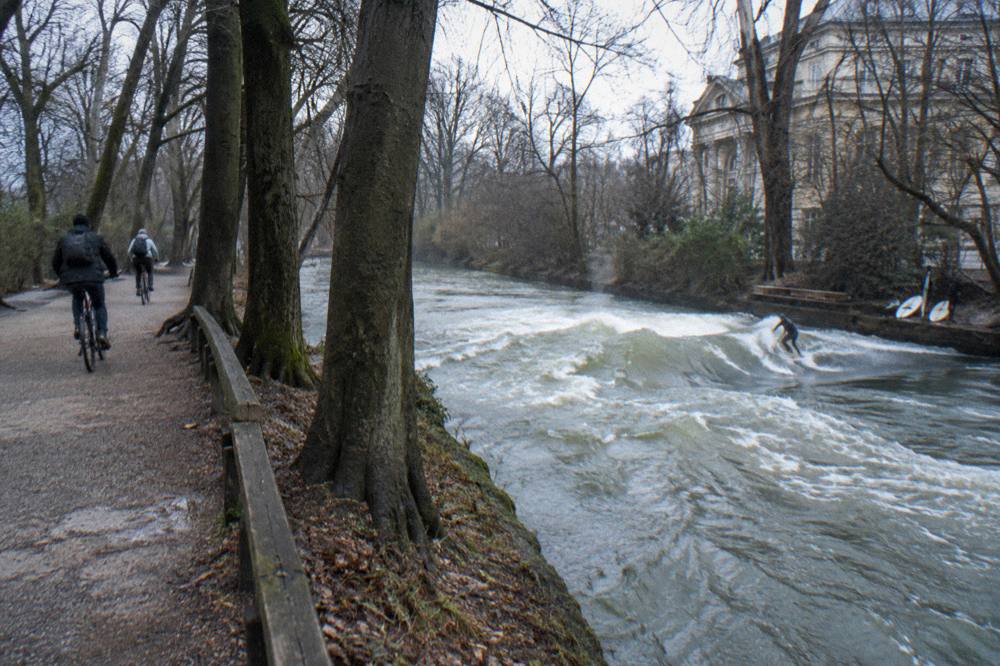
Working outward: the Eisbach wave sits where the park meets the city, and surfing there is permitted again under the amended general decree, with a self-releasing leash mandatory and a ban from 22:00; watching from the bank costs nothing and is covered in detail in the Eisbach wave and its surfers. Beyond it, the English Garden runs north with its 78 km of paths, dogs-leashed rule and no-barbecue policy, and the Seehaus beer garden on the lake opens into the evening in season. West of the market, the Königsplatz museum quarter and the NS-Dokumentationszentrum, free to enter and open Tuesday to Sunday 10:00 to 19:00, sit inside an easy ride for anyone who wants history alongside lunch.
| Destination | Character | Ride effort from the market |
|---|---|---|
| Eisbach wave | Standing surf wave, free to watch | Short ride, flat |
| English Garden and Seehaus | Park paths, beer garden, lake | Easy half-day, flat |
| Königsplatz museums | Glyptothek, NS-Dokumentationszentrum | Short ride, flat |
| Isar gravel banks south | Quieter riverside, swimming sections in season | Moderate, flat |
| Nymphenburg Palace park | Canal-side riding, palace park | Longer ride, flat |
Timing the extras depends on the season. July, the warmest month, averages highs of about 24 to 25 C with lows near 14 to 15 C, which makes a park-and-river day comfortable; May is the wettest month on average, with roughly 92 to 108 mm of rain, so a market morning doubles as a rain Plan B, since the stalls and garden partly shelter. In deep winter the market's shorter hours pair naturally with the Christkindlmarkt, and winter riding has its own rules of thumb, described in Munich in winter on a bike. However long you stay, the guide to how many days in Munich is enough helps you balance market mornings, museum hours and a day trip without rushing.
For riders who want the whole route without planning any of it, a guided loop is the low-effort version of this section, and the daily classic with its beer garden stop is the natural pick. It pairs with the market especially well on a first visit, when you want the maypole, the wave and a garden in one coherent story rather than three separate map pins.
Common Questions About Viktualienmarkt
Viktualienmarkt: What To Eat And When To Go?
Graze rather than order one dish: pretzels and breads, cheese cut to order, cured meats and sausages, pickles, seasonal fruit and juice, plus a beer in the central garden. Stalls keep minimum selling hours of 10:00 to 18:00 Monday to Friday from April to October, 10:00 to 17:00 in winter, and 10:00 to 15:00 on Saturdays; the market closes Sundays.
Is Viktualienmarkt Open On Sunday?
No. The market is closed on Sundays and public holidays, which follows the German retail pattern. Saturdays run to about 15:00 and are the busier weekend option.
Can I Ride My Bike Into The Market Square?
Not during the day. The old-town pedestrian zone bans cycling, with a local exception only between 21:00 and 09:00. Park at racks in the surrounding streets and walk in.
How Far Is Viktualienmarkt From Marienplatz?
A short walk of a few minutes southeast of Marienplatz. On a bike, the market is a few minutes' ride from the Isar path and the southern tip of the English Garden.
Can I Bring Food From The Stalls Into The Beer Garden?
In true Munich beer gardens, bringing your own food while buying beer on site is a long-standing custom, and the market garden is of that type. Restaurant terraces are different; check the posted rules at the garden.
Munich rewards this kind of morning: a basket from the market, a river path, a wave, a garden. Start at the stalls, and the rest of the ride plans itself.