Munich On Two Wheels: A First-Timer Route
Munich is one of the easiest big cities in Germany to ride a bike in, and a first loop from Marienplatz can take in the Isar, the English Garden and a beer garden in a single morning.
Short answer
A first-timer loop starts at Marienplatz, follows the Isar downstream, cuts into the English Garden past the Chinese Tower and surfer wave, and returns through Schwabing. The official English Garden tour route from Marienplatz runs about 15 km and takes roughly 2 hours of riding, or a guided half-day tour covers similar ground in 3 hours with a local guide.
Munich earns its cycling reputation with hard numbers. The city's bike modal share sits at 21 percent of daily trips, the highest among German large cities, and the signed Münchner Radlnetz stretches to 1,200 km of routes, including 14 radial routes that all start at Marienplatz. That last fact matters for a first-timer more than any other: the city's own bike network was designed so that a visitor standing on Marienplatz is, by definition, already at the centre of the map. From there the two most rewarding destinations for a new rider, the Isar banks and the English Garden, sit within a short, mostly flat ride of each other, connected by riverside paths that need almost no navigation.
What Does A First-Timer Bike Loop Of Munich Look Like?
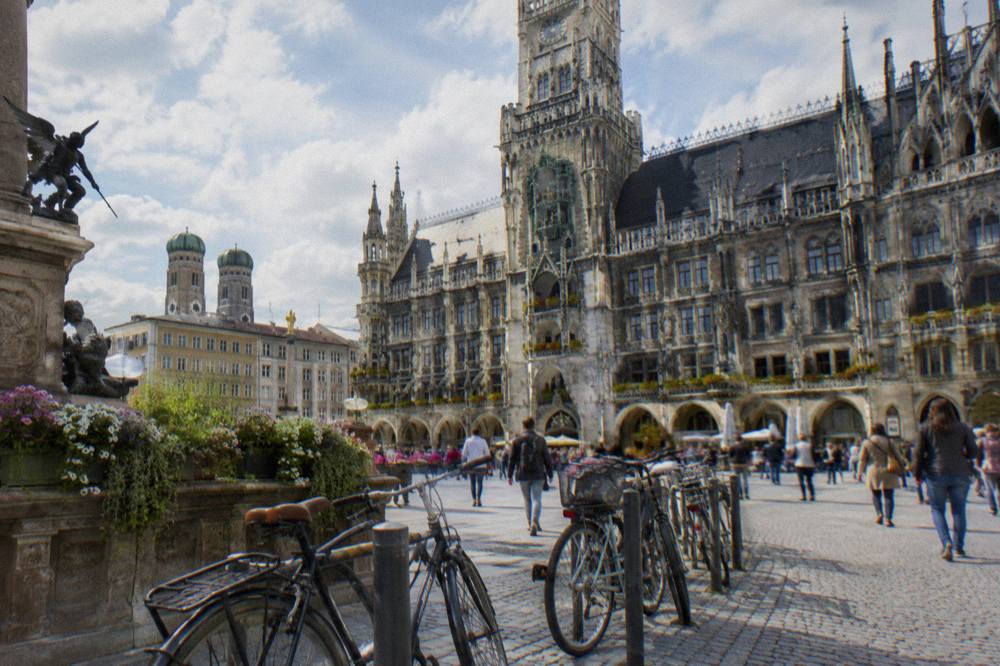
A sensible first loop starts at Marienplatz, drops down to the Isar, follows the river north past the museums, enters the English Garden near the Eisbach wave, rides up to the Chinese Tower beer garden, and returns through Schwabing to the centre. The city's own tourism route for exactly this ride runs about 15 km and roughly 2 hours of riding, and it is the loop this guide walks through below. Since the loop passes several of the city's headline sights, pair it with our roundup of Munich's unmissable sights if you want to linger at stops like the Viktualienmarkt or Nymphenburg.
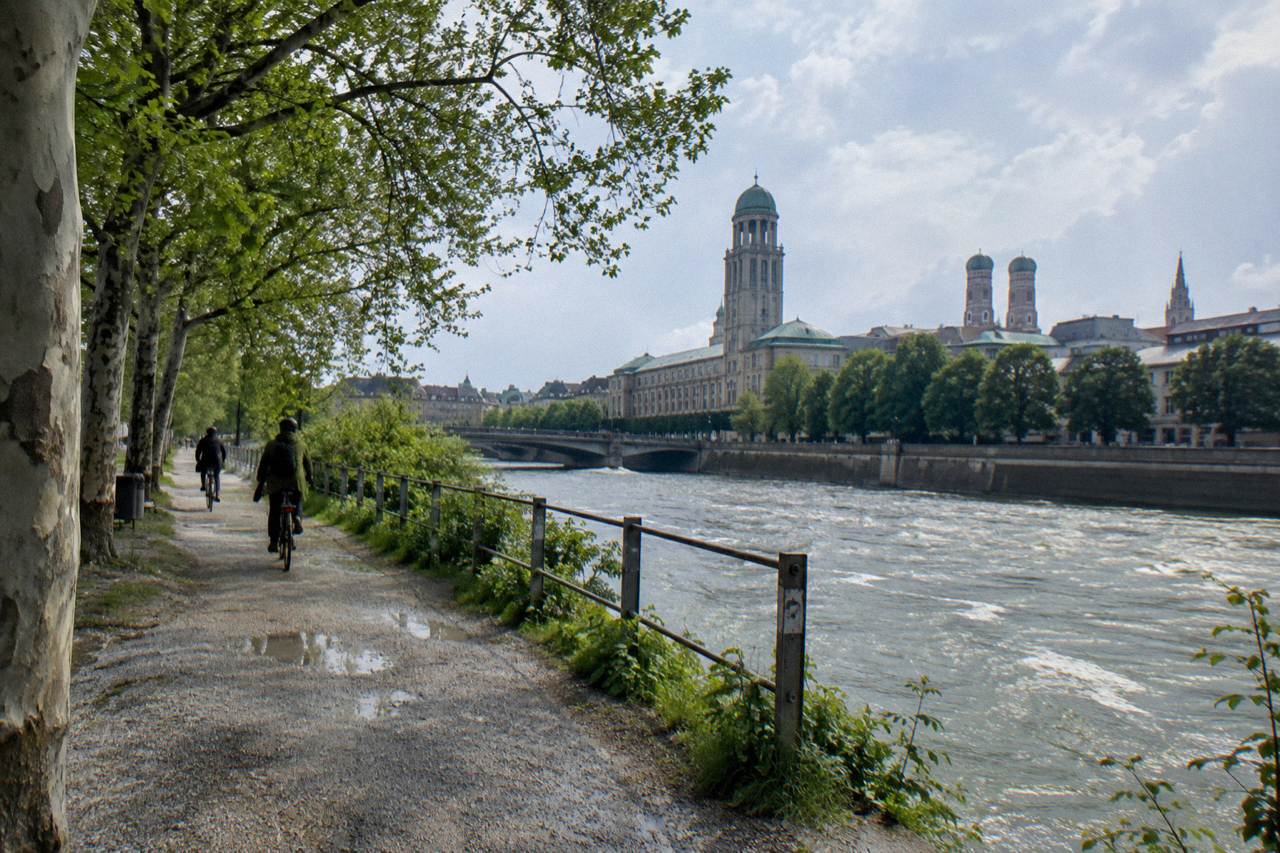
The backbone of the loop is the Isar. The river runs through Munich from south-west to north-east, and its gravel and asphalt banks carry pedestrians, runners and cyclists for the whole length of the city. For a first-timer the stretch between the Deutsches Museum and the Eisbach confluence is the easiest introduction: car-free, wide and flat. The official tourism board route described on munich.travel follows the Isar downstream from Marienplatz, then threads through the English Garden as far as Aumeister at the northern end before returning. A first visit does not need the full length; turning around at the Chinese Tower, about halfway up the garden, keeps the day at a comfortable half-morning.
The return leg deserves as much thought as the outbound one. Riding back through Schwabing and the university quarter puts you back on streets with traffic, but Munich has 103 designated bicycle streets with a combined length of about 47 km where bikes have priority and cars are limited to 30 km/h, and several of them sit on natural return lines from the English Garden toward the centre. If the legs are tired, the Isar paths run both directions, so simply rejoining the river and following it south is always an option that requires no map reading at all.
| Leg | What the route data says | First-timer notes |
|---|---|---|
| Marienplatz to the Isar | Radial routes of the 1,200 km Radlnetz start at Marienplatz | Short urban stretch, tram tracks to cross at right angles |
| Isar banks northward | Riverside paths run the length of the city | Car-free, shared with walkers, watch for gravel sections |
| English Garden loop | Official tour route about 15 km, about 2 hours riding, to Aumeister and back | Cut short at the Chinese Tower for a half-morning version |
| Return via Schwabing | City streets and bicycle streets, 30 km/h limits where signed | Use bicycle streets where available, otherwise rejoin the Isar |
One planning note: beer gardens make natural rest stops, and the garden at the foot of the Chinese Tower is a fixture of this loop. Its opening times depend on weather, with the kiosk only at cold or uncertain weather and full service from late morning in good conditions, so check the operator's site on the day rather than planning around a fixed schedule. For more on pairing rides with beer gardens, the Munich beer gardens by bike guide covers the big gardens reachable on two wheels.
Where Can You Find A Munich Bike Map You Can Trust?
The two most dependable map sources are the city's own cycling network pages on stadt.muenchen.de, which document the 1,200 km Radlnetz and its radial routes, and the Radlstadtplan the city publishes as its official cycling map. The MyRadl sharing app doubles as a station map if you rent from the public system, and the tourism board's English Garden route page gives the one loop worth committing to memory.
The city's cycling department maintains the network reference: the Münchner Radlnetz page on stadt.muenchen.de, updated by the mobility authority, lists the 14 radial routes from Marienplatz, the inner and outer Radlring rings, and the green corridors including the Isar, Würm and Nymphenburg routes. That structure is effectively the mental map a first-timer needs: radials in and out, rings to hop between them, and the Isar corridor as a car-free spine. The city is also investing visibly in this network; the Altstadtring Nordwest project alone delivered 1.85 km of wide, separated bike paths, and 1,500 new bike parking spaces were installed at 66 locations in 2025, including a free, video-surveilled 24-hour garage at Hirtenstraße near the Hauptbahnhof opened in January 2026.
For the English Garden specifically, the tourism board publishes the route most first-timers actually ride: about 15 km from Marienplatz, roughly 2 hours, following the Isar downstream and returning through the garden past Aumeister. Print it or screenshot it, because the garden's 78 km of paths are generous to the point of confusion, with many parallel tracks and no signage system a visitor can quickly parse. A paper map or an offline map makes the difference between a loop and a meander.
| Map source | What it gives you | Best used for |
|---|---|---|
| stadt.muenchen.de Radlnetz pages | The 1,200 km signed network, radial routes from Marienplatz, ring routes | Understanding the structure before you set off |
| Radlstadtplan, the city's cycling map | The official printed cycling map of Munich | Carrying a reliable offline reference |
| MyRadl app map | Live positions of about 1,000 fixed stations across the MVV area | Finding and returning rental bikes |
| munich.travel English Garden route | The about 15 km, about 2 hour official loop description | The one route worth memorising |

Navigation stress is one reason first-timers often hand the job over instead. Munich by Bike: Half-Day Tour with Local Guide runs 3 hours with a local guide and is the natural upgrade from a self-drawn loop: the guide handles the route, the riding pace and the stops, and the booking page lists what is included. If you would rather weigh the formats side by side first, the rent a bike or take a guided tour guide lays out the trade-offs in detail.
How Do You Ride From Marienplatz To The English Garden?
Leave Marienplatz heading east toward the Isar, drop to the riverside paths, and follow the north bank upstream to the Eisbach channel, which feeds the English Garden. The surfing wave sits at the southern edge of the park near Haus der Kunst, and from there the garden's path network carries you north past the Chinese Tower toward Aumeister, per the official about 15 km loop.
The transition from city to park is one of the best moments of the ride. The Eisbach, the fast little channel that powers the famous wave, enters the English Garden at its southern tip, and the wave itself sits within sight of the Prinzregentenstraße bridge. Surfers ride it under rules set by the city: an amended general decree from Lord Mayor Dominik Krause governs the wave, with a mandatory self-releasing leash, a surfing ban from 22:00, and posted signs to follow. Watching from the bank costs nothing and is covered in more depth in the Eisbach wave and surfers guide.
Inside the garden, ride to the conditions, not to a schedule. The park's rules are posted and simple: dogs on leads, no barbecues or open fires, and no swimming in the Eisbach, which the city describes as life-threatening. Cycling is permitted on the paths, and with 78 km of them the garden rewards a loose plan over a fixed line. The Chinese Tower, a 25 m wooden structure to a design of 1789, is the landmark to aim for; the beer garden at its foot seats thousands and serves as the natural halfway point of the loop. In good weather brass bands play there on Wednesday from 16:00, Friday from 15:00, Saturday from 14:00 and Sunday from 12:00, per the operator's site.
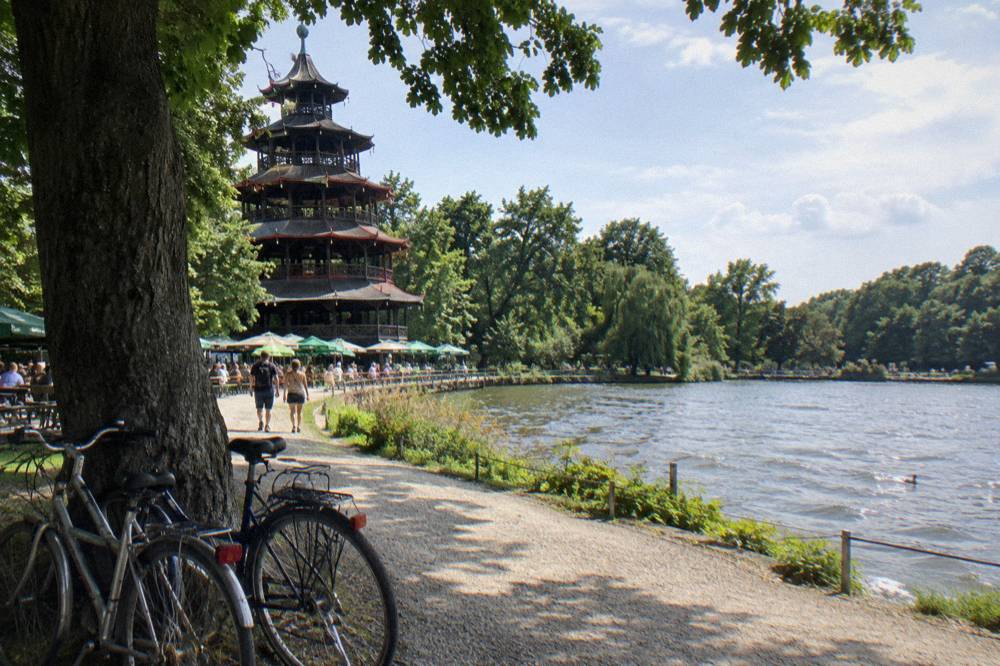
The Seehaus beer garden at the garden's Kleinhesseloher See is the alternative stop, opening weekdays from 12:00 and weekends and holidays from 11:30, though kitchen and restaurant times run separately. Both gardens run weather-dependent schedules, so treat them as rewards rather than appointments. Beyond the tower, the official route continues to Aumeister at the northern end before turning back; riders short on time can loop back at the lake and still feel they have seen the garden properly. For a deeper dive into the park by bike, see the English Garden by bike.
A guided alternative covering the same territory is the English Garden, Olympic Park and Nymphenburg Palace ride, a 3-hour classic bike tour that links the garden with two other big-name green spaces. It suits riders who want the garden plus the palaces without planning three separate loops; check the booking page for inclusions and meeting details.
Where Does The Isar Fit Into A First Ride?
The Isar is both the route out and the safety net of a first ride: its banks form a continuous car-free corridor through the city, so a rider who is ever unsure of the way can simply find the river and follow it south to return toward the centre. The paths are shared with pedestrians and the surface varies, so ride at touring pace and give walkers room.
The river defines Munich's cycling geography the way the Radlring defines its street network. Downstream from the centre, the paths pass the Deutsches Museum and the museums of the Kulturstrand stretch before the river bends north-east; upstream, they run toward the southern suburbs and, eventually, out along the long-distance Isar cycle route, which runs 299 km from Scharnitz in Tyrol to the Danube near Deggendorf, with the Munich to Landshut section around 77 km and largely flat. A first-timer will use only a few kilometres of this, but knowing the corridor exists removes most navigation anxiety.
Two practical cautions come with the banks. First, swimming in the Isar outside designated sections is not allowed, and even in the permitted sections it is at your own risk, with a ban when the water level passes 1.20 m at the Munich measuring point; the seven designated sections are mapped in the city's Isar app. Second, the riverside paths are mixed-use and busy on summer weekends, so the riding style is patience, not pace. If you want to extend the day beyond the city, the Isar cycle path from Munich guide covers where the corridor leads and how to ride it.
For riders who would rather let someone else own the route decisions, an e-bike extends the same territory without extending the effort. The Best of Munich Electric Bike Tour is a 4-hour shared e-bike ride covering the highlights, and the e-bike option is worth understanding on its own merits; the e-bike or regular bike comparison explains who benefits from the motor.
What Should First-Timers Watch Out For On Munich Streets?
The three things that catch new riders are tram tracks, pedestrian-zone rules and path-use signs. Cross rails at close to a right angle, expect the Altstadt pedestrian zone to be closed to bikes between 9:00 and 21:00, and use signed bike paths where the blue signs order it, since children up to 8 must and up to 10 may ride pavements but adults generally may not.
German traffic law gives cyclists both rights and duties, and the essentials are few. The basic rule of the road code is constant caution and mutual consideration. Bikes may ride side by side only when traffic is not obstructed, otherwise single file. Cycle-path use is compulsory only where signs 237, 240 or 241 order it; right-hand paths without those signs are optional. Bicycles must carry a bell and, in darkness, approved lighting powered by a dynamo, battery or rechargeable store, per section 67 of the road licensing rules. Rental bikes from established operators come equipped; if you ride at night, check the lights before you set off.
| Situation | The rule | Where it comes from |
|---|---|---|
| Riding in the Altstadt pedestrian zone | Allowed only between 21:00 and 9:00, at walking pace, giving way to pedestrians | City cycling network pages, stadt.muenchen.de |
| Signed bike paths (blue sign, white bike) | Use compulsory where signs 237, 240 or 241 order it | StVO section 2 |
| Riding side by side | Allowed when traffic is not obstructed | StVO section 2 |
| Bicycle streets | Bikes have priority, 30 km/h cap, cars only where signed | City cycling department |
| Lights and bell | Approved lights required in darkness, bell always required | StVZO sections 67 and 64a |
Beer deserves a specific word, because this is Bavaria and the loop passes beer gardens. There is no general prohibition on cycling after a beer, but riding while unfit is a criminal offence in Germany, and a guided ride with a beer garden stop builds the pause into the schedule rather than leaving it to willpower. The question of how alcohol and bikes interact in Munich law is covered plainly in the dedicated can you drink beer and ride a bike article. For the broader rulebook, from winter riding to what to do if your bike is stolen, the cycling rules for visitors guide is the reference page.
Guided Tour Or Self-Guided Loop: Which Suits A First Visit?
A self-guided loop suits confident riders who want flexibility and low cost, and the official about 15 km route makes that easy. A guided half-day tour suits first-time visitors, anyone nervous about German street rules, and riders who want the beer garden stop and the stories built in; the 3-hour Munich by Bike tour with a local guide is the closest guided match to the loop described above.
The honest comparison is about what you are buying. Self-guided, you buy freedom: stop when the wave is good, linger at the Chinese Tower, turn back early. The costs are rental, a MyRadl day pass or a private shop hire, and your own navigation. The public system prices classic bikes at EUR 1 per 30 minutes with a EUR 9 day tariff, and e-bikes at EUR 3 per 30 minutes with a EUR 18 day tariff, with the first 30 minutes free on classic bikes for holders of eligible transit subscriptions. MyRadl is not free, but it is cheap, station-based across about 1,000 locations, and the Munich bike rental prices guide covers where to pick up a bike and what rental shops ask for deposits.
| Option | Duration and format | Who it suits |
|---|---|---|
| Self-guided official loop | About 15 km, about 2 hours riding, own bike or rental | Confident riders who want flexibility |
| Munich by Bike: Half-Day Tour with Local Guide | 3 hours, shared classic bike tour with a local guide | First-timers who want stories and a set schedule |
| Munich: 3-Hour Guided Bike Tour | 3.5 hours, shared classic bike tour | Visitors wanting a slightly longer highlights ride |
| Munich Small-Group Bike Tour | 3 hours, shared classic bike tour, small group | Riders who prefer fewer people in the group |
Guided, you buy context. A local guide turns the Feldherrnhalle scaffolding, the Eisbach decree and the 1789 English Garden design from footnotes into the day's narrative, and the guide owns the decisions about traffic, pace and where to stop. Munich bike tours run from a 2-hour private highlights ride to 5-hour classics; prices and inclusions change with season and format, so check each booking page. Match the format to your confidence and the route to your day: compare all 18 guided rides on Bike Tours Munich.
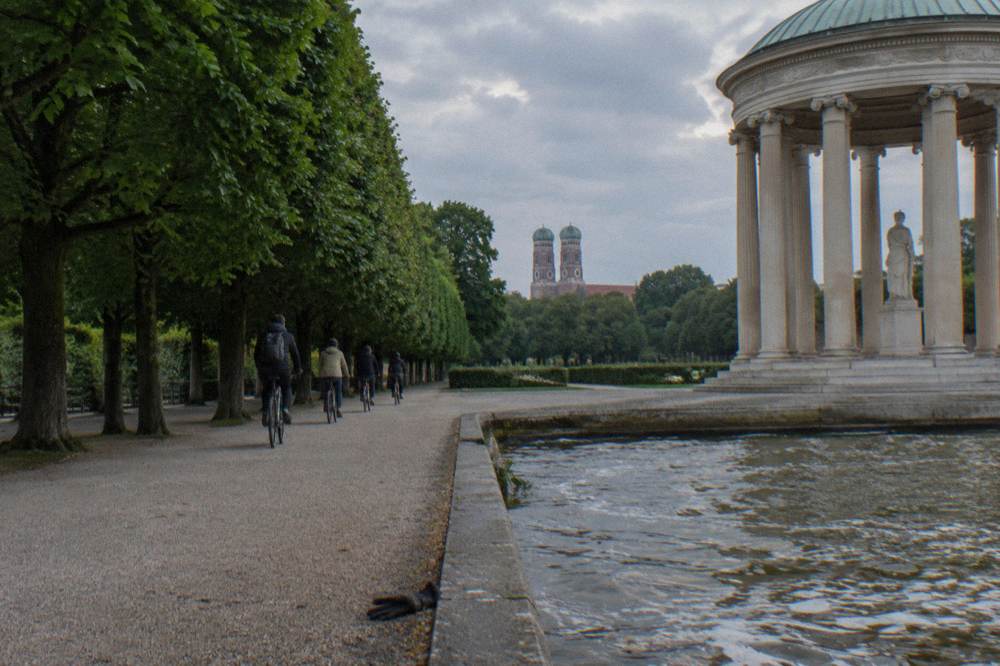
The half-day tour with a local guide is the one most first-timers book after sketching a loop like this one and realising they would rather not carry the mental load, and a rider who enjoys the self-guided version often books a themed ride, such as the street art tour, on a later visit. Neither choice is wrong; the loop is the same city either way, and Munich's bike network, 1,200 km of it, is patient with both.
Common Questions About A First Bike Ride In Munich
Where Do I Find A Munich Bike Map?
Use the city's own cycling pages on stadt.muenchen.de for the 1,200 km Radlnetz structure, the official Radlstadtplan for a printable map, and the munich.travel English Garden route page for the about 15 km first-timer loop from Marienplatz.
Is Munich Good For Bike Rides As A Beginner?
Yes. The bike modal share of 21 percent means drivers expect cyclists, there are 103 bicycle streets with 30 km/h limits, and the Isar banks and English Garden give a beginner long car-free stretches before any street riding is needed.
What About Renting Bikes In Munich?
The public MyRadl system rents classic bikes at EUR 1 per 30 minutes or EUR 9 per day, and e-bikes at EUR 3 per 30 minutes or EUR 18 per day, from about 1,000 fixed stations. Private shops offer day hires too; rental prices and pickup details are covered in the dedicated rental guide.
How Long Does A First Bike Ride Munich Loop Take?
The official English Garden loop from Marienplatz runs about 15 km and roughly 2 hours of riding at a relaxed pace, plus stops. Cut it short at the Chinese Tower for a shorter morning, or let a 3-hour guided half-day tour cover similar ground with a local guide.
Can I Combine A Beer Garden With A First Ride?
Easily. The Chinese Tower beer garden sits at the halfway point of the English Garden loop, and the Seehaus sits at the Kleinhesseloher See. Both run weather-dependent hours, so check the operator's site on the day, and keep any alcohol modest before riding on.
Do I Need To Follow Special Rules When I Ride In Munich?
A few, and they are simple: cross tram tracks at a right angle, stay out of the Altstadt pedestrian zone between 9:00 and 21:00, use signed bike paths where the blue signs order it, and make sure the bike has a bell and working lights for darkness.