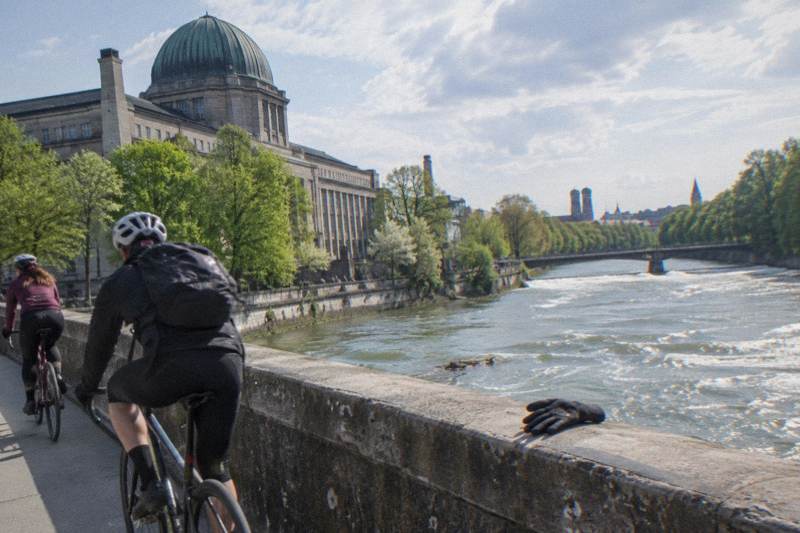
Can You Cycle Around Munich?
Yes, you can cycle around Munich: a signed 1,200 km city network, bike-friendly lanes and flat riverside paths make a full loop easy. Here is how to plan it.
Yes, absolutely. Munich runs a signed city cycling network of 1,200 km, made up of 14 radial routes from Marienplatz plus an inner and outer ring, so a circuit of the city is a normal ride here, not an expedition. Bikes already account for 21 percent of daily trips in Munich, the highest share among German large cities, and the terrain is flat enough that no distance or time figure is needed to make the case. The question is less whether you can ride around the city and more how you want to do it: on your own along the Isar, or with a guide who stitches the highlights together. For a ride with historical weight, our guide to Munich's Third Reich sites you can cycle to maps out the stops and explains how guided tours handle the subject.
The backbone of any loop is the radial-plus-ring design of the Münchner Radlnetz. Fourteen numbered routes fan out from Marienplatz to the edges of the city, and two ring routes, an inner and an outer one, let you circle the centre without weaving back through it. Green corridors such as the Isar, Würm and Nymphenburg paths link the rings, which means much of a full circuit runs along water rather than beside traffic. The city publishes the details of the Munich cycling network on its official mobility pages, and the network is refreshed continuously: 103 designated bicycle streets with a combined length of 47 km now give riders priority on whole stretches of road.
If you would rather have someone else handle the route, a guided ride is the low-effort version of the same loop:
Prices and meeting details sit on each booking page, so check there before you plan around a specific figure.
How Easy Is It To Ride A Loop Of The City?
Easy, by big-city standards. The loop-friendly parts of the network are separated from cars, the ring routes avoid the busiest central streets, and Munich's cycling culture means drivers expect bikes everywhere. The city counted 103 bicycle streets by late 2025, added 1,500 bike parking spaces at 66 locations in 2025, and continues to build wide, separated paths such as the 1.85 km Altstadtring Nordwest section delivered in 2026. None of that promises a stress-free ride on every street, but it does mean the infrastructure for a circuit exists and is being expanded deliberately.
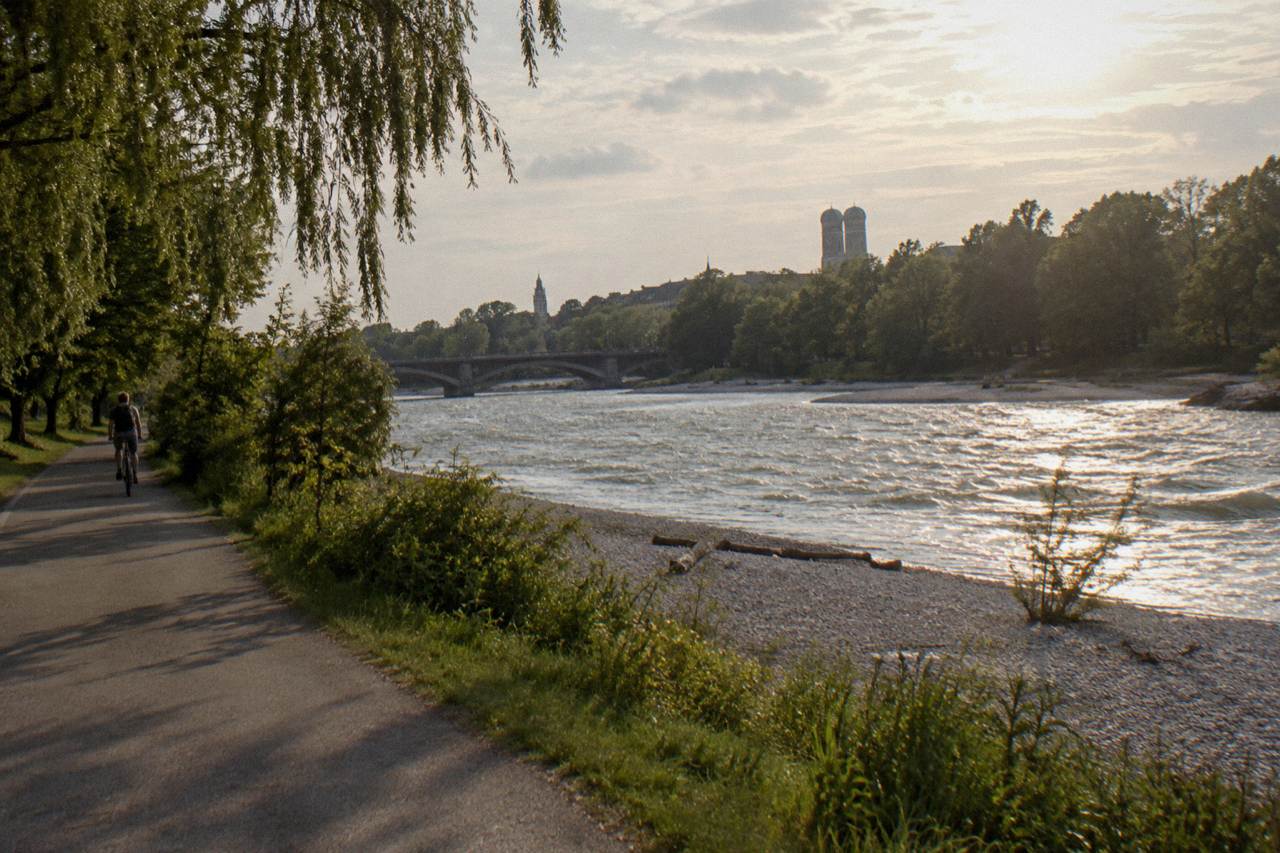
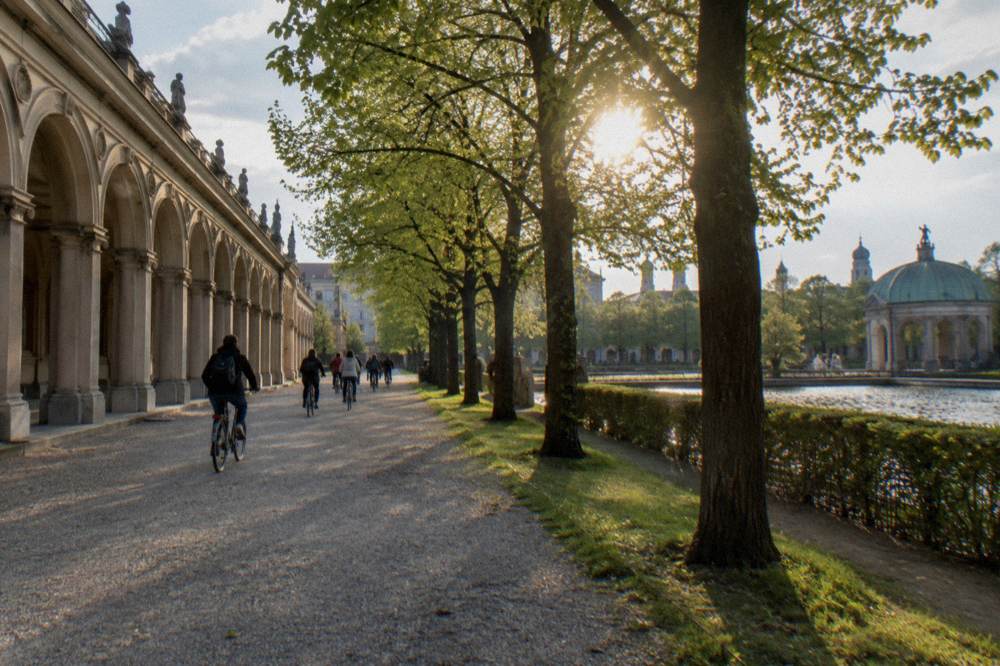
The practical shape of a loop usually follows water. Riders following the Isar downstream pass the Deutsches Museum side of the river, continue north into the English Garden with its 78 km of paths shared with joggers, and can return through the park past the Chinese Tower, a 25 m structure built to a design of 1789 with a beer garden at its foot. Heading west instead, canal-side paths lead toward Nymphenburg: a documented route from the Olympic Park along the Nymphenburg-Biedersteiner-Kanal runs about 10 km one way to Schloss Blutenburg, or roughly 16 km to the Hirschgarten beer garden. The park rules are simple and posted: dogs stay leashed, barbecues and open fires are prohibited, and swimming in the Eisbach is banned. The English Garden is open year-round with free entry.
For riders whose ambitions outgrow the city limits, the same river is the way out. The full Isar cycle path runs 299 km from Scharnitz in Tyrol to the Danube confluence near Deggendorf, and the Munich to Landshut section stretches about 77 km, largely flat and free of intersections. That turns a city loop into the first leg of a possible day trip, though it is a commitment better saved for a second visit.
| Loop ingredient | What it looks like | Where it fits a circuit |
|---|---|---|
| Radial routes | 14 signed routes from Marienplatz outward | Getting from the centre to the ring quickly |
| Ring routes | Inner and outer Radlring | The circling part of the loop itself |
| Green corridors | Isar, Würm and Nymphenburg paths | Traffic-light riding along water |
| Bicycle streets | 103 streets, 47 km total, riders have priority | Quiet links inside districts |
| Isar long-distance path | 299 km Scharnitz to Deggendorf, Munich to Landshut about 77 km | Extending a city loop into a day trip |
For riders who want a loop with the scaffolding taken care of, the half-day option below is built exactly around a guided circuit of the city core with a local guide:
The tour runs 3 hours and covers the central highlights. This ride carries a 4.7 rating across 420 reviews, a substantial body of feedback, so the star figure carries real weight alongside the route description and booking page details.
What Rules Apply When You Ride In Munich?
German road rules apply, and the ones that matter are short: ride with constant caution, use a signed cycle path where signs 237, 240 or 241 order it, keep to single file when side-by-side riding would obstruct traffic, and give pedestrians priority in shared zones. Children up to 8 must and up to 10 may ride on pavements. Bikes need working, type-approved lighting and a bell at night or you risk a fine. None of this is onerous, and visitors used to cycling in any European city will adjust within a few minutes.
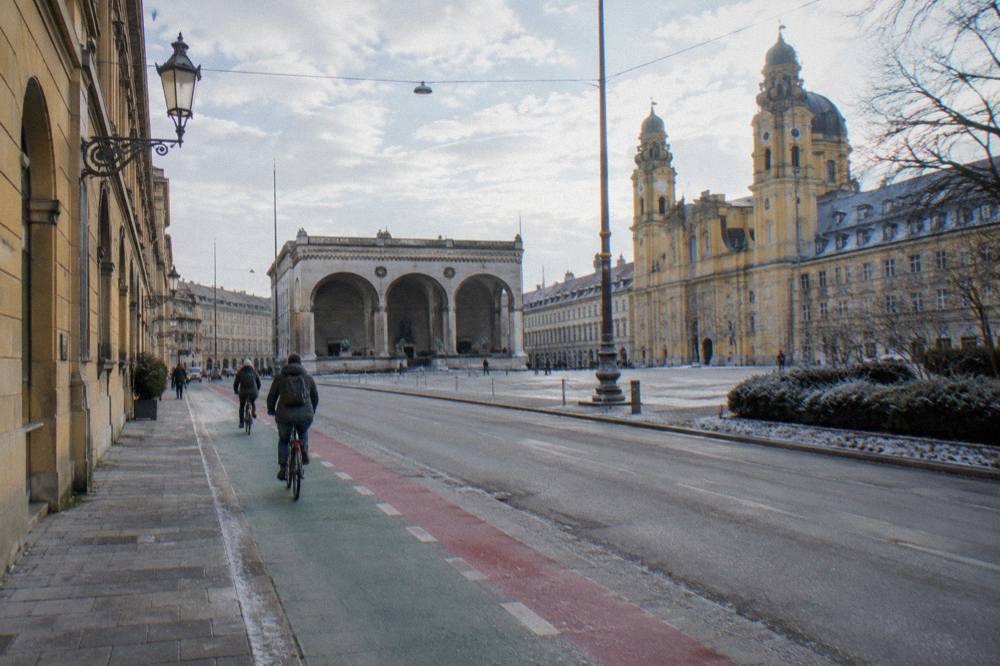
A few Munich specifics are worth knowing before you set off. In pedestrian zones, cycling is generally prohibited, except where a supplementary sign permits it; in the Old Town pedestrian zone and in Sendlinger Straße, riding is allowed between 21:00 and 09:00. On bicycle streets, bikes have priority, riding side by side is allowed, and motor traffic is limited to 30 km/h where it is admitted at all, and cars must leave at least 1.5 m when overtaking elsewhere. The legal basis is section 2 of the road traffic regulations, and the lighting requirements sit in section 67 of the vehicle equipment rules. Winter visitors get one extra allowance: if a signed bike path has not been cleared of snow, cyclists may ride on the road instead, and the city clears bike paths from 3 cm of snow, with winter routes of about 155 km cleared within two hours.
One detail that catches visitors out is tram tracks: crossing rails at a shallow angle is how wheels get caught, so the standard advice is to cross them at close to a right angle. And if a rented or shared bike goes missing during the ride, found bikes are only accepted by the police after a theft check, with collection from the city lost property office by appointment, so a theft report to the police is the first call, not the last.
If a self-guided loop sounds like route-finding work you would rather skip, this is the decision point where a guided ride earns its fee:
Do You Need Your Own Bike?
No. Munich has had a regional bike-share system, MyRadl, since 7 May 2026, with classic bikes and e-bikes at about 1,000 stations and roughly 6,700 bikes across the city and 36 neighbouring municipalities. A classic bike costs 1 euro per 30 minutes capped at 9 euros a day, an e-bike 3 euros per 30 minutes capped at 18 euros. Register once in the MVV app, unlock with a QR code, and return the bike at an official station or pay a 20 euro service fee.
Holders of eligible transit subscriptions ride the first 30 minutes free on a classic bike or at 1.50 euros on an e-bike, and there are subscriptions on top: 10 euros a month or 60 euros a year. Each rental lasts at most 24 hours, with pauses of up to 12 hours possible, and one account can unlock up to four bikes, which suits families. By mid-June 2026 riders had already completed about 116,200 journeys on the system, an early sign of how quickly it has been adopted. For more Munich planning, browse the rest of Bike Tours Munich.
Rental shops are the alternative when you want one bike for a whole day or a specific model, and guided tours usually include the bike in the ticket, which removes the question entirely. One central example near the Hauptbahnhof rents comfort city bikes from about 15 euros a day and e-bikes from about 20 euros, holds a photo ID as deposit and requires an accompanying adult for under-18s. Helmets are not legally required for adults in Germany, though many operators supply them and recommend their use. For a fuller comparison of rental prices against tour inclusions, see the Munich bike rental prices guide, and the rent or take a guided tour guide walks through the trade-off in detail.
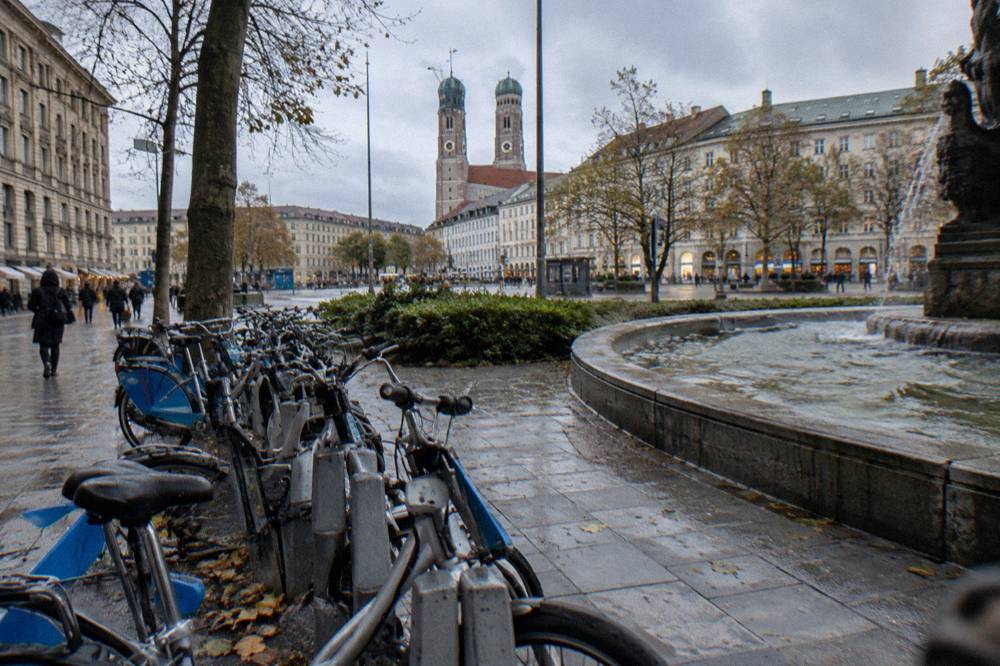
Two practical notes for planning. First, bikes are not free on public transport: S-Bahn, U-Bahn and approved regional trains require a separate bicycle day ticket, bikes are not allowed on buses and trams except children's and folding bikes, and U-Bahn carriage is blocked on weekday mornings and late afternoons outside Bavarian school holidays. Check the MVV bicycle ticket page for the current price before you buy. Second, if your loop only needs a bike for a few hours, the per-30-minute share tariff is usually the cheaper route to the same ride.
There is even a free guided option for riders who want company without a ticket price: the city's mobility department runs cost-free guided bike tours from April to October, capped at 20 participants, covering roughly 13 to 15 km through individual districts in about 2.5 hours, with registration opening two weeks ahead through the city's own channels. It is a district ride rather than a highlights circuit, but it costs nothing and shows parts of Munich most visitors never reach.
What Does A Guided Circuit Cover?
**A guided circuit typically stitches the Old Town, the Isar banks and the English Garden into one ride of roughly 3 to 4 hours, with a beer garden stop on several versions. The Munich: 3-Hour Guided Bike Tour runs 3.5 hours in a shared-group format, and the listing spells out the route and inclusions in full. Stops and meeting points vary by operator and day, so check the live booking page for the exact start location and what is covered in the price.
The related ride is the 3.5-hour guided city tour, and it pairs naturally with this question: it is exactly the kind of circuit a first-time visitor imagines when asking whether the city can be ridden around. Several other shared rides in the same family add a beer garden break or stretch to 4 or 5 hours, so the choice is really about pace and stops, not feasibility. Where you base yourself shapes the ride too, and our guide to the best Munich neighborhoods for visitors explains what each area means when you plan to get around by bike.
The longer variant below stretches the same idea to the parks and palaces at the city's edges, which is where a self-guided loop starts to demand real planning:
This 3-hour shared ride links three of the destinations a full circuit would otherwise require separate trips to reach. Its review pool is small, fewer than a dozen reviews, so there is no meaningful rating to report; the route itself is the argument. Note one current closure that affects park plans: the Olympic Stadium interior has been closed to visitors since September 2025 for a renovation expected to last two to three years, though the surrounding Olympiapark grounds and the Olympiaberg remain accessible.
When Is The Best Time To Ride Around The City?
Late spring through early autumn is the natural window, and July is the warmest month with average highs around 24 to 25 C, though May is the wettest with roughly 92 to 108 mm of rain across 16 to 17 rain days. Winter riding works, the city grooms the winter routes, but short daylight and cold mornings, January averages a high of just 2 to 4 C, make it a different experience. These figures are long-term climate averages, not forecasts, so treat them as planning ranges.
Summer adds one more reason to route the loop along the Isar: swimming is allowed in seven designated sections of the river, with typical summer water temperatures of 14 to 22 C. It is prohibited when the water level exceeds 1.20 m at the Munich measuring point, always at your own risk, and a map of the sections sits in the city's Isar app, so a mid-ride dip is a real option on a hot August afternoon rather than a plan you improvise.
Events shape the calendar more than weather does. The 191st Oktoberfest drew about 7.4 million visitors to the Theresienwiese between 19 September and 4 October 2026, and riding around the city during those two weeks means heavier foot traffic around the festival grounds. The 192nd edition runs 18 September to 3 October 2027. The Christmas market season on Marienplatz runs 20 November to 24 December 2026, and the Tollwood Winter Festival follows on the Theresienwiese from 24 November to 23 December 2026. Beer garden stops, a fixture of the guided tours, are weather-dependent: the garden at the Chinese Tower opens from 11:00 on weekdays and 10:00 on weekends in good weather, with a kiosk-only service in the cold. For a fuller seasonal breakdown, see the best time for a Munich bike tour guide.
So, can you cycle around Munich? The answer the city's own infrastructure gives is yes, and it gives it with numbers: 1,200 km of signed routes, a bike share that reaches the whole region, and a loop you can ride on water-side paths almost end to end. Whether you trace it yourself or let a guide draw the line, the circuit is there for the riding:
Common Questions About Cycling Around Munich
Can You Cycle Around Munich?
Yes. Munich has a signed 1,200 km cycling network with inner and outer ring routes, flat terrain, water-side green corridors and a regional bike-share system, so a full circuit of the city is a routine ride rather than a challenge.
Is Munich Good For Beginner Cyclists?
By big-city standards, yes. Bikes make up 21 percent of daily trips, drivers expect riders, and 103 bicycle streets give bikes priority. The ring routes and park paths keep most of a loop away from heavy traffic.
Can I Use A Share Bike For A Full Loop?
Yes. MyRadl classic bikes cost 1 euro per 30 minutes, capped at 9 euros per day, and must be returned to an official station. For a long loop, the day cap makes share bikes a practical choice, but plan your return station in advance.
Do Munich Bike Tours Include The Bike?
Most guided tours include the bicycle, and several include a helmet option as well. Confirm the exact inclusions, meeting point and price on the booking page for the specific tour before you go.
Are There Rules I Should Know Before Riding?
A few: use signed cycle paths where the blue signs order it, ride single file when two-abreast would block traffic, keep to walking pace where bikes share pedestrian zones, and carry a lock plus lights if you ride after dark. The full visitor rules are summarized in our cycling rules guide.