What Is The Best Area To Stay In Munich As A Tourist?
Where to base yourself in Munich as a visitor, area by area, with what each one means if you plan to see the city by bike.
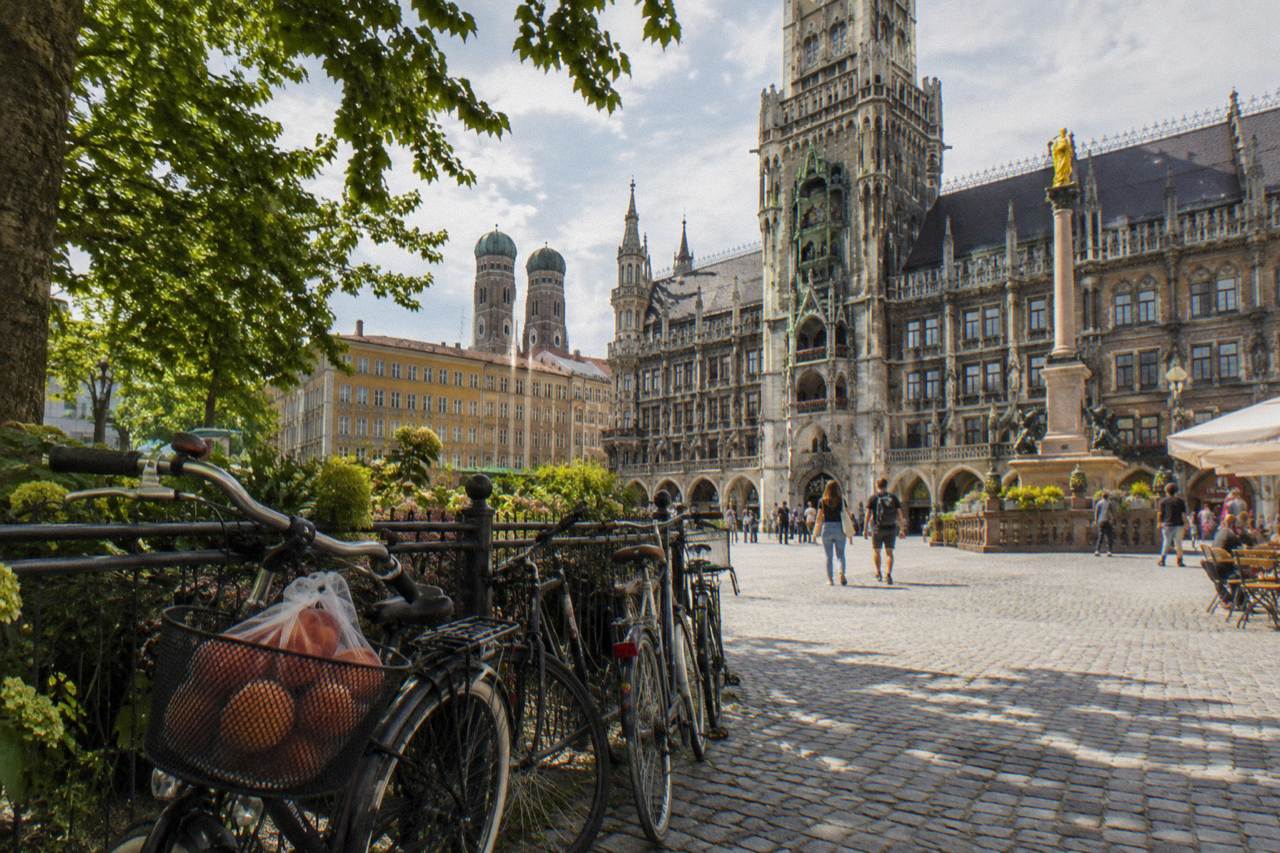
For most first-time visitors the best area to stay in is the block between Marienplatz, the Viktualienmarkt and the eastern edge of the old town, because the main sights, the market and the Isar banks sit within easy walking or riding distance of each other. From there the English Garden begins a short ride north, and the S-Bahn hub underneath Marienplatz connects everything else. Cyclists get the added benefit of flat terrain along the river the whole way.
Munich is compact enough that the choice of neighbourhood matters less than in London or Paris, but it still shapes your days. The city's signed cycling network, the Münchner Radlnetz, totals 1,200 km of routes built around 14 radial routes that all start at Marienplatz, plus an inner and outer ring and green corridors along the Isar and the Nymphenburg canals, as the city's mobility department documents on its official Radlnetz page. In practice that means wherever you sleep, a signed route leads you back to the centre.
That geometry is why a guided bike tour is the easiest way to cover the city. A good base plus a guided first ride gives you the layout of the city in a single morning. The 3.5-hour guided ride that anchors many of our guides, Munich: 3-Hour Guided Bike Tour, is built exactly for that job, and the pairing below gives you a shorter and a small-group alternative in the same family.
Which Area Suits First-Time Visitors Best?
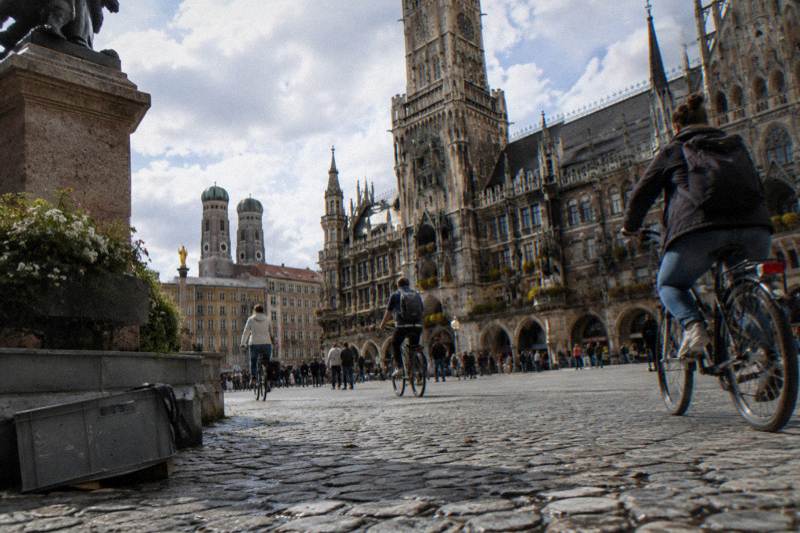
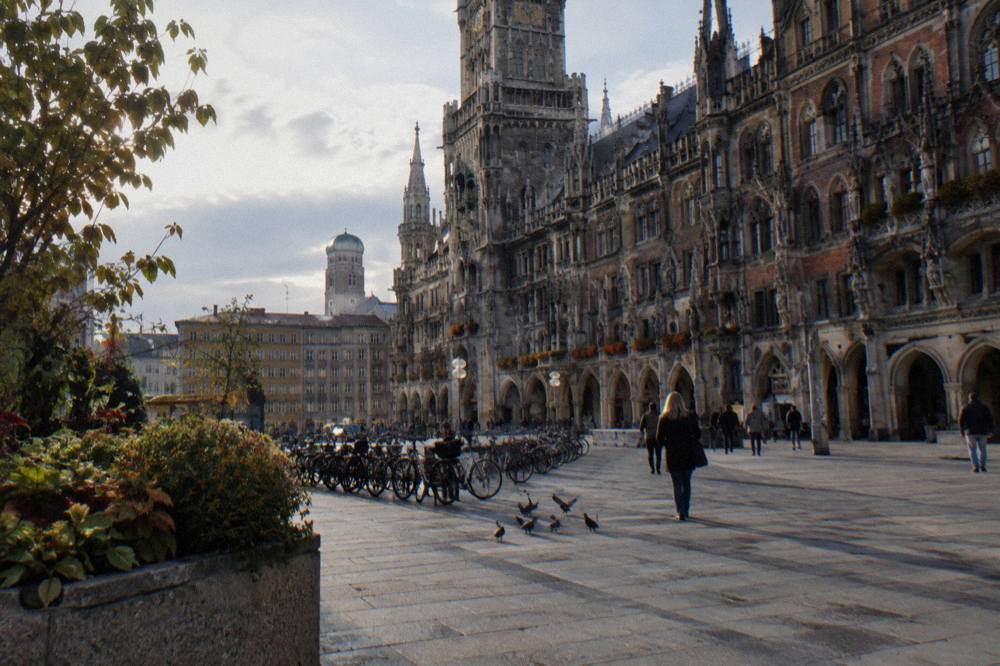
The Altstadt, Munich's old town, suits first-time visitors best, because nearly every headline sight sits inside or on its edge: Marienplatz and the New Town Hall, the Viktualienmarkt, the Residenz, the Hofbräukeller and the entrances to the English Garden. The trade-off is that the pedestrian zone restricts cycling between 9 a.m. and 9 p.m., so you wheel your bike or ride the perimeter streets during the day.
The old town is small enough to cross on foot in twenty minutes, which is exactly its value. The Viktualienmarkt, the daily food market at its southern edge, keeps minimum selling hours set by the city markets authority: April to October Monday to Friday 10:00 to 18:00, November to March 10:00 to 17:00, and Saturdays 10:00 to 15:00 year-round, with most stalls closed on Sundays and public holidays. Individual stalls set their own hours within those minimums, as the city's own market page explains, so an early-evening arrival still finds food stands open in the warmer half of the year.
Cycling inside the pedestrian zone has a specific local rule worth knowing. Riding is generally prohibited in Fußgängerzonen, but where the additional sign "Radfahrer frei" allows it, you ride at walking pace or an adapted speed and pedestrians have priority across the whole surface. In Munich's old town pedestrian zone and in Sendlinger Straße, cycling is permitted between 9 p.m. and 9 a.m., which is why night rides through the empty old town are a genuine local pleasure, a theme our evening and night bike rides guide covers in detail.
For orientation on day one, the bike makes more sense than the tram. The city's tourism board publishes a self-guided English Garden and Isar loop of roughly 15 km and about two hours that starts at Marienplatz, follows the Isar downstream and returns through the garden, which tells you how close the two biggest green lungs sit to an old-town base.
Where Should You Stay For The English Garden And The Isar?
Staying on the eastern side of the Isar, or in Schwabing just north of the English Garden, puts the park and the river paths at your door instead of a ride away. The English Garden stretches several kilometres north from the city centre, holds 78 km of paths shared by cyclists and joggers, and is free, open year-round and 376 hectares in size, so a base at either end changes how often you use it.
This is the choice for visitors who picture mornings riding along a river rather than past shopfronts. The Isar corridor is the city's main green cycling artery: the full Isar cycle path runs 299 km from Scharnitz in Tyrol to the Danube near Deggendorf, and the Munich to Landshut section of about 77 km is largely flat and intersection-free, which tells you how rideable the local banks are. Our Isar cycle path in Munich guide walks the riverside options in full.
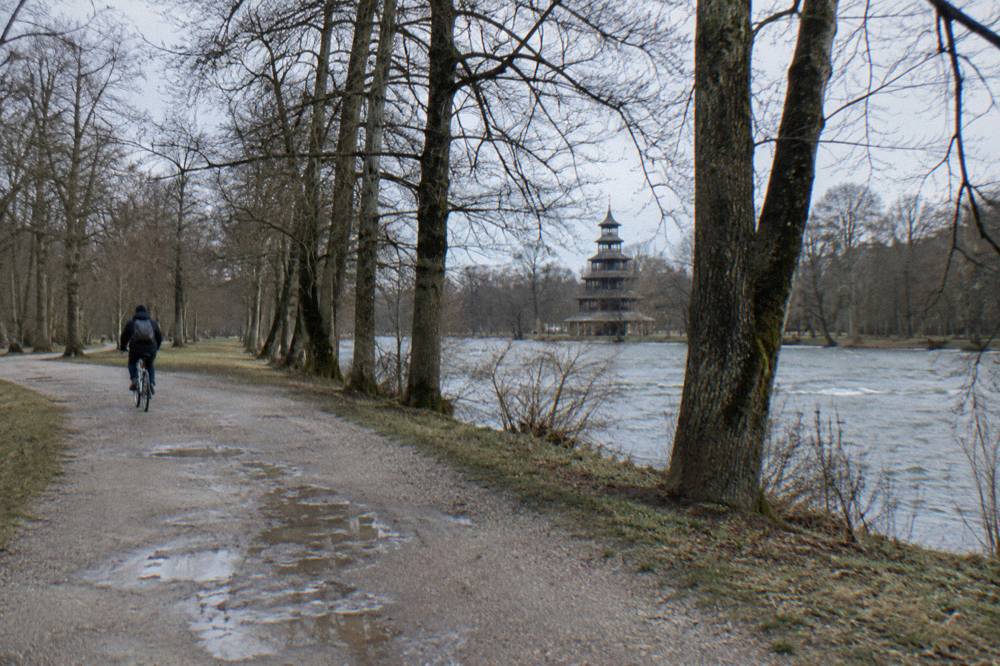
Inside the garden the rules are clear and enforced: dogs must stay leashed, barbecues, open fires and camping are prohibited, and swimming in the Eisbach is banned as life-threatening. The Chinese Tower, the 25 m wooden pagoda of 1789 design, has a beer garden at its foot, and the whole park is free to enter. The famous Eisbach surf wave sits at the southern edge near Haus der Kunst; surfing is allowed again under the amended general decree of Lord Mayor Dominik Krause, with a mandatory self-releasing leash, a 22:00 surfing ban and posted signs to follow. Watching from the bank costs nothing, a point our free things to do in Munich guide expands on.
A guided ride is the efficient way to learn this side of the city, because the park's path network is dense and signposts favour locals.
Is Staying Near The Hauptbahnhof Practical For Cyclists?
Yes, the Hauptbahnhof area is practical and usually cheaper than the Altstadt, and for cyclists it has quietly become one of the best-connected bases in the city. A free, video-surveilled 24-hour bike garage opened in Hirtenstraße in January 2026, street racks line Arnulfstraße on both sides, and a further garage with more than 300 spots is planned for the Arnulfstraße and Seidlstraße crossing for 2027, per the city's own announcements.
The district's reputation is functional rather than charming, but the arithmetic favours it. From the station you are one S-Bahn stop or a ten-minute ride from Marienplatz, and the station sits on the western radial routes of the 1,200 km signed network. The 2025 construction season added 1,500 new bike parking spaces across 66 locations city-wide, and the station quarter took a large share, so secure overnight bike storage is less of a worry here than almost anywhere else in the centre.
One planning note matters if you will mix rail and riding. Bikes need the MVV bike day ticket on the S-Bahn, U-Bahn and approved regional trains, with blocked hours on weekdays: U-Bahn Monday to Friday 6 to 9 and 16 to 18, S-Bahn Monday to Friday 6 to 9, and the afternoon U-Bahn block lifted during Bavarian school holidays. Buses and trams take no standard bikes at all. Check mvv-muenchen.de for the current ticket price before you travel. Our bikes on trains and S-Bahn guide carries the full rule set.
If you would rather not own the logistics at all, the small-group ride below handles the bike and the route for you, which is a reasonable way to spend your first day from a station base.
How Do The Outlying Areas Compare By Bike?
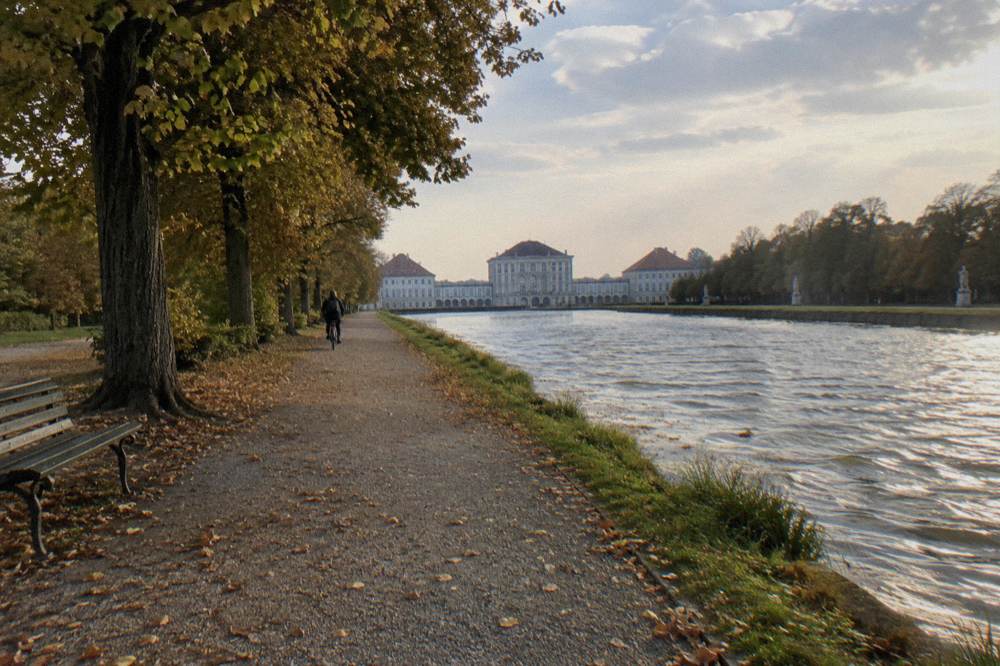
Nymphenburg in the west, Olympiapark in the north and the southern districts each trade walkability for space and quieter streets, and all of them connect to the centre along the green corridors of the Radlnetz. The Nymphenburg canal route alone offers 10 km one-way to Schloss Blutenburg or 16 km to the Hirschgarten from an Olympiapark start, so a base near any canal gives you car-light riding almost from your door.
Each area has a distinct character for a cycling visitor:
| Area | What defines it | What a cyclist gets |
|---|---|---|
| Altstadt and Viktualienmarkt | Headline sights, market, pedestrian zone | Flat centre, signed radials from Marienplatz, night cycling 21:00 to 9:00 in the zone |
| East of the Isar and Schwabing | English Garden and river paths at the door | 78 km of park paths, Isar corridors, beer gardens at the Chinese Tower and Seehaus |
| Hauptbahnhof quarter | Function, price, rail links | Free 24-hour bike garage since January 2026, racks on Arnulfstraße, one S-Bahn stop to Marienplatz |
| Nymphenburg and the west | Palace park, canals, residential calm | Canal routes of 10 to 16 km, palace park fountains Easter to mid-October |
| Olympiapark and the north | 1972 parkland, Olympiaberg views | Park grounds accessible year-round; stadium interior closed for renovation |
Two closures shape 2026 and 2027 visits. The Olympic Stadium has been closed to visitors since September 2025 for a renovation expected to last roughly two to three years, though the wider park grounds and the Olympiaberg remain open, as the Olympiapark's own pages state. And at Nymphenburg the palace interiors carry a ticket, with a combined summer ticket and a cheaper winter one, while the park itself and its canal rides, Friday to Sunday 11:00 to 18:00 early in the year to mid-October, are the cyclist's share of the visit. Our Nymphenburg Palace by bike guide covers the western approach.
How Does Your Base Change With The Seasons?
In the warm months an Isar or English Garden base pays off daily, because beer gardens, park paths and river swimming sections are all in play; in the winter months an Altstadt or Hauptbahnhof base wins, because the Christmas markets cluster around Marienplatz and the city's winter service clears bike paths from 3 cm of snow. Neither choice locks you out of the other side of town, since the whole network is signed from Marienplatz.
The seasonal calendar is unusually legible in Munich. The Christkindlmarkt on Marienplatz runs 20 November to 24 December 2026, opening earlier than in past years, with hours Monday to Saturday 10:00 to 21:00, Sundays 10:00 to 20:00 and Christmas Eve until 14:00. Tollwood's winter festival follows on the Theresienwiese from 24 November to 23 December. If a market trip is the reason for your visit, an old-town base saves you a cold ride home each evening.
Winter riding itself is better supported than most visitors expect. The city clears all bike paths, including bicycle streets, from 3 cm of snow, with winter routes of roughly 155 km cleared within two hours and the rest within three, on a service window of 2:00 to 22:00, per the city's winter-service page. The German cyclists' association adds that there is no winter-tyre obligation for bikes, and that if a signed bike path is not cleared you may ride on the road instead. Our Munich in winter on a bike guide collects the full picture. If the winter setup has you tempted to ride further, our guide to cycling a full loop of Munich shows how the network connects for a longer outing.
Summer visitors should weigh one more fact from the seasons data: May is Munich's wettest month on the long-term averages, at roughly 92 to 108 mm across 16 to 17 rain days, while July, the warmest month, averages highs around 24 to 25 °C. A river-side base earns its keep precisely in that July window.
Where Should Families And Slower Riders Base Themselves?
Families and riders who prefer gentle mileage should stay near the English Garden or the Isar banks, because the park offers 78 km of car-light paths, dogs-leashed grass for breaks, and beer gardens with non-alcoholic options at intervals, all without touching a main road. The tour side mirrors that logic: a first guided loop teaches the network, then the family branches off alone.
The practical pattern that works for most travelling families is a base on the garden's edge, a guided ride on day one, and self-guided loops afterwards. The 3.5-hour guided city ride makes a natural day one; check the booking page for the meeting point, minimum age and what is included, as those details live on the listing. For deeper planning, our bike tour with kids and families guide works through child seats, trailers and which routes suit short legs.
Bike-share deserves a word for families weighing a car-free stay. A classic MyRadl bike costs 1 euro per 30 minutes capped at 9 euros a day, an e-bike 3 euros per 30 minutes capped at 18 euros, and holders of eligible transit subscriptions ride the first 30 minutes free on a classic bike, though the system is not free. Children up to 8 must ride on the pavement, and up to 10 may, which shapes family route choices near traffic.
Common Questions About The Best Area To Stay In Munich As A Tourist
What Is The Best Area To Stay In Munich As A Tourist?
For most visitors, the area between Marienplatz, the Viktualienmarkt and the Isar, because the core sights, the market and the English Garden all sit within a short flat ride of it, with the S-Bahn hub at Marienplatz covering everything else.
Is The Old Town Good For Cycling?
Cycling in the pedestrian zone is restricted during the day, permitted between 9 p.m. and 9 a.m., but the ring streets and the Isar banks give car-light alternatives, and all 14 radial cycling routes of the city network start at Marienplatz.
Is It Better To Stay Near The English Garden Or The Centre?
The garden and Isar side suits visitors who want riverside mornings and park paths at the door; the centre suits first-timers prioritising sights and markets. The two are a short ride apart along the river, so neither choice excludes the other.
Is Munich Safe To Cycle Between Neighbourhoods?
Munich has Germany's highest bike modal share among large cities, 21 percent of daily trips, plus 103 bicycle streets and a 1,200 km signed network, all of which makes drivers accustomed to cyclists. Standard caution still applies, and helmets are recommended though not required.
Can I Stay Car-Free And Still See Nymphenburg Or The Lakes?
Yes. The Nymphenburg canal routes run 10 to 16 km from the Olympiapark side, bikes travel on the S-Bahn and U-Bahn with a bike day ticket outside blocked hours, and the Starnberger See round ride of about 50 km starts at an S-Bahn station.
Which Area Is Cheapest For Visitors?
The Hauptbahnhof quarter is generally the more functional, less touristed central base, and it now has the best bike parking in the city, including a free 24-hour video-surveilled garage that opened in Hirtenstraße in January 2026.